What Actually Changes for Houseplants Between October and March
Winter care is not a separate discipline. One variable moves — light — and watering, feeding, growth and pest pressure all follow it. Get the causal order right and the seasonal advice writes itself.
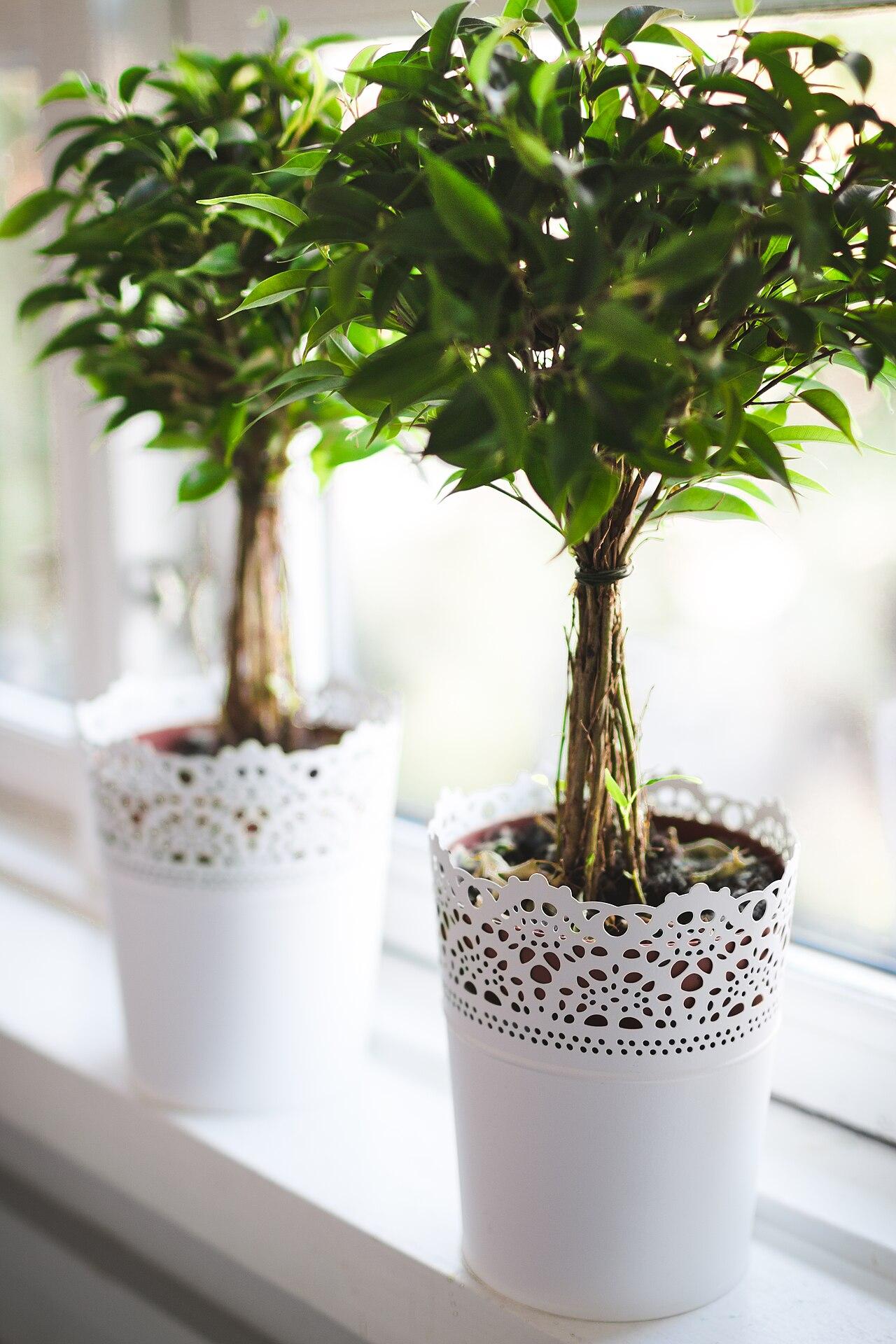
Photo: Bright windowsill by Lucas Alexander lucasalexander · CC0 · via Wikimedia Commons
01One variable moves, and everything else follows
Winter houseplant advice is usually delivered as a list of unrelated rules: water less, stop feeding, raise humidity, move things around. It is far easier to remember — and to apply to a plant nobody has written a guide for — once you see that all of it descends from a single change.
Between the summer and winter solstices, a window at temperate latitudes loses light on three fronts at once. The day is short, the sun sits low so the light arrives at a glancing angle through more atmosphere, and winter cloud is persistent. The combined effect at a given windowsill is not a modest dip; it is commonly a reduction of light to a small fraction of the June figure.
A plant with a fraction of its light photosynthesises at a fraction of the rate. It builds less tissue, so it takes up less water and fewer nutrients, so the medium stays wet longer and any fertiliser you add has nowhere to go. Every other piece of winter advice is downstream of that one sentence.
Note that this is a description of a north-temperate home, not a botanical law. A plant under a grow light on a timer, or in a warm bright room near the equator, does not experience winter at all, and should keep being watered and fed as if it were summer — because for that plant, it is.
02Water: same volume, longer interval
The commonest winter mistake is to keep the schedule and reduce the amount — a splash every week instead of a soak. That is exactly backwards. A partial watering wets the top of the pot, leaves the lower root ball permanently dry, and concentrates salts in the middle.
Keep watering thoroughly, until it runs from the drainage hole, and simply do it much less often. Then verify rather than count: push a wooden skewer or your finger to a third of the pot's depth. If it comes out cool and damp, wait.
Two details matter more in winter than at any other time. Use room-temperature water — water straight from a cold tap onto tropical roots is a genuine shock. And empty every saucer within half an hour, because a pot standing in cold water at 16°C in a dim room will not dry out for weeks.
Watch for the trap that catches experienced growers: a plant that is wilting in wet medium. The reflex is to water it. The cause is nearly always roots that have already rotted and can no longer take water up. Check the roots before reaching for the can.
| Plant | Summer | Winter |
|---|---|---|
| Pothos, philodendron, monstera | 7–10 days | 2–3 weeks |
| Peace lily, calathea, fern | 5–7 days | 10–14 days |
| Ficus, dracaena, rubber plant | 7–14 days | 3–4 weeks |
| Snake plant, ZZ plant | 3–4 weeks | 6–10 weeks |
| Succulents and most cacti | 10–14 days | 4–8 weeks, or none at all if kept cold |
03Feeding: stop, with two exceptions
A plant that is not producing new tissue cannot use nitrogen. Fertiliser applied to a stalled plant does not sit inertly either — it accumulates in the medium as soluble salts, which raises the concentration around the roots and makes water uptake harder. The visible result, weeks later, is brown crisp leaf tips that people then misdiagnose as dry air.
For most foliage houseplants in a temperate home, stop feeding around late October and resume when you see new growth in late February or March. Not when the calendar says spring — when the plant starts moving.
The two exceptions are plants under supplementary light that keep growing normally, and winter-flowering plants doing their actual season: cyclamen, poinsettia, Schlumbergera in bud. Those keep being fed, at half strength.
If you have been feeding through several winters, flush the pots when you restart in spring: water slowly with about four pot-volumes of plain water, letting it drain away each time, to carry accumulated salts out through the bottom.
04Where not to put a plant in winter
Winter adds two hazards that do not exist in July, and they sit about a metre apart in most rooms.
The first is a radiator. A plant directly above one gets a rising column of hot dry air, its medium dries unevenly and fast, and the leaf tissue transpires harder than the roots can supply in low light. The result is scorched edges on a plant that is being watered adequately.
The second is the windowsill at night — specifically, a windowsill behind a drawn curtain. The curtain traps the plant between fabric and cold glass, and on a January night that pocket can approach outdoor temperature. Tropical foliage plants sustain chill damage well above freezing: blackened patches and collapsed leaves appear after a single night below about 5°C. Move plants off the sill in the evening, or tuck the curtain behind them.
Contact with the glass itself is worth avoiding for the same reason. A leaf resting against a cold pane conducts heat away all night and often shows a dead patch exactly where it touched.
| Group | Comfortable minimum | Damage begins around |
|---|---|---|
| Tropical foliage (calathea, alocasia, ficus) | 16°C | 10–12°C, and lower if the medium is wet |
| Tough foliage (pothos, snake plant, ZZ, dracaena) | 13°C | 7–10°C |
| Succulents kept dry | 10°C | Around 5°C for most, lower for hardy sedums |
| Desert cacti kept dry | 7°C | Below 4°C — though a cool dry rest is what makes them flower |
| Christmas cactus and relatives | 13°C | 10°C — and cool nights are exactly what sets the buds |
05Dry air: what helps and what only looks like it does
Central heating genuinely does dry a room. Relative humidity indoors in winter often falls below 30%, sometimes into the low twenties, while most tropical foliage plants are comfortable somewhere around 40–50%.
Misting does not fix this. A misted leaf is wet for a few minutes, after which the humidity of the room is exactly what it was; the effect on a plant's water balance over a day is negligible. It also leaves mineral spotting on the leaves and, on plants with dense crowns or fuzzy foliage, encourages fungal problems.
What actually raises the humidity around a plant, in ascending order of effectiveness: grouping plants together so their combined transpiration builds a slightly moister pocket; standing pots on a wide tray of pebbles topped with water, so the pot base sits above the waterline; moving the plants that care most into a bathroom or kitchen; and running a humidifier, which is the only option that reliably moves a whole room.
Before blaming the air, though, rule out the two more common causes of brown tips: fertiliser salts in the medium, and fluoride or chlorine in tap water. Those account for more crisp tips in most homes than humidity does.
- Plants that genuinely suffer in dry air — Calathea, maranta, ferns, alocasia, most orchids and anything with thin papery leaves. These are the ones worth relocating or running a humidifier for.
- Plants that do not care — Succulents, cacti, snake plant, ZZ, pothos, philodendron, dracaena, ficus. Dry winter air is close to their natural condition, and raising humidity for them is effort spent on nothing.
- The exception that looks like humidity — Spider plants and dracaenas brown at the tip from water quality, not air. Filtered water fixes them; a humidifier will not.
06Adding light, cheaply
Everything above is damage limitation. The one intervention that changes the underlying constraint is more light, and it is easier and cheaper than most people assume.
Start with the free options. Move each plant as close to the glass as it will tolerate — light intensity falls away sharply with distance, so a metre closer to the window is a large gain. Clean the windows, and wipe the leaves, because winter dust on a broad leaf in dim light measurably reduces what reaches it. Rotate pots a quarter turn every week or two, since plants lean much harder toward a weak source. And move plants out of the summer positions where they were shaded from strong sun — that shade is now a liability.
Then consider a lamp. A 10–20 W LED grow light on a plug timer, 20–40 cm above the foliage and running 10–12 hours a day, transforms a dark corner for the cost of a few pounds of electricity a season. Modern fittings look like ordinary lamps and no longer have to cast pink light.
One caveat: do not add evening light to plants that set buds by day length. Schlumbergera and poinsettia need genuinely long uninterrupted nights in autumn to flower, and a lamp in the same room can be enough to prevent it.
07The things not to do until spring
Several routine tasks are simply worse in winter, because the plant lacks the light and energy to recover from them.
- Do not repot — Root disturbance in low light means a plant sitting in a larger volume of medium it cannot dry, with no capacity to grow into it. Wait for spring, unless you are dealing with root rot or a pot that has actually broken.
- Do not prune hard — A hard cut back is an invitation to regrow, and there is nothing available to regrow with. Remove dead and diseased material by all means, and save shaping for spring.
- Do not start a fertilising programme to fix slow growth — Slow growth in December is the correct behaviour. Feeding it is the reliable way to turn a healthy dormant plant into a salt-damaged one.
- Do not carry a tender plant home unwrapped — A few minutes between a shop and a car at freezing temperature is enough to blacken tropical foliage. Ask for a sleeve, or wrap it in whatever you have.
- Do not skip the pest check — Warm dry rooms are ideal for spider mites, and scale populations that were invisible outdoors become obvious by February. Inspect leaf undersides and axils when you bring plants in, and again a month later.
Frequently asked questions
- My plant is dropping leaves in November. Is it dying?
- Usually not. Steady loss of the oldest leaves as light falls is a plant shedding foliage it can no longer afford to keep supplied. Sudden loss of many leaves at once points at a cold draught, a chill, or a dramatic move instead.
- Should I water succulents at all in winter?
- If they are kept cool and bright, very little — every four to eight weeks, or nothing at all for desert cacti given a genuinely cold dry rest. If they are in a warm heated room, they keep growing and still need occasional water; judge by the leaves, which wrinkle slightly when it is time.
- Is it worth buying a humidifier?
- Only if you keep plants that actually need it — calatheas, ferns, alocasias, orchids. For pothos, succulents and snake plants it changes nothing you would notice.
- Can I repot if the plant is badly rootbound in January?
- You can, but do it minimally: one size up, no root pruning, no teasing the root ball apart, and no fertiliser afterwards. A full repot is much safer in March.
Lan Nguyen
Balcony grower & founding editor
Lan has kept ornamental plants on a 12 m² apartment balcony for eight years, mostly tropical foliage and small-scale bonsai. She writes the care and comparison guides here, and has killed enough plants to be specific about how.
Keep reading
Stop Watering on a Schedule: A Seasonal Approach Instead
The most common question is 'how often should I water this?' — and the honest answer is that the interval changes by a factor of three between July and January. Here is how to read it instead of counting days.
How to Read the Light in Your Home Honestly
Every care label says 'bright indirect light' and almost nobody knows what that means in an actual room. Here are three ways to measure it without buying anything.
Feeding Houseplants: Less Often Than You Think
Fertiliser is not plant food and it does not fix an unhappy plant. It replaces the nutrients a pot runs out of — and giving more than that does measurable harm.