How to Read the Light in Your Home Honestly
Every care label says 'bright indirect light' and almost nobody knows what that means in an actual room. Here are three ways to measure it without buying anything.
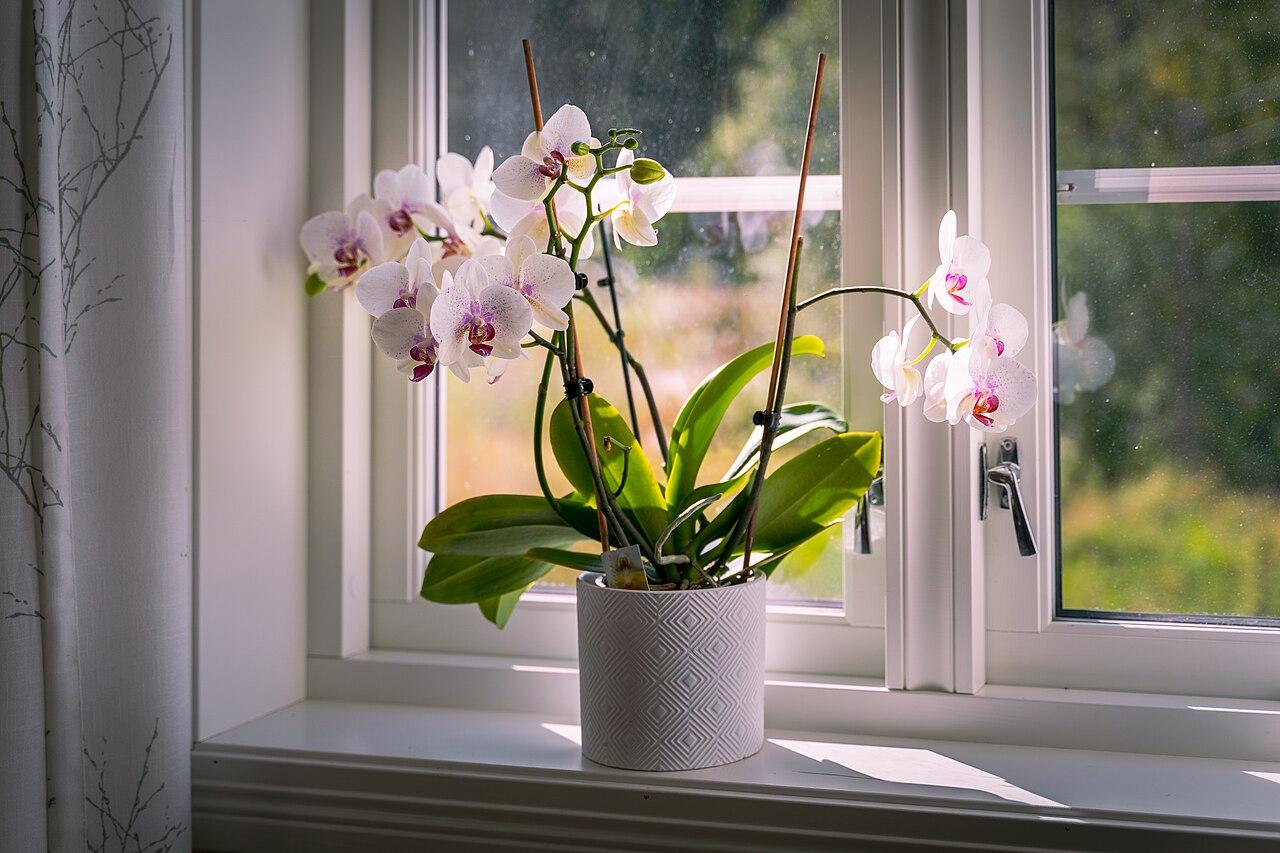
Photo: Houseplant by Øyvind Holmstad · CC BY-SA 4.0 · via Wikimedia Commons
01Why your room lies to you
Your eyes automatically compensate across an enormous range of brightness — from roughly 100,000 lux in direct summer sun to 100 lux in a lamp-lit room. That is a thousandfold difference that you barely perceive, because your pupils and visual system smooth it out.
Plants have no such compensation. Photosynthesis depends on the actual quantity of photons arriving, and a room that feels 'nice and bright' to you may be delivering less than a twentieth of what the plant needs.
This is why so much plant advice fails in practice. The care label is not wrong; the reader's estimate of their own room is.
02Three ways to measure without equipment
Any of these is enough to make a good decision. The shadow test is the fastest and the one worth learning.
- The shadow test — At midday on a clear day, hold your hand about 30 cm above the spot. A sharp, dark, well-defined shadow means direct or very bright light. A soft-edged but clearly visible shadow means medium — this is what 'bright indirect' actually looks like. A faint shadow you have to look for means low light. No shadow at all means the spot will not sustain a plant.
- The reading test — On an overcast day, can you read small print comfortably at that spot without switching on a lamp? Yes, easily: medium light. Yes, with some squinting: low light. No: too dark for anything.
- Your phone — A free light-meter app using the front camera sensor is rough but useful for comparing two spots. Broadly: below 500 lux is low, 500–2,000 medium, 2,000–10,000 bright indirect, above 10,000 direct sun.
03Windows: aspect and distance
Which way a window faces sets the character of the light, and how far back you are sets the quantity. Distance matters more than most people expect: light intensity falls roughly with the square of the distance, so a plant two metres back from a window may be receiving under a tenth of what one at the glass gets.
| Aspect | Character | Suits |
|---|---|---|
| North | Soft, even, no direct sun | Ferns, calathea, pothos, peace lily |
| East | Gentle direct sun in the morning | Most foliage plants — the safest all-rounder |
| South | Strong direct light most of the day | Succulents, cacti, ficus, citrus |
| West | Intense hot direct sun in the afternoon | Succulents and sun-lovers; scorches thin leaves |
| Any, 2 m+ back | Low light regardless of aspect | ZZ plant, snake plant, cast iron plant |
04What the labels mean
Translating nursery language into rooms removes most of the confusion.
- Full sun / direct light — Several hours of unobstructed sun falling on the leaves. Right at a south or west window with nothing in the way.
- Bright indirect — Very bright but with the sun's rays diffused or blocked — a north window, a metre back from an east window, or behind a sheer curtain. This is what most tropical foliage plants want.
- Medium light — A metre or two from a window, or a bright room where the plant cannot see the sky directly. A soft but visible shadow.
- Low light — Several metres from a window, or in a room with a small or shaded window. Survivable for a short list of plants, and always with reduced watering.
05Things that quietly steal light
Sheer curtains cut roughly 40 to 60% of incoming light. Standard double glazing removes another 10 to 20%, and modern low-emissivity coatings more than that.
External obstructions matter enormously and are easy to overlook: a tree, a balcony above, a neighbouring building. A south-facing window facing a wall three metres away is not a south-facing window in any practical sense.
Dirty glass is a real and easily fixed loss — up to 20% on a neglected window. So is dust on the leaves themselves, which matters most precisely where light is already scarce.
And light changes across the year. A windowsill that was excellent in June can drop below the threshold in December as the sun sits lower and days shorten. Reassess in autumn rather than assuming a spot is permanently fine.
06When to give up and add a light
If the best spot in your home fails the shadow test and you want more than the handful of genuinely shade-tolerant species, a grow light is the honest answer. It is cheaper than repeatedly replacing plants.
Full-spectrum white LEDs work fine and look like ordinary lighting — the purple ones are not more effective for general growing, just cheaper to manufacture. Aim for 20–40 W over a small group of plants.
Position it 20–40 cm above the foliage and run it 10 to 12 hours a day on a plug-in timer. Longer is not better; plants need a dark period for normal metabolism, and continuous light stresses most species.
Frequently asked questions
- Does a bright ceiling light help?
- Essentially not at all. Room lighting is designed for eyes, not photosynthesis, and delivers a fraction of the intensity plants need — typically 100–300 lux at plant level versus the thousands they want.
- Can a plant get too much light indoors?
- Yes. Direct sun through glass at a south or west window scorches thin-leaved tropicals — pale bleached patches that turn brown. Acclimatise gradually when moving a plant to a brighter spot.
- How long before I see the effect of moving a plant?
- New growth tells you within four to eight weeks. Existing leaves will not change. Judge a move by whether new leaves come in larger, better-spaced and better-coloured than the previous ones.
Lan Nguyen
Balcony grower & founding editor
Lan has kept ornamental plants on a 12 m² apartment balcony for eight years, mostly tropical foliage and small-scale bonsai. She writes the care and comparison guides here, and has killed enough plants to be specific about how.
Keep reading
Stop Watering on a Schedule: A Seasonal Approach Instead
The most common question is 'how often should I water this?' — and the honest answer is that the interval changes by a factor of three between July and January. Here is how to read it instead of counting days.
Feeding Houseplants: Less Often Than You Think
Fertiliser is not plant food and it does not fix an unhappy plant. It replaces the nutrients a pot runs out of — and giving more than that does measurable harm.
Repotting: How to Tell When, and How Not to Overdo It
Most people repot too early, too often, and into pots that are far too big. Each of those makes root rot more likely, not less.