Why Your Succulent Is Stretching — and What You Can Still Do
The rosette opens up, the stem lengthens, the leaves point downward and get further apart. That is etiolation, it is always a light problem, and it does not reverse. But the plant is fixable.
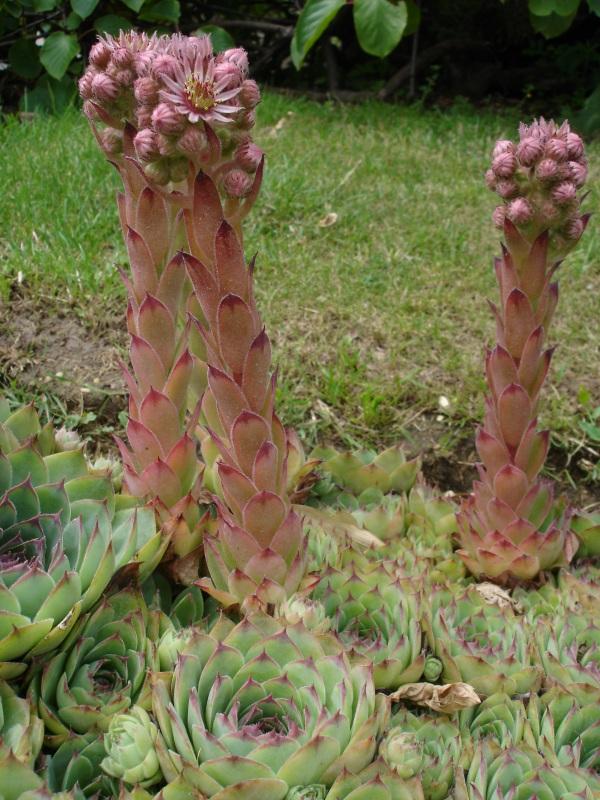
Photo: Sempervivum by Bouba · CC BY-SA 3.0 · via Wikimedia Commons
01What is actually happening
Etiolation is a plant's search behaviour. In low light, a succulent redirects resources into extending its stem, hoping to reach better light above whatever is shading it. It also spaces its leaves further apart and angles them outward to catch more of what little light there is.
The result is unmistakable once you know it: a tight rosette becomes a loose spiral on a lengthening stem, the spacing between leaves grows, and new leaves come in paler and thinner than the old ones.
It is not a disease and it does not mean you have done something else wrong. It is a purely mechanical response to insufficient light intensity.
02Ruling out the other explanations
People often try fertiliser, different watering, or a repot first. None of those cause or cure stretching.
Overfeeding can produce soft, weak growth, but it does not lengthen the stem or space the leaves. Overwatering causes mushy leaves and rot, not elongation. A pot-bound plant slows down rather than stretching.
The one confusing case is a plant that stretches while sitting in a bright-looking window. Almost always the window delivers far less usable light than it appears to — glass, curtains, an overhang, or a building opposite cuts intensity dramatically, and your eyes adjust while the plant cannot.
03The fix: behead and re-root
You cannot compact a stretched plant. What you can do is cut off the good part and start it again — and this is the standard, low-risk procedure, not a last resort.
- 1. Cut — With a clean sharp blade, cut through the stem 3–5 cm below the rosette. Keep the cut straight and quick rather than sawing.
- 2. Strip and save — Gently twist off the lowest few leaves from the cutting's stem. Keep them — each intact leaf, removed cleanly with its base, will grow a new plant.
- 3. Callus — Leave the cutting and the leaves on a dry surface out of direct sun for three to seven days, until the cut ends are dry and sealed. Planting a fresh wet cut invites rot.
- 4. Root — Set the cutting on top of dry gritty mix — do not bury it. Mist the surface every few days once roots appear, usually after two to three weeks, and begin normal watering once it is anchored.
- 5. Keep the base — Do not throw away the decapitated stump. Water it as normal and within a few weeks it usually pushes two or more offsets from the leaf axils, giving you a cluster instead of a single plant.
04Increase the light carefully
A plant that has been growing in shade has thin, poorly protected leaves. Move it straight into full afternoon sun and it will scorch — pale bleached patches that turn brown and never recover.
Acclimatise over two to three weeks. Start with an hour of direct morning sun, then two, then three, increasing gradually. If you use a grow light, start it further away and move it closer over the same period.
Watch for the good signs: leaves growing closer together, new growth in a tighter rosette, and often stronger colour — many succulents develop red, pink or purple edges only under strong light. That colouring is a stress response and it is what most people are buying the plant for.
| Light received | Growth | Colour |
|---|---|---|
| Under 2 h bright | Visible stretching within weeks | Pale, uniform green |
| 2–4 h bright | Slow, slight stretching over months | Green, little colour |
| 4–6 h direct | Compact, steady growth | Good colour on coloured cultivars |
| 6+ h direct | Very compact, slower | Strong red/purple stress colour |
| Sudden increase from low | Sunburn within days | Bleached patches, permanent |
05Preventing it next time
Rotate pots a quarter turn every week or two. Succulents lean toward light, and rotation keeps a rosette symmetrical even in a merely adequate spot.
Reassess in autumn. A windowsill that supplied plenty in July can drop below the threshold in November as the sun angle changes and days shorten — most etiolation happens over winter and is noticed in spring.
Choose species for the light you have. Haworthia, Gasteria and many Sansevieria tolerate lower light without stretching noticeably. Echeveria, Sedum and Graptopetalum are the ones that stretch fastest and are best kept for genuinely bright positions.
Frequently asked questions
- Will the stretched part ever fill back in?
- No. The spacing between existing leaves is fixed once the stem has grown. Only new growth responds to better light, which is why beheading is the standard fix.
- Can I just bury the long stem deeper?
- It hides the problem but the buried stem often rots, since it is not adapted to being underground. Cutting and re-rooting is more reliable and takes about the same time.
- Do grow lights need to be purple?
- No. Full-spectrum white LEDs work perfectly well and are far more pleasant to live with. What matters is intensity and duration — roughly 10–12 hours a day, positioned 20–30 cm above the plants.
Lan Nguyen
Balcony grower & founding editor
Lan has kept ornamental plants on a 12 m² apartment balcony for eight years, mostly tropical foliage and small-scale bonsai. She writes the care and comparison guides here, and has killed enough plants to be specific about how.
Keep reading
Soak and Dry: The Only Succulent Watering Method Worth Learning
Little and often feels careful and kills succulents. The method that works is counterintuitive: drench them completely, then do nothing at all for weeks.
Christmas Cactus Care: Getting It to Flower on Schedule
Schlumbergera is not a desert plant and treating it like one is why yours has never bloomed. It is a jungle epiphyte, and its flowering is triggered by darkness and cool nights.
Succulents vs Cacti: Which One Actually Belongs Indoors?
They sit on the same shelf at the garden centre and get sold with the same care card, but succulents and cacti want noticeably different amounts of light. Picking wrong is why one of them is stretching.