Christmas Cactus Care: Getting It to Flower on Schedule
Schlumbergera is not a desert plant and treating it like one is why yours has never bloomed. It is a jungle epiphyte, and its flowering is triggered by darkness and cool nights.
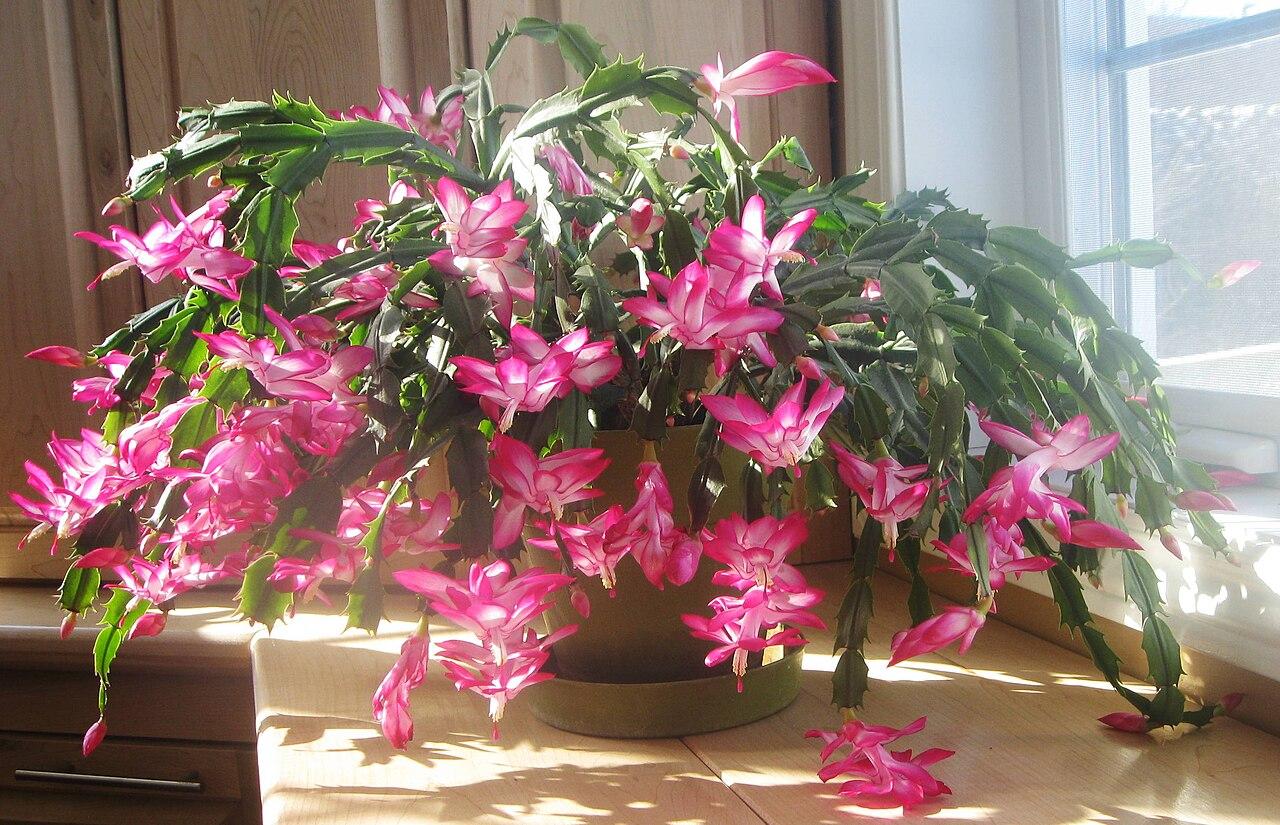
Photo: Schlumbergera by Cactus_de_noël.jpg: Empereur Day derivative work: Peter coxhead (talk) · CC BY-SA 3.0 · via Wikimedia Commons
01It is a cactus, but not that kind of cactus
Schlumbergera is native to the coastal mountain forests of south-eastern Brazil, where it grows as an epiphyte in the crooks of tree branches and on mossy rock, in filtered light and high humidity. It has no spines and no thick water-storing stem, because it never needed them.
Everything that goes wrong with these plants comes from applying desert-cactus care. Full harsh sun scorches the flat stem segments to a red-purple and then bleaches them. A gritty near-sterile mix and six weeks between waterings leaves it permanently shrivelled.
Treat it instead as something between an orchid and a houseplant: bright indirect light, a chunky organic mix that holds some moisture, water when the top third dries, and decent humidity.
02Everyday care
- Light — Bright indirect. An east window is close to perfect. Direct midday and afternoon sun causes reddening and eventually bleached patches.
- Water — When the top third of the mix is dry — roughly weekly in summer, every 10–14 days in winter. Never let it dry out completely for long, and never leave it standing in water.
- Mix — Two parts standard potting compost to one part orchid bark and one part perlite. It needs air around the roots but not the near-inert grit a desert cactus wants.
- Humidity — Appreciates more than average household air. A pebble tray or grouping with other plants helps, especially through a heated winter.
- Feeding — Balanced fertiliser at half strength monthly from spring to late summer. Stop entirely once you begin the darkness treatment.
- Pot — Likes being snug. Repot every three to four years at most; a pot-bound plant flowers more freely.
03Making it bloom
Schlumbergera is a short-day plant: it initiates flower buds in response to lengthening nights, reinforced by cooler temperatures. If your plant sits in a warm room with a lamp on every evening, it never receives the signal.
Start about six to eight weeks before you want flowers — early to mid October for a December bloom. For that period the plant needs 12 to 14 hours of complete, uninterrupted darkness every night, and night temperatures between roughly 10 and 15°C.
Complete darkness means complete. A street light through a gap in the curtain or a hallway light switched on at 11pm is enough to interrupt the cycle. The simplest method is a spare room with unbroken curtains, or a cardboard box placed over the plant each evening and removed each morning.
| Weeks | Darkness | Temperature | Water |
|---|---|---|---|
| 1–6 | 12–14 h uninterrupted every night | 10–15°C at night | Reduce — let the top half dry |
| When buds appear | Return to normal light | Normal room temperature | Resume normal watering |
| Budding to flowering | Normal | Avoid draughts and heat sources | Keep evenly moist |
| After flowering | Normal | Normal | Rest 4–6 weeks with less water |
04Bud drop, and how to avoid it
The most common complaint is a plant covered in buds that drops every one of them before opening. It is nearly always environmental stress, and nearly always avoidable.
The biggest single cause is movement. Once buds have set, the plant orients them to the light, and rotating or relocating it forces a reorientation it cannot afford. Mark the pot and put it back the same way round every time.
The others are sudden temperature swings, draughts from doors and windows, proximity to a radiator or heating vent, and inconsistent watering — either letting it dry out completely or keeping it soggy while it is budding.
05Pruning and propagation
Prune a month or so after flowering finishes. Twist off one or two segments from the end of each stem — they separate cleanly at the joint — and the plant responds by branching at that point, producing more stem tips and therefore more flowers next season.
Those removed segments are your cuttings. Let each piece of two or three segments callus for two or three days, then push the base about a centimetre into damp mix. Roots form within three to four weeks.
Put three or four cuttings into one pot rather than one each. Schlumbergera looks best full, and a single cutting takes years to make a presentable plant.
Frequently asked questions
- Mine bloomed in November, not December. Did I do something wrong?
- No — you probably have a Thanksgiving cactus, which naturally flowers earlier. Most plants sold as Christmas cacti are S. truncata. Adjust the start of the dark treatment if you want to shift the timing.
- How long do these plants live?
- Decades. They are commonly passed down through families, and hundred-year-old specimens exist. They flower better as they age and get pot-bound.
- Why are the stem segments limp and wrinkled?
- Check the roots. Both underwatering and root rot cause limpness. If the mix is dry, water thoroughly and it recovers in a day; if the mix is wet and the stems are limp, unpot and cut away rotted roots.
Lan Nguyen
Balcony grower & founding editor
Lan has kept ornamental plants on a 12 m² apartment balcony for eight years, mostly tropical foliage and small-scale bonsai. She writes the care and comparison guides here, and has killed enough plants to be specific about how.
Keep reading
Soak and Dry: The Only Succulent Watering Method Worth Learning
Little and often feels careful and kills succulents. The method that works is counterintuitive: drench them completely, then do nothing at all for weeks.
Why Your Succulent Is Stretching — and What You Can Still Do
The rosette opens up, the stem lengthens, the leaves point downward and get further apart. That is etiolation, it is always a light problem, and it does not reverse. But the plant is fixable.
Peace Lily Care: The Plant That Tells You When It's Thirsty
Spathiphyllum droops theatrically the moment it runs low on water and perks back up within hours. That feedback loop makes it the best teaching plant there is — as long as you don't take the drooping as a schedule.