Soak and Dry: The Only Succulent Watering Method Worth Learning
Little and often feels careful and kills succulents. The method that works is counterintuitive: drench them completely, then do nothing at all for weeks.
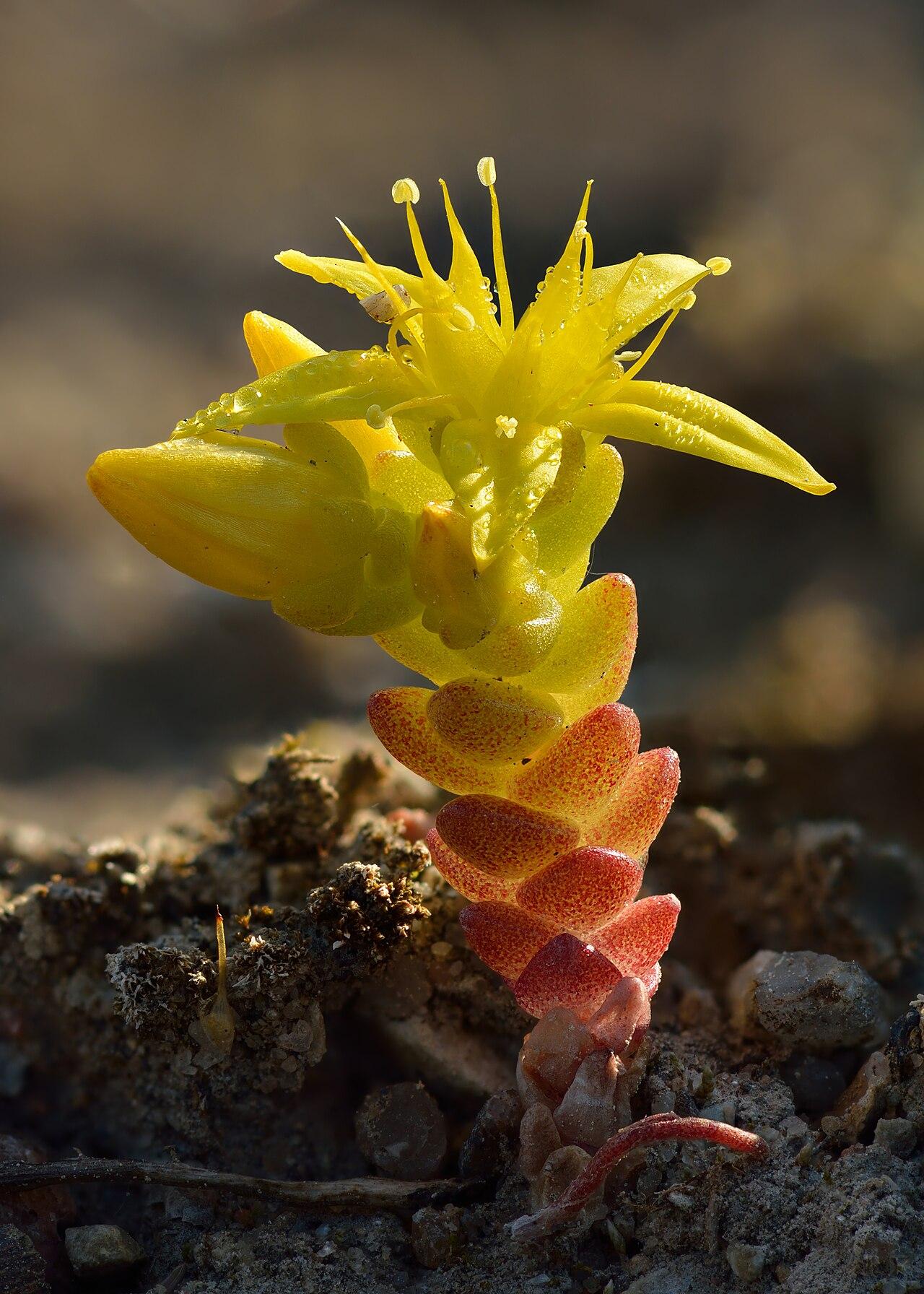
Photo: Sedum by Ivar Leidus · CC BY-SA 4.0 · via Wikimedia Commons
01Why little-and-often fails
Succulents evolved in places with long dry spells punctuated by heavy rain. Their roots are built to respond to that pattern: a deep soaking triggers a burst of fine root growth, the plant takes up water fast, and the roots then tolerate a long dry period.
Give them a splash every few days and none of that happens. The top centimetre stays damp while the lower root ball never dries, roots stay shallow and lazy, and the permanently moist zone at the base of the pot becomes exactly the environment soil-borne fungi need.
The plant looks fine for months. Then one day a lower leaf goes translucent, and by the time you notice, the stem is already soft.
02How to actually do it
The mechanics take about a minute per plant.
- 1. Check first — Push a wooden skewer to the bottom of the pot. If it comes out damp, darkened, or with mix stuck to it, wait. Bone dry and clean means water.
- 2. Drench — Pour water slowly over the whole surface until it runs freely from the drainage hole. Aim for at least a quarter of the pot's volume in water.
- 3. Drain completely — Let it finish dripping and tip out anything in the saucer. Water sitting under the pot cancels everything you just did correctly.
- 4. Walk away — No top-ups, no misting, no 'just a little because it looks dry'. The surface drying is the point.
03How long is the dry period?
There is no universal number, which frustrates people, but the variables are easy to reason about. Anything that speeds drying shortens the interval; anything that slows it lengthens the interval.
In practice, a small Echeveria in a 10 cm terracotta pot of gritty mix on a bright summer windowsill is often ready every 8 to 10 days. The same plant in a 15 cm glazed pot of standard compost in a dim room might need six weeks — and in that situation you should fix the pot and mix rather than the schedule.
| Factor | Dries faster | Dries slower |
|---|---|---|
| Pot material | Unglazed terracotta | Plastic, glazed ceramic |
| Pot size | Small and shallow | Large and deep |
| Mix | 50%+ grit, pumice, coarse sand | Peat-based potting compost |
| Light | Bright, direct sun | Low light |
| Season | Active summer growth | Winter dormancy |
| Air movement | Open room, a fan, outdoors | Closed terrarium, still corner |
| Temperature | Warm | Cool |
04Seasonal adjustment matters more than people expect
Most common succulents slow dramatically in winter, and some stop entirely. A plant that is not growing is not using water, and the mix stays wet for weeks — combine that with cool temperatures and low light and you have the classic winter rot.
Through late autumn and winter, water roughly once a month, and only if the leaves have started to look slightly less firm than usual. Many growers keep desert cacti completely dry for eight to ten weeks and lose nothing.
Be aware that a minority of succulents — Aeonium, Haworthia, many Senecio — are winter growers that rest in summer instead. If yours is visibly growing in December and sulking in July, water it on the opposite schedule.
05Reading the plant
Succulents signal both extremes clearly once you know what to look at, and the signals are opposites of one another.
| Signal | Underwatered | Overwatered |
|---|---|---|
| Leaf feel | Soft, wrinkled, slightly leathery | Soft, mushy, squashy |
| Leaf colour | Dull, sometimes reddish stress colour | Pale, yellowing, translucent |
| Which leaves first | Lower and outer leaves shrivel | Lower leaves drop off at a touch |
| Stem | Firm | Soft or brown at the soil line |
| Recovery | Full, within a day of watering | Only by cutting away the rot |
06If you have already overwatered
Stop watering and unpot the plant. Shake off the wet mix and look at the roots and the base of the stem. Healthy roots are pale and firm; rotting roots are brown, thin and fall apart between your fingers.
Cut away everything soft with a clean blade, working up the stem until you reach firm white tissue. Leave the plant out of soil, in a dry shaded spot, for two to five days so the cuts callus over. This step feels wrong and is essential.
Repot into completely dry gritty mix and do not water for a week. If the whole base is gone, behead the plant: cut a clean healthy top, callus it for several days, and set it on dry mix — most rosette succulents root readily from a beheading and you end up with a better-looking compact plant.
Frequently asked questions
- Should I water from the bottom?
- You can, and it encourages deeper rooting. Stand the pot in a few centimetres of water for 10–20 minutes until the surface darkens, then remove it and drain. The dry-out period afterwards still applies.
- What if my pot has no drainage hole?
- Then soak-and-dry is impossible, and no watering technique will save the plant long-term. Either drill a hole or use the container as a cachepot with the plant in a plastic pot inside it.
- Do succulents need misting?
- No. Misting wets the leaves without reaching the roots, and on rosette types water trapped between leaves causes rot at the crown. The only exception is unrooted cuttings and propagating leaves.
Marcus Hale
Contributor — soil & propagation
Marcus spent six years in a wholesale nursery mixing media by the cubic metre before moving to container growing at home. He covers potting mixes, repotting and the unglamorous half of plant care.
Keep reading
Why Your Succulent Is Stretching — and What You Can Still Do
The rosette opens up, the stem lengthens, the leaves point downward and get further apart. That is etiolation, it is always a light problem, and it does not reverse. But the plant is fixable.
Christmas Cactus Care: Getting It to Flower on Schedule
Schlumbergera is not a desert plant and treating it like one is why yours has never bloomed. It is a jungle epiphyte, and its flowering is triggered by darkness and cool nights.
Stop Watering on a Schedule: A Seasonal Approach Instead
The most common question is 'how often should I water this?' — and the honest answer is that the interval changes by a factor of three between July and January. Here is how to read it instead of counting days.