Succulents vs Cacti: Which One Actually Belongs Indoors?
They sit on the same shelf at the garden centre and get sold with the same care card, but succulents and cacti want noticeably different amounts of light. Picking wrong is why one of them is stretching.
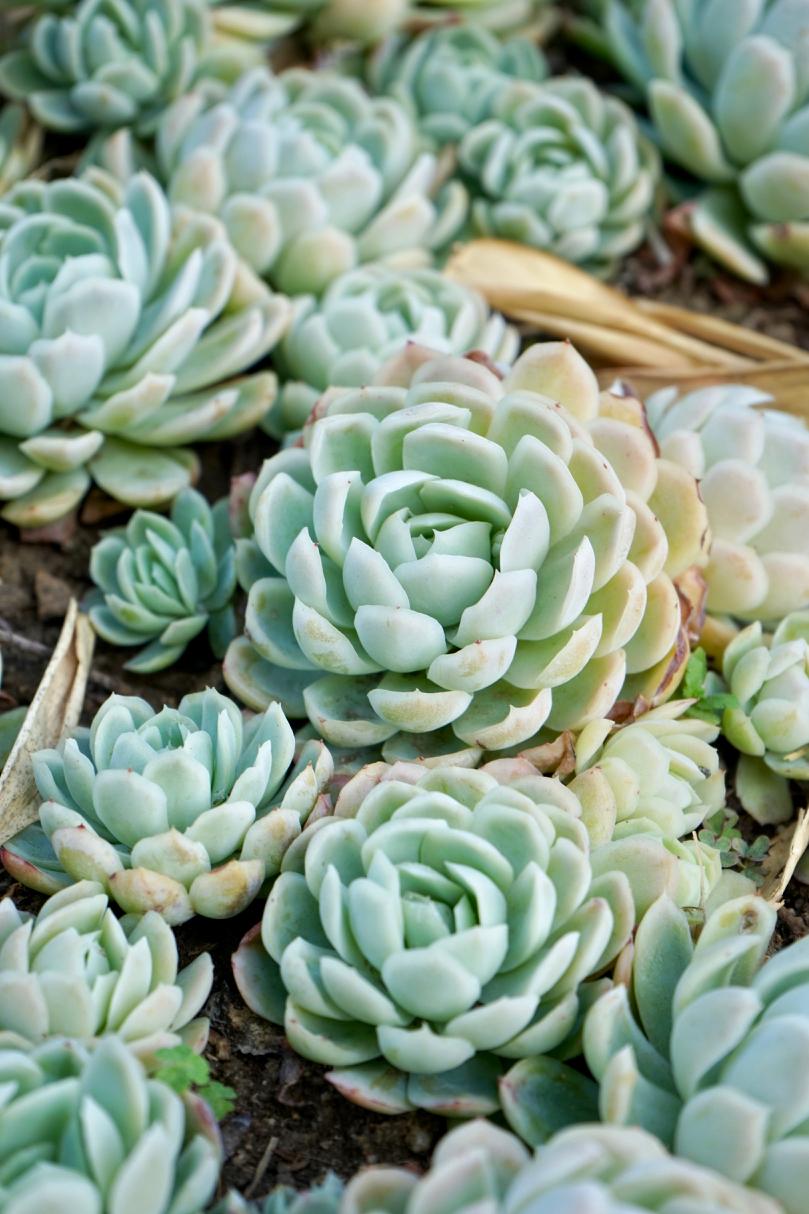
Photo: Echeveria by Eria Wei · CC BY-SA 4.0 · via Wikimedia Commons
01The relationship, stated plainly
A succulent is any plant that stores water in thickened leaves, stems or roots. That is a survival strategy, not a family tree — it has evolved independently in dozens of unrelated plant groups.
Cacti are one specific family within that group: Cactaceae. They store water in the stem rather than the leaves, and almost all of them carry areoles, the small cushioned points that spines grow from. If it has areoles, it is a cactus. If it has fat leaves and no areoles, it is a succulent but not a cactus.
So the question is never really 'succulent or cactus'. It is 'a leaf-storing succulent from a mild, seasonally dry climate, or a stem-storing cactus from a hot desert' — and those two want different windows.
02Side by side
The table below covers the common indoor cases: Echeveria, Sedum, Haworthia and Crassula on the succulent side, and Mammillaria, Ferocactus and Opuntia on the cactus side.
| Leaf succulents | Desert cacti | |
|---|---|---|
| Light | 4–6 h bright light, some direct sun | 5–8 h direct sun, the more the better |
| Best window | East or south-facing, sheer curtain | Unshaded south or west-facing |
| Summer watering | Soak every 10–14 days | Soak every 14–21 days |
| Winter watering | Every 3–4 weeks | Often none at all for 8–10 weeks |
| Soil | 50% grit / 50% potting mix | 60–70% grit, very little organic matter |
| First sign of trouble | Translucent mushy lower leaves | Soft brown patch at the soil line |
| Tolerates low light? | Poorly, but survives longer | No — stretches within weeks |
03Light is the decision, not water
Both groups are described as low-maintenance, and both are, once the light is right. Get the light wrong and no watering routine saves them.
A leaf succulent in a moderately bright east window will hold its rosette shape for a year or more. The same window will visibly ruin a barrel cactus: the newest growth comes in narrower than the old, and you end up with a pale, tapering tip that never thickens back out. That is etiolation, and it does not reverse.
This is why the honest answer for most apartments is succulents. Unless you have an unshaded south or west window, or you are willing to run a grow light, a desert cactus is going to be slowly deforming in your care.
- Bright, unshaded, sun most of the day — Either group works. This is the only situation where cacti genuinely thrive indoors.
- Bright but filtered — sheer curtain, east window — Leaf succulents. Haworthia and Gasteria in particular handle this well.
- A metre or more back from any window — Neither. Choose a foliage plant instead — a ZZ plant or a pothos will be happier and look better.
04Watering: the same principle, different intervals
Both groups want soak-and-dry. Water thoroughly until it runs from the drainage hole, then leave the medium completely alone until it is dry all the way through. The frequent light sprinkle that feels careful is the thing that rots them.
The interval differs because leaf succulents hold less reserve than a stem-storing cactus and have more surface area to lose water from. In summer, a 12 cm potted Echeveria on a bright windowsill is usually ready every 10 to 14 days. A Mammillaria of the same size in the same window can go three weeks.
In winter, the gap widens dramatically. Many desert cacti enter a genuine dormancy in cool, short-day conditions and want nothing at all for two months. Succulents slow down but rarely stop entirely — check monthly, water if the leaves have started to look slightly less firm.
05Which one should you buy?
If this is your first drought-adapted plant and you are working with an ordinary apartment window, buy a leaf succulent — Haworthia, Gasteria or a Sedum. They tolerate a wider band of light, they show stress earlier and more legibly, and a stretched succulent can be beheaded and re-rooted into a compact plant again.
Buy a cactus if you have real sun and want a plant you can genuinely forget about for weeks at a time. Just accept that the trade is inflexibility: the light requirement is not negotiable, and mistakes are recorded permanently in the shape of the stem.
If you want both and only have one good window, put the cactus in it and keep the succulent a little further back.
Frequently asked questions
- Is a Christmas cactus a desert cactus?
- No. Schlumbergera is a jungle cactus that grows on tree branches in Brazilian cloud forest. It wants bright indirect light and more consistent moisture than a desert cactus — treat it more like a succulent than like a Mammillaria.
- Why is my succulent stretching even in a sunny window?
- Usually the window is sunny for less of the day than it feels. Check it at three points across the day; a window that is dazzling at noon may deliver only two hours of usable light. Stretching always means light, never water.
- Can I use the same soil for both?
- You can, if you build the grittier version and simply water the succulents more often. It is easier to adjust watering than to keep two mixes on hand.
Lan Nguyen
Balcony grower & founding editor
Lan has kept ornamental plants on a 12 m² apartment balcony for eight years, mostly tropical foliage and small-scale bonsai. She writes the care and comparison guides here, and has killed enough plants to be specific about how.
Keep reading
Terracotta vs Plastic Pots: Does It Really Change Anything?
Terracotta is the aesthetic default and plastic is what your plant arrived in. The difference is not decorative — it changes how fast the medium dries, which changes your entire watering routine.
Pothos vs Monstera: The Honest Comparison
Both are climbing aroids with glossy green leaves, and in a nursery pot they look like the same plant at different sizes. The difference shows up two years later, when one has taken over a corner of the room.
Snake Plant vs ZZ Plant: Which Survives a Dark Room?
These two get recommended interchangeably for the corner that gets no light. They are both genuinely tough, but they fail in different ways, and one of them handles a cold flat much better.