Pothos vs Monstera: The Honest Comparison
Both are climbing aroids with glossy green leaves, and in a nursery pot they look like the same plant at different sizes. The difference shows up two years later, when one has taken over a corner of the room.
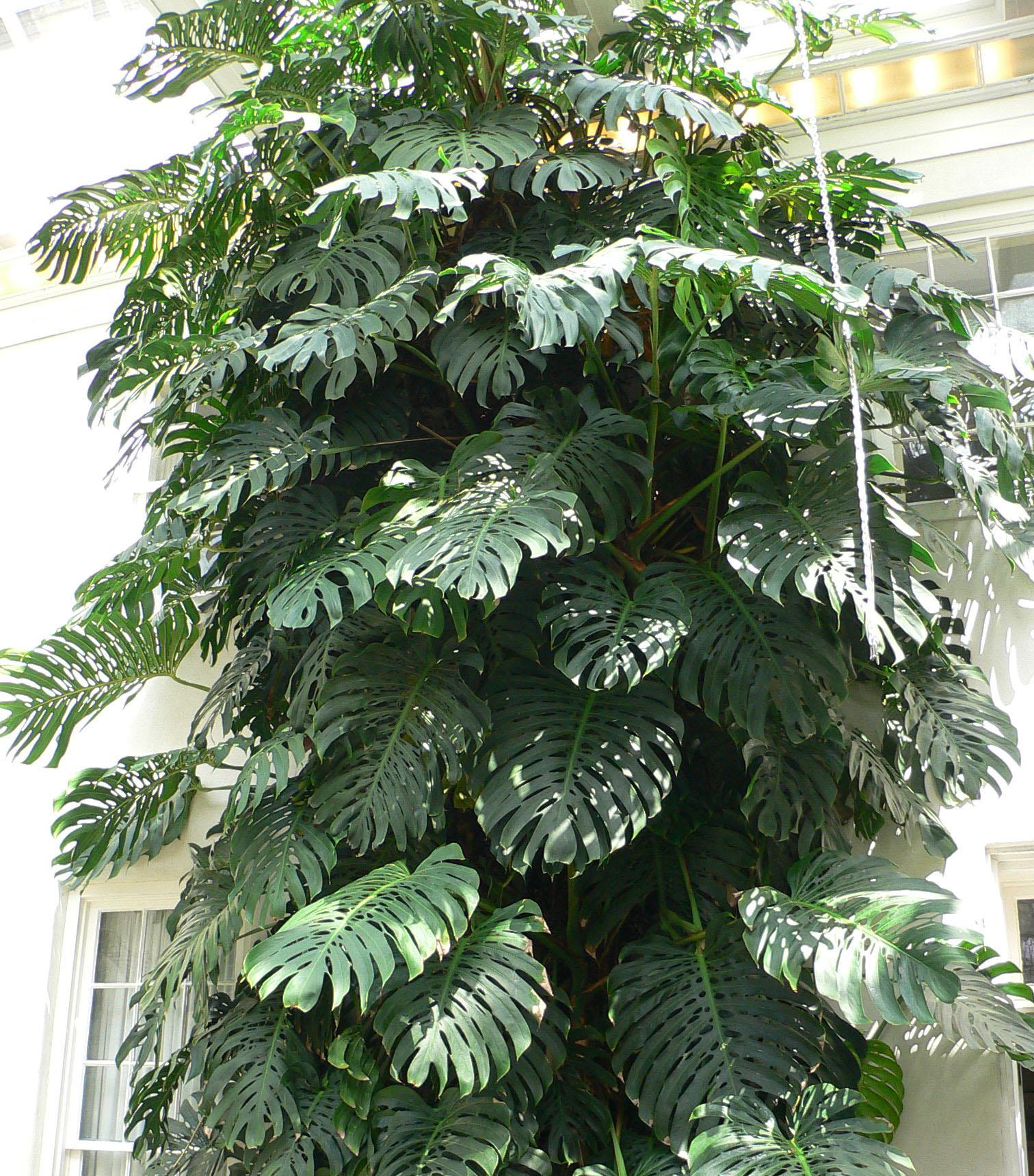
Photo: Monstera deliciosa by Unknown author · CC BY-SA 3.0 · via Wikimedia Commons
01They are relatives, not twins
Both belong to Araceae, the aroid family, and both are climbers that in the wild start on the forest floor and work their way up a tree trunk. That shared strategy is why they respond to the same broad care.
The divergence is scale. Epipremnum aureum — pothos, devil's ivy — keeps modest leaves and trails happily, which is why it works on a bookshelf indefinitely. Monstera deliciosa is built to get large: given a pole to climb and enough light, each new leaf comes in bigger than the last, and the leaves eventually split into the fenestrated shape people buy it for.
Neither of those behaviours is optional. A pothos will not become a dramatic architectural plant, and a monstera will not stay small because your shelf is small.
02Side by side
| Pothos | Monstera deliciosa | |
|---|---|---|
| Mature indoor size | Trails 1–3 m, leaves stay 8–15 cm | 1.5–2.5 m tall, leaves 30–60 cm |
| Minimum viable light | Low — survives well back from a window | Medium-bright indirect, near a window |
| Light needed to look good | Medium indirect | Bright indirect for 6+ hours |
| Fenestrations (splits) | Never | Only with good light and a support pole |
| Support needed | None — trails or climbs freely | Moss pole or plank, effectively required |
| Watering | Top 3–4 cm dry | Top 3–4 cm dry |
| Propagation | Very easy — node cutting in water | Easy — node cutting, larger and slower |
| Toxic to pets | Yes (calcium oxalate) | Yes (calcium oxalate) |
03Light: the one place they genuinely differ
Pothos has an unusual tolerance for dim conditions. It will hold decent-looking foliage two or three metres from a window, in a hallway, in an office lit mostly by ceiling panels. Growth slows to almost nothing and variegated cultivars revert toward plain green, but the plant stays presentable for years.
Monstera in that same spot does not die either — and that is the trap. It produces small, entire, unsplit leaves on long stretched stems, looking progressively less like the plant in the photo that sold it. People conclude their monstera is 'fine' when it is actually in a slow decline of form.
If your intended spot is dim and you want it to look good rather than merely be alive, that decides it: pothos.
04Space, support and the thing nobody mentions
A monstera without a pole sprawls sideways. The stems get long and heavy, the plant leans out of its pot, and you end up staking it badly a year later. Put the pole in when you repot, before the plant needs it — driving a pole into an established root ball damages roots.
Aerial roots are not a defect and should not be cut off. Guide them into the pole and keep the pole slightly damp; they anchor the plant and feed the larger leaves that follow.
Pothos needs none of this. It can trail from a high shelf, climb a small pole for larger leaves, or be cut back hard whenever it gets unruly — it responds to a hard prune by branching, which is why old pothos plants get fuller rather than leggier if you keep trimming them.
- Shelf, hanging basket, or top of a cabinet — Pothos. It is designed for exactly this and stays in scale.
- Empty floor corner near a bright window — Monstera on a pole. This is where it earns its price.
- Desk or small side table — Pothos. A monstera will look right for about eight months and then be a problem.
05Care overlap: nearly total
Water both when the top 3–4 cm of medium has dried. Both prefer a chunky, well-aerated aroid mix — bark, perlite and coir rather than dense bagged potting soil — and both are far more likely to be killed by a pot without drainage than by neglect.
Both accept average household humidity, though monstera's larger leaves show crisp brown edges sooner in a dry, heated room. Both are toxic to cats and dogs, so neither solves that problem.
Feed both at half strength monthly through the growing season and not at all in the darkest part of winter. There is no meaningful difference in feeding between them.
06The verdict
Buy a pothos if you want a plant that is genuinely hard to kill, fits a shelf, propagates endlessly for free, and forgives a dim room. It is the better first plant by a wide margin, and there is no stage at which you outgrow it.
Buy a monstera if you have a bright corner with floor space and want one plant to be the visual anchor of the room. Commit to the pole and the light, and in two years you will have something a pothos can never become.
If you cannot decide: get the pothos now, and get the monstera when you have identified the specific bright corner it will live in.
Frequently asked questions
- Is 'mini monstera' a monstera?
- No. Rhaphidophora tetrasperma is a different genus. It splits its leaves at a much smaller size and stays narrower, which makes it a reasonable middle option if you want fenestrations without the footprint.
- Why won't my monstera's leaves split?
- Almost always light, sometimes maturity. Young plants produce entire leaves regardless; after four or five leaves, continued lack of splitting means it needs a brighter spot and something to climb.
- Can I grow pothos permanently in water?
- Yes, and it will live for years, but growth stays slow and leaves stay small. Change the water fortnightly and add a very dilute hydroponic feed if you want it to do more than survive.
Lan Nguyen
Balcony grower & founding editor
Lan has kept ornamental plants on a 12 m² apartment balcony for eight years, mostly tropical foliage and small-scale bonsai. She writes the care and comparison guides here, and has killed enough plants to be specific about how.
Keep reading
Snake Plant vs ZZ Plant: Which Survives a Dark Room?
These two get recommended interchangeably for the corner that gets no light. They are both genuinely tough, but they fail in different ways, and one of them handles a cold flat much better.
Succulents vs Cacti: Which One Actually Belongs Indoors?
They sit on the same shelf at the garden centre and get sold with the same care card, but succulents and cacti want noticeably different amounts of light. Picking wrong is why one of them is stretching.
Terracotta vs Plastic Pots: Does It Really Change Anything?
Terracotta is the aesthetic default and plastic is what your plant arrived in. The difference is not decorative — it changes how fast the medium dries, which changes your entire watering routine.