Semi-Hydroponics: What LECA and Pon Actually Solve
Growing houseplants in clay balls is not a gimmick and it is not a shortcut. It trades one set of problems — overwatering, fungus gnats, guesswork — for another, and the trade is worth it for some people and not others.
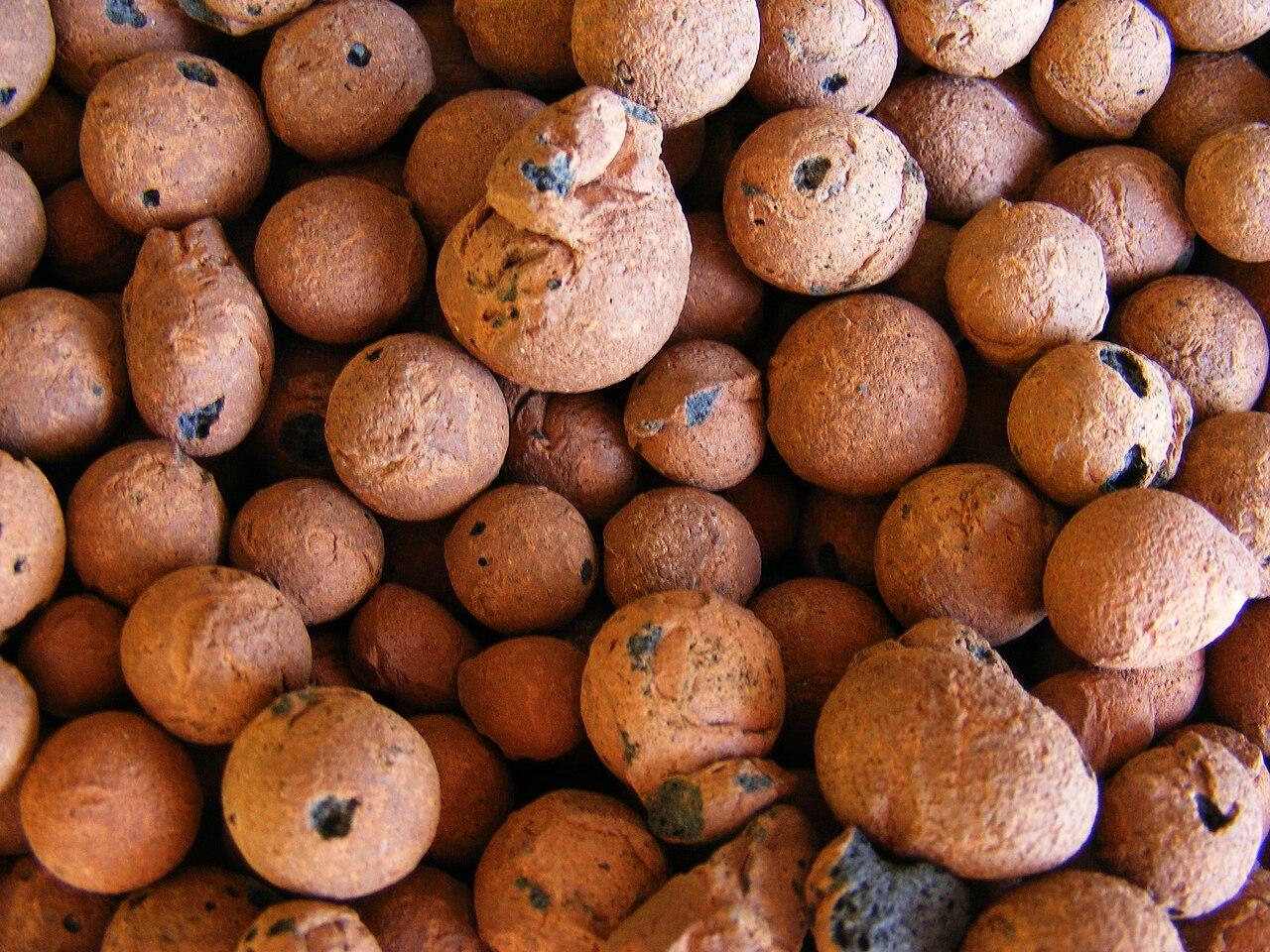
Photo: Expanded clay aggregate by Lucis · CC BY-SA 3.0 · via Wikimedia Commons
01What semi-hydro is, and what it is not
Semi-hydroponics means growing a plant in an inert, chemically neutral medium that holds no nutrients of its own, with a small reservoir of nutrient solution at the base of the pot. The medium wicks moisture upward from that reservoir, and the roots sit in permanently damp but highly aerated conditions.
It is not hydroponics in the commercial sense — there are no pumps, no aeration stones and no recirculation. It is not the same as keeping a cutting in a jar of water, which is a nutrient-free environment where a plant slowly starves. And it is not inherently better than soil; it is a different set of trade-offs.
Two media dominate. LECA — lightweight expanded clay aggregate — is clay fired until it puffs into porous balls, sold under names like Hydroton. It is coarse, reusable indefinitely, and wicks moderately. Pon is a blended mineral mix, typically pumice, zeolite and lava rock, usually with a slow-release fertiliser included; it is finer, wicks better, and behaves more like a conventional medium.
The core benefit both provide is the same: a root zone that is simultaneously wet and full of air, which is exactly the combination that soil struggles to deliver and that root rot exploits when it fails.
02The honest case for and against
The advantages are real and specific. Overwatering becomes almost impossible, because the medium cannot become waterlogged in the way compost does — this alone makes it attractive to anyone who has lost plants to rot. Fungus gnats disappear entirely, since there is no organic matter for larvae to feed on. Watering becomes a visual check of a reservoir level rather than a judgement about damp compost. Repotting is rare, because the medium does not break down. And root health is visible if you use a clear inner pot.
The disadvantages are equally real. You take on complete responsibility for nutrition, and a mistake there shows up faster than it would in soil, which buffers. The initial conversion sets a plant back by a month or more. Salts accumulate in the medium and it must be flushed regularly. The setup costs more than a bag of compost. And not every plant is suited to it.
The pattern among people who switch and stay switched is fairly consistent: they had recurring problems with overwatering or fungus gnats, they keep aroids and other plants that transition easily, and they like the routine of a measured nutrient solution more than the judgement of feeling compost.
People who try it and go back to soil are usually those who kept a wide range of plants including ones that resent it, or who found the nutrient management more demanding than the problem it replaced.
| LECA | Pon | |
|---|---|---|
| Particle size | Coarse, 8–16 mm balls | Fine to medium mineral blend |
| Wicking | Moderate — needs a shallow reservoir | Strong — more forgiving |
| Fertiliser | Every watering, from the solution | Often includes slow-release to start |
| Reusable | Indefinitely, after washing | Yes, though it degrades slowly |
| Stability | Light — top-heavy plants tip | Heavier and more stable |
| Best for | Aroids, hoyas, plants you can watch | Beginners; a gentler transition |
03Setting it up
The standard arrangement is a two-pot system: a plastic inner pot with holes or slots, sitting inside a watertight outer container. The nutrient solution fills the outer container to roughly a fifth to a quarter of the inner pot's height, and the medium wicks it upward.
That level is the crucial detail. The root mass and the base of the stem must sit above the waterline, not in it. Roots submerged continuously in still solution have no oxygen and rot exactly as they would in waterlogged compost, and a crown sitting in water rots even faster. The plant drinks from the damp medium above the reservoir, not from the reservoir itself.
Rinse LECA thoroughly before first use — it is dusty, and the dust clogs the pore spaces you are buying it for. Soaking it for several hours first also means it starts saturated rather than pulling water away from the plant.
Then refill when the reservoir empties, and let it run dry for a day before refilling. That brief dry period pulls fresh air down through the medium and is part of why the system works. Constantly topping up a reservoir that never empties recreates the problem you were avoiding.
04Nutrition, which is now entirely your job
LECA and pure LECA systems contain no nutrients at all. Every drop of water you add must be a complete hydroponic nutrient solution, including the micronutrients that soil normally supplies — calcium, magnesium, iron, manganese and the rest. An ordinary houseplant fertiliser designed to supplement soil is not sufficient on its own, because it assumes the medium is providing the remainder.
Use a fertiliser formulated for hydroponics or specifically for semi-hydro, at the dilution the manufacturer specifies for continuous feeding — typically well below the strength used for occasional feeding in soil. Mix fresh; solutions left standing for weeks change chemically and grow algae.
Flush the system with plain water every three to four weeks. Salts concentrate as water evaporates, and in an inert medium there is nothing to buffer that. A white crust on the upper pellets is the visible signal, and by then you are overdue. Run plain water through the medium for a minute or two, let it drain, then refill with fresh solution.
Pon simplifies this at the start, since most pon products include a slow-release fertiliser that lasts a few months. After that runs out you are in the same position and must feed with every watering.
Watch pH if plants look chlorotic despite regular feeding. Semi-hydro systems drift, and nutrient availability is pH-dependent; a target of roughly 5.5–6.5 suits most houseplants, and cheap test strips are enough to spot a serious drift.
05Converting a plant, and which plants to try
Roots grown in soil and roots grown in a semi-hydro system are structurally different. Soil roots have fewer aerenchyma — the internal air channels that let a root function in a wet environment — so many of them die back after conversion and are replaced by new water-adapted roots. That die-back is the source of the alarming month people describe after switching.
Convert in spring or summer, when the plant has the light and energy to grow the new roots. Remove it from its pot and wash every trace of compost from the roots under running water — remaining organic matter rots in the system and defeats the point. Trim damaged and mushy roots away. Then pot into pre-soaked LECA, keep the reservoir shallow for the first few weeks, and be patient.
Expect four to six weeks with no visible growth, and some leaf loss on a plant that had a large root system. Do not feed heavily during this period; a weak solution is enough while there is little root to take it up. And do not keep lifting the plant to look.
Cuttings are the easier route, and the one worth starting with. A cutting rooted directly in LECA never has soil roots to lose, so it grows water roots from the start and transitions to nothing.
- Transition well — Pothos, philodendron, monstera, syngonium, scindapsus, hoya, anthurium, alocasia, sansevieria, spathiphyllum. Aroids as a group are the natural fit.
- Manageable with care — Ficus, dracaena, peperomia, begonia, calathea. Slower to convert and less forgiving of nutrient mistakes.
- Usually not worth it — Succulents and cacti, which are adapted to dry cycles and do poorly in permanently damp conditions; ferns; and orchids, which already grow in an airy medium suited to them.
- The best starting point — A rooted pothos or philodendron cutting in a small clear jar of LECA. Cheap, fast, visible, and it teaches the system before you risk a plant you care about.
Frequently asked questions
- Can I keep using my normal houseplant fertiliser?
- Not on its own. Standard fertilisers assume the soil supplies calcium, magnesium and trace elements. In an inert medium you need a complete hydroponic formulation, or a base feed plus a cal-mag supplement.
- Why is there algae on my LECA?
- Light reaching the nutrient solution. It is unsightly rather than harmful — use an opaque outer pot, and flush and rinse the top layer when it builds up.
- Do fungus gnats really disappear?
- Yes, if the conversion is thorough. The larvae feed on organic matter and fungi in damp compost, and a properly washed semi-hydro pot has none. Any remaining compost on the roots undoes this.
- Is pon easier than LECA?
- For most beginners, yes. It wicks more reliably, is heavier and more stable, and usually starts with a slow-release fertiliser, which removes the nutrition question for the first few months.
Marcus Hale
Contributor — soil & propagation
Marcus spent six years in a wholesale nursery mixing media by the cubic metre before moving to container growing at home. He covers potting mixes, repotting and the unglamorous half of plant care.
Keep reading
Coco Coir vs Peat: What Should Actually Fill Your Pots
Peat is being phased out and coir is the replacement everyone reaches for. They behave differently in ways that matter — in how they wet, how they hold nutrients, and in one chemical quirk that catches people out.
Can You Reuse Old Potting Mix? Usually, With Conditions
Spent compost is not waste, and it is not automatically safe either. The question is what happened to it in the pot — whether it collapsed, whether it was fed, and whether the plant that lived in it was healthy.
Bark, Pumice, Grit and the Rest: A Guide to What Goes in a Mix
Every potting recipe is a base plus amendments. Knowing what each amendment actually does — and which ones do nothing — lets you build a mix for a plant nobody has written a recipe for.