Scale and Thrips: The Two Pests That Get Found Too Late
Mites and mealybugs are visible and vulnerable. These two are neither — scale sits under a waterproof cover and thrips spend half their life inside the leaf and in the pot. Both need a different approach from a bottle of soap.
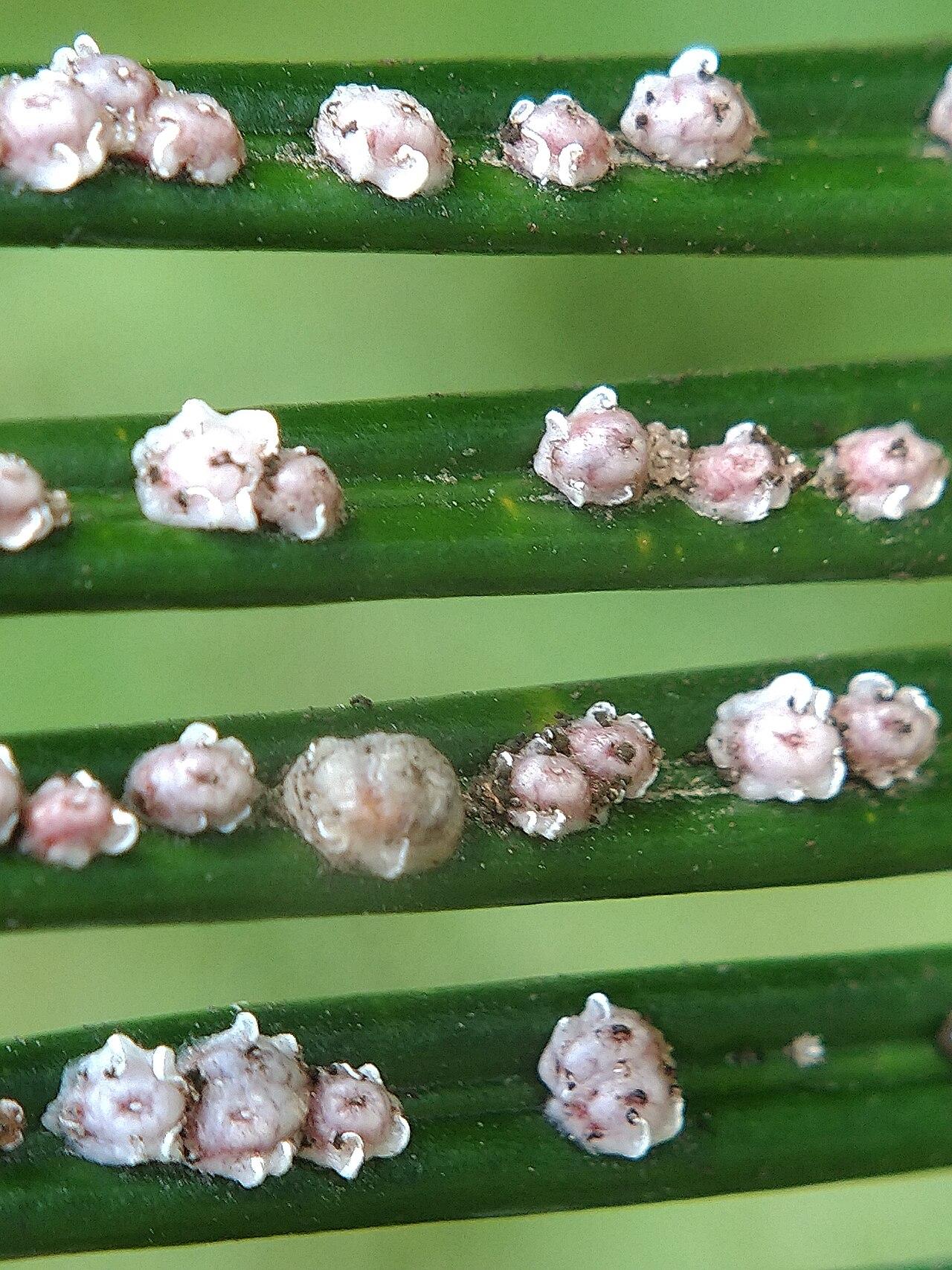
Photo: Scale insect by BARAKAT2011 · CC BY-SA 3.0 · via Wikimedia Commons
01Why these two are the difficult ones
Spider mites and mealybugs are unpleasant but tractable. They live on the surface, they have soft bodies, and a thorough application of soap or oil reaches and kills most of what is there. Persistence is needed, but the method is obvious.
Scale and thrips break that model, in opposite directions. An adult scale insect sits under a waxy or hardened cover cemented to the plant — a shield that a water-based spray runs straight off. Thrips lay their eggs inside leaf tissue, feed as tiny larvae in crevices, and then drop off the plant entirely to pupate in the top layer of the potting medium.
In both cases, a treatment that visibly kills everything you can see leaves the majority of the population untouched, and the infestation returns in a fortnight looking like the treatment failed. It did not fail; it hit the wrong stage of the life cycle.
Everything below follows from that. The tactics are about timing and coverage, and about treating places that do not look infested.
02Identifying scale
Scale rarely looks like an insect, which is why it goes unnoticed for months. What you see are small immobile bumps — tan, brown or grey — along stems, tight into leaf axils, and in neat rows down the midrib on the leaf underside. People routinely mistake them for part of the plant, or for scarring.
The first symptom is usually not the insect at all. Soft scale excretes honeydew, so the tell is a sticky varnish on the leaves below the infestation, on the shelf, or on the floor. Given a few weeks, black sooty mould grows on that honeydew — harmless in itself, but it blocks light and it is a reliable pointer to look upward for the source.
Armoured scale produces no honeydew at all, so it announces itself differently: yellow speckling or pale spotting on the foliage, general decline, and eventually a plant that looks tired for no visible reason. Fern scale is the common indoor armoured species, with brown oyster-shell female covers and small white male covers scattered like flecks of paint.
The distinction is worth ten minutes of examination, because it determines whether one entire category of treatment will work.
| Soft scale | Armoured scale | Mealybug | |
|---|---|---|---|
| Typical look | Domed tan or brown blister, up to about 5 mm | Flat oyster-shell or circular cover, often with white male covers | White cottony blob with a waxy fringe |
| Honeydew | Copious — sticky leaves and sooty mould | None | Copious |
| Cover attached to body? | Yes, part of the insect | No — a separate shield it sits under | Waxy secretion, no shield |
| Systemic imidacloprid | Effective | Not effective | Effective |
| Generation time indoors | About 60 days; several generations a year | Around 95 days | About 30 days |
03Treating scale: the crawler window is the whole point
A scale insect is mobile for a short period after hatching. In that crawler stage it has legs, no protective cover, and a soft body — and it is the only stage a contact spray reliably kills. Adults under their covers survive nearly anything you apply topically.
This is why one thorough treatment never clears an infestation and four spaced treatments usually do. Indoors, with several overlapping generations a year and no seasonal synchrony, crawlers are emerging more or less continuously, so the schedule matters more than the product.
Start mechanically. Isolate the plant. Scrape the covers off with a fingernail, an old toothbrush or a cotton bud dipped in 70% isopropyl alcohol; each cover removed is a female no longer laying. Prune out any stem so encrusted that cleaning it is unrealistic — on a badly infested plant this is faster and kinder than a long chemical campaign.
Then spray horticultural oil, covering every surface: stems, both sides of every leaf, leaf axils, the growing tip, and the top of the medium. Oil works by smothering, so coverage is the active ingredient — a missed underside is a reservoir. Repeat every 7–10 days for at least four applications.
A systemic based on imidacloprid, applied as a soil drench, is genuinely useful against soft scale and mealybugs, because the insect drinks the sap and the compound reaches it under its cover. It does not control armoured scale — armoured species feed differently — so identify before you spend money. Systemics are also not labelled for edible plants, so keep them away from herbs and citrus you intend to eat.
04Identifying thrips
Thrips are 1–2 mm and cigar-shaped, and most people never see the insect — they see the damage and assume it is a watering or light problem. Adults are dark brown to black and move with a quick nervous scuttle when disturbed; the larvae are pale yellow, slower, and cluster along veins and in the folds of unopened leaves.
The damage is distinctive once you know it. Thrips puncture individual cells and drain them, and the emptied cells go silvery. The result is a metallic or bronzed sheen across the leaf surface, quite unlike ordinary chlorosis, often with tiny black varnish-like specks of frass scattered across it. New growth comes out distorted, puckered or streaked, because it was fed on while still forming.
Two things are commonly confused with it. Spider mite damage is a fine pale stippling, concentrated on leaf undersides, with webbing in the axils when the infestation is advanced. Sunburn is a bleached patch confined to the side facing the window, and it does not spread to new leaves. Thrips damage moves with the new growth and comes with black specks.
A blue sticky trap set just above the foliage is the cheapest confirmation there is. Thrips are strongly drawn to blue, and a trap tells you both that they are present and, week by week, whether your treatment is working.
05Treating thrips: you must treat the pot
The life cycle explains every failed thrips treatment. Females insert their eggs into plant tissue, where no spray reaches them. The larvae feed for several days on the plant. Then the prepupa stops feeding and drops off into the top of the potting medium, where it pupates for a few days, protected, before emerging as an adult and flying back up. The whole cycle takes roughly two to three weeks in a warm room.
So at any moment a large share of the population is either sealed inside a leaf or sitting in the pot. Spray only the foliage and you knock down the visible adults, feel successful for four days, and then watch a fresh cohort emerge from the medium.
The treatment that works is a campaign on both fronts, sustained for longer than the life cycle — four to five weeks minimum, because you are waiting out the protected egg and pupal stages rather than killing them.
- Isolate first — Adults fly. Move the plant to another room before you disturb it, not after, or you will distribute the problem across the collection.
- Wash the foliage — A firm shower or a rinse under the tap physically removes a large share of adults and larvae. Do this before every spray; it does more work than the spray itself.
- Spray the plant — Insecticidal soap, horticultural oil or spinosad, covering both leaf surfaces and the growing tip, every 5–7 days for at least four rounds. Alternate modes of action if you can — western flower thrips develops resistance quickly to any single one.
- Treat the medium — This is the step people skip. A drench of Steinernema feltiae nematodes, or an application of predatory soil mites (Stratiolaelaps scimitus), targets the pupal stage in the pot. Both are sold for indoor use and are harmless to the plant, pets and people.
- Remove the worst growth — Cut off badly distorted new leaves and any bud that is heavily fed on. They carry eggs, they will never look right, and removing them shortens the campaign.
- Monitor with traps — Blue sticky traps, replaced weekly, are how you know when to stop. Two consecutive clean weeks after the last treatment means it is over.
| Week | Plant | Medium | Monitoring |
|---|---|---|---|
| 1 | Isolate, shower, prune damaged growth, spray | Nematode or predatory mite drench | Trap up, count |
| 2 | Shower and spray again | — | Count; expect numbers still rising |
| 3 | Shower and spray, switch product | Second drench | Count; numbers should be falling |
| 4 | Shower and spray | — | Count |
| 5 | Spray only if traps are still catching | — | Two clean weeks means done |
06Prevention, which is mostly quarantine
Both pests arrive from outside. They do not spontaneously appear on a plant you have owned for three years in a flat. They come in on a new plant, on a bunch of cut flowers, on a plant returning from a summer outdoors, or occasionally through an open window in warm weather.
Quarantine every new plant for three to four weeks in a different room, and inspect it on arrival: leaf undersides, both sides of the midrib, every leaf axil, the growing tip, and the stem right down to the medium. A hand lens costs very little and turns a guess into a decision.
Cut flowers are the underrated route. Thrips in particular travel on chrysanthemums, roses and gerberas, and a vase sitting beside a houseplant for a week is an efficient transfer. Keep bought flowers away from your plants.
The plants that come indoors in autumn deserve the most attention, because they arrive carrying whatever they picked up outdoors into a warm room with no predators, no rain and no wind. Hose them down thoroughly, check them over, and keep them apart from the rest for a month.
Finally, unstressed plants are noticeably less attractive to both pests, and they tolerate a low-level infestation for far longer without visible damage. Correct light and correct watering are the two cheapest pest control measures available.
Frequently asked questions
- Does neem oil work on either of these?
- It helps against thrips larvae and scale crawlers as a contact treatment, and it has some antifeedant effect. It does not penetrate a mature scale cover and it will not reach pupae in the medium. Treat it as one contact option among several, not as a solution on its own.
- Can I just wipe scale off and be done?
- On a small plant caught early, sometimes yes — but only if you repeat the inspection weekly for a month to catch crawlers you missed. On anything larger, manual removal is the first step of a treatment, not the whole treatment.
- One plant has thrips. Do I need to treat the whole collection?
- Treat the infested plant and inspect everything within about two metres, plus anything that shared a shelf. Adults fly, so assume neighbours are exposed — but do not blanket-spray healthy plants on suspicion.
- Do thrips bite people?
- They occasionally probe skin and it can sting briefly, particularly outdoors in summer. They do not feed on people, breed on people, or live in houses away from plants.
Lan Nguyen
Balcony grower & founding editor
Lan has kept ornamental plants on a 12 m² apartment balcony for eight years, mostly tropical foliage and small-scale bonsai. She writes the care and comparison guides here, and has killed enough plants to be specific about how.
Keep reading
Spider Mites vs Mealybugs: Identify It Before You Spray
These are the two pests you are most likely to meet indoors, and the treatments barely overlap. Getting the identification right saves weeks of the wrong approach.
Root Rot: Catching It Early and Saving the Plant
By the time the leaves tell you, the roots have been failing for weeks. Here is what to look for earlier, and the surgery that saves a plant that still has firm tissue somewhere.
Fungus Gnats: Annoying, Mostly Harmless, Easy to Eliminate
The small black flies drifting out of your pots are not eating your plant. They are a symptom of medium that stays too wet — which is why the fix is a watering fix.