Fungus Gnats: Annoying, Mostly Harmless, Easy to Eliminate
The small black flies drifting out of your pots are not eating your plant. They are a symptom of medium that stays too wet — which is why the fix is a watering fix.
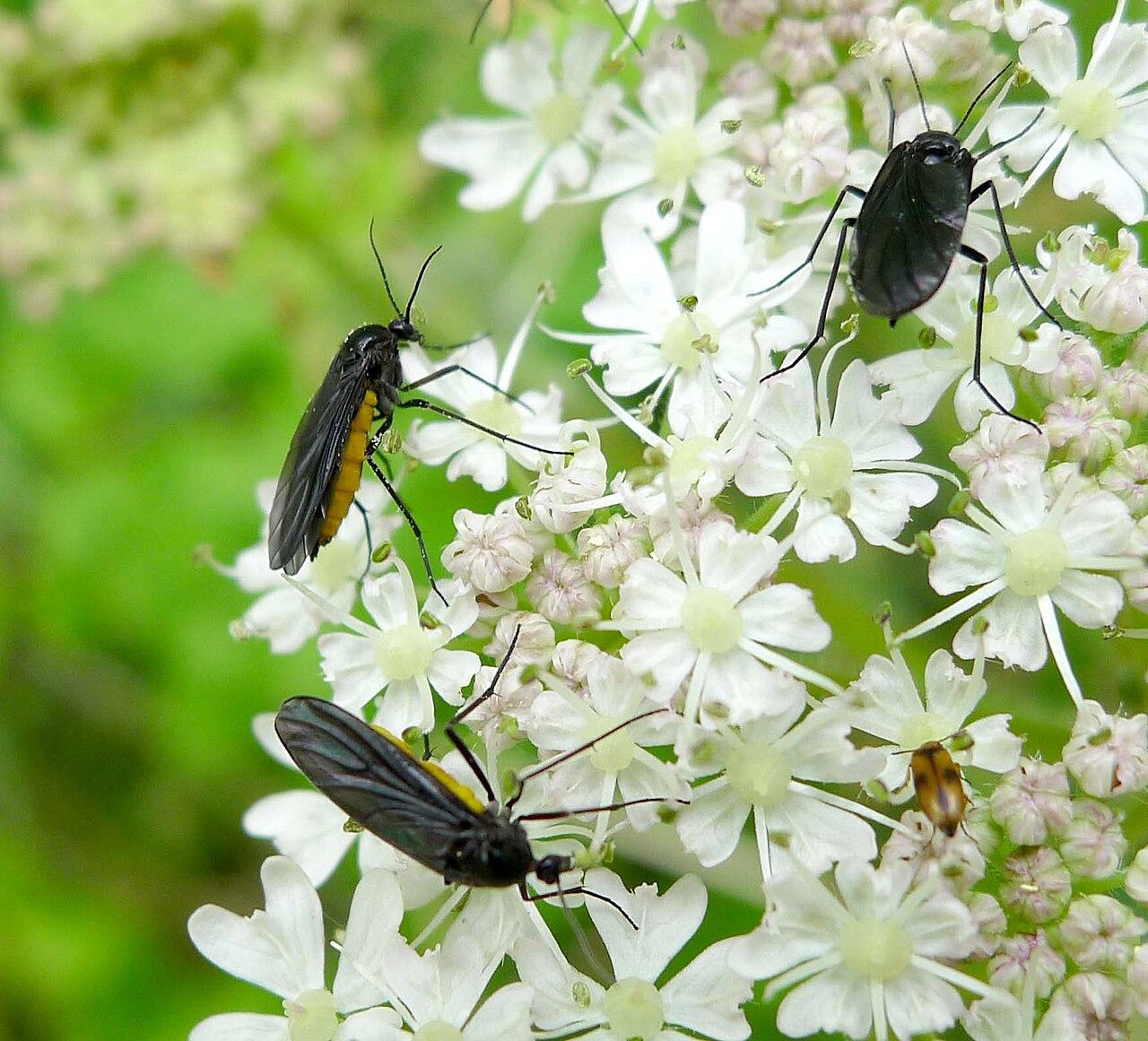
Photo: Sciaridae by gailhampshire from Cradley, Malvern, U.K · CC BY 2.0 · via Wikimedia Commons
01What they are and what they do
Fungus gnats are small dark flies, two to four millimetres long, from the families Sciaridae and Mycetophilidae. The adults are weak fliers that drift up when you disturb a pot and gather at windows.
The adults do not bite, do not feed on plants, and live only about a week. The larvae — translucent with a distinct black head, a few millimetres long — live in the top layer of the medium and eat fungi, algae and decaying organic matter.
In most infestations the damage to the plant is negligible. In heavy ones, or in pots of seedlings and fresh cuttings, larvae will also feed on fine root hairs, which shows as unexplained wilting and stunted growth in plants whose roots have no other problem.
02The life cycle, and where to break it
The whole cycle takes about three to four weeks at room temperature: eggs laid on damp medium hatch in four to six days, larvae feed for around two weeks, pupation takes three to seven days, and the adults live about a week — each female laying up to 200 eggs.
Every stage except the adult depends on damp medium in the top two to three centimetres. That is the single point of leverage.
It also means you have to keep treating for at least a month. Killing the adults you can see does nothing about the larvae already in the pot, which is why one round of anything never works.
03The fix, in order of importance
Do the first item regardless of what else you do. The rest accelerate the process.
- 1. Let the surface dry — Allow the top 3–4 cm to dry completely between waterings. This makes the medium uninhabitable for eggs and young larvae, and for most houseplants it is better practice anyway.
- 2. Bottom water — Water from below for a few weeks so the surface stays dry while the roots still drink. Highly effective in combination with the point above.
- 3. Yellow sticky traps — Place flat or just above the medium surface. They catch egg-laying adults and, just as usefully, tell you whether the population is falling.
- 4. A physical barrier — A 1–2 cm layer of coarse sand, fine grit or horticultural perlite on the surface stops adults reaching the medium to lay. It also dries fast, which reinforces step one.
- 5. BTI — Bacillus thuringiensis israelensis, sold as mosquito bits or dunks, kills larvae specifically and is harmless to plants, pets and people. Steep in water and use it for watering for three to four weeks.
- 6. Beneficial nematodes — Steinernema feltiae, watered into the medium, parasitises the larvae. The most thorough biological option for a large collection, and more expensive.
04What not to bother with
Household fly spray kills adults you can see and nothing else, and it is unpleasant to use around plants you live with. The population rebuilds from larvae within days.
Cinnamon on the medium surface has mild antifungal properties and is often recommended. It does not reliably kill larvae, though it may slightly reduce their food supply.
Dish soap drenches and neat hydrogen peroxide can kill larvae but also damage roots, and neither is more effective than BTI, which is targeted and harmless to the plant.
Repotting alone rarely solves it. Larvae come along in the root ball, and fresh bagged compost frequently contains eggs already.
| Week | Action |
|---|---|
| 1 | Sticky traps out; switch to bottom watering; add a grit layer; first BTI drench |
| 2 | Second BTI drench; keep surface dry; check trap counts |
| 3 | Third BTI drench; counts should be clearly falling |
| 4 | Final drench; keep traps up two more weeks to confirm |
05Preventing the next outbreak
Check new plants before they join the collection. Tap the pot over a sheet of paper and watch for anything that flies or crawls out, and quarantine for two weeks.
Store bagged compost sealed and dry. An open bag in a damp shed becomes a breeding site, and you then inoculate every plant you repot.
Remove fallen leaves and dead material from the medium surface — that decaying matter is exactly what the larvae eat.
Use a chunkier mix. Media with more perlite, bark and grit dry faster at the surface and are much less attractive to gnats than fine peat-based compost.
Frequently asked questions
- Will fungus gnats kill my plant?
- Very unlikely for an established plant. Seedlings, fresh cuttings and small-rooted plants are genuinely at risk from heavy larval feeding, so treat those promptly.
- Are they the same as fruit flies?
- No. Fruit flies are rounder, tan-coloured with red eyes, and hover around fruit and drains. Fungus gnats are slender, dark, mosquito-like, and stay near pots.
- I have gnats in every pot. Do I treat all of them?
- Yes, simultaneously. Adults move freely between pots, so treating one at a time just relocates the population.
Marcus Hale
Contributor — soil & propagation
Marcus spent six years in a wholesale nursery mixing media by the cubic metre before moving to container growing at home. He covers potting mixes, repotting and the unglamorous half of plant care.
Keep reading
Spider Mites vs Mealybugs: Identify It Before You Spray
These are the two pests you are most likely to meet indoors, and the treatments barely overlap. Getting the identification right saves weeks of the wrong approach.
Root Rot: Catching It Early and Saving the Plant
By the time the leaves tell you, the roots have been failing for weeks. Here is what to look for earlier, and the surgery that saves a plant that still has firm tissue somewhere.
Four Potting Mixes That Cover Almost Every Houseplant
Bagged compost is designed for garden beds and outdoor containers, not for a pot indoors. Four ingredients and four ratios will serve everything on your shelf better.