Rubber Plant vs Fiddle Leaf Fig: Which Statement Tree to Buy
Both are Ficus, both grow into indoor trees, and both are sold as the centrepiece for a corner. One of them is considerably easier than the other, and it is not the fashionable one.
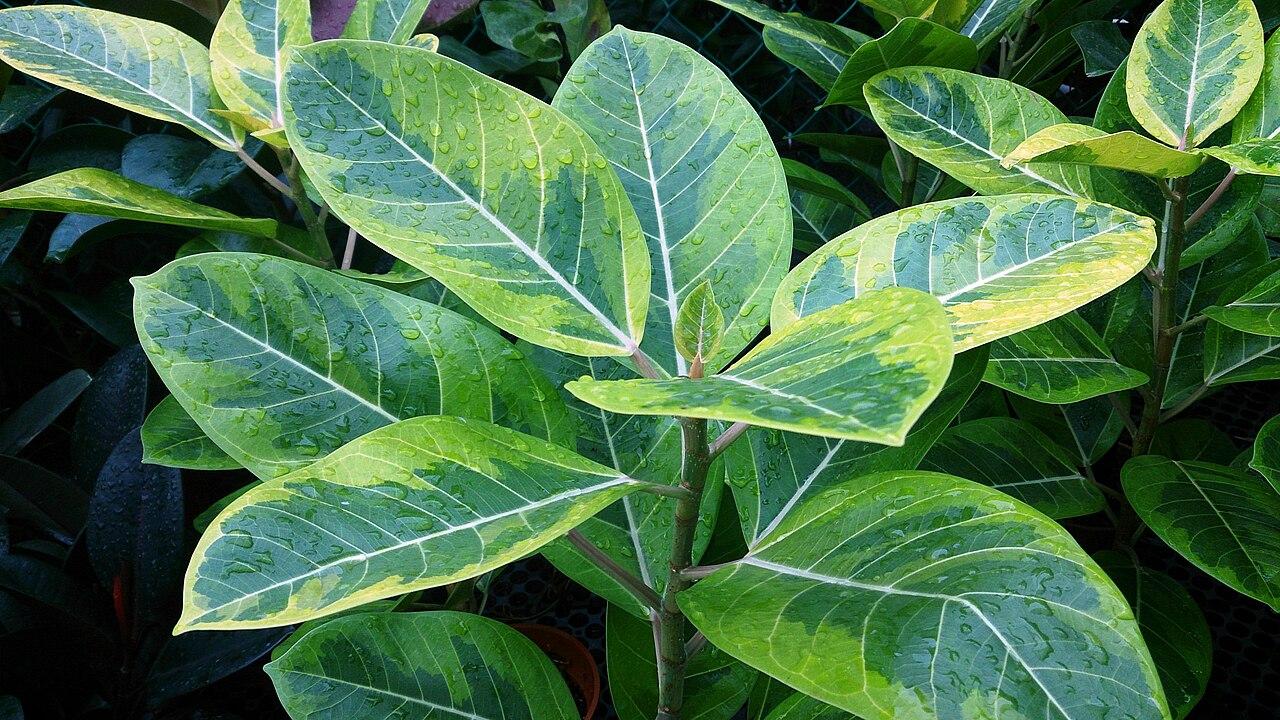
Photo: Rubber plant by Mokkie · CC BY-SA 4.0 · via Wikimedia Commons
01Two members of the same genus, one much easier
Ficus elastica and Ficus lyrata are close relatives that occupy the same role in a room: a single-stemmed tree with large glossy leaves, two metres tall or more, filling a corner. They are usually bought for the same reason and priced similarly.
The fiddle leaf fig has been the fashionable choice for a decade, and it has a reputation for being temperamental. That reputation is partly deserved and partly a consequence of what people ask of it — usually a dim corner chosen for its appearance rather than its light.
The rubber plant has no such reputation, and the difference is genuine rather than a matter of familiarity. It tolerates a wider range of light, a wider range of watering, and relocation.
Both share the family traits: a milky latex sap that irritates skin and stains, large leaves that stay on the plant for years and therefore display every blemish permanently, and a tendency to drop leaves after any change in conditions.
02Light: where they genuinely differ
The fiddle leaf fig wants bright light and does not compromise. In its native West African forest it grows into a canopy tree, and the specimens sold as houseplants come from bright nursery conditions. It needs a position within about a metre of a large window with several hours of bright light, ideally including gentle morning sun. Below that it drops its lower leaves steadily, produces progressively smaller new ones, and develops long bare stretches of stem.
The rubber plant wants bright indirect light too, but it accepts medium light without falling apart. Growth slows, the leaves stay slightly smaller, and the burgundy cultivars lose some of their colour — but the plant remains a plant rather than a stick with three leaves at the top.
This single difference decides most purchases. If your intended corner is more than about two metres from a window, or the window faces north, the fiddle leaf fig will disappoint you within a year and the rubber plant will not.
Both bleach in unfiltered direct afternoon sun through glass, and both benefit from being rotated a quarter turn every week or two.
| Rubber plant (F. elastica) | Fiddle leaf fig (F. lyrata) | |
|---|---|---|
| Minimum usable light | Medium — tolerates 2–3 m from a window | Bright — needs to be within about 1 m |
| Watering tolerance | Forgiving of both directions | Narrow — punishes both extremes |
| Tolerance of being moved | Moderate | Poor — drops leaves at every relocation |
| Growth rate in good light | Fast | Moderate |
| Humidity needs | Undemanding | Prefers moderate; browns at the edges in dry air |
| Cold tolerance | Down to about 12°C | Down to about 15°C; more sensitive |
| Branching after pruning | Reliable | Reliable, but slower to respond |
| Leaf appearance | Thick, glossy, oval; burgundy and variegated forms | Very large, sculptural, violin-shaped |
03Watering, and the brown patches both produce
Both want the same rhythm: thoroughly wet, then allowed to dry down about halfway before the next watering. In practice that is every 7–10 days in summer and every two to three weeks in winter for a mid-sized plant in a bright room.
The difference is the width of the acceptable band. A rubber plant left dry for an extra fortnight sheds a couple of lower leaves and continues. A fiddle leaf fig in the same situation produces brown patches on several leaves that never heal.
Both produce brown patches for opposite reasons, which is why misdiagnosis is so common. Dark brown to black patches that start in the centre or base of a leaf, on the lower leaves first, and spread outward, are root rot from overwatering. Light tan, dry, crisp damage at the edges and tips is underwatering, dry air, or salt build-up.
The reliable check for either is the same, and it costs nothing: push a wooden skewer to the bottom of the pot and leave it a minute. Damp and darkened means wait; dry and clean means water. This is more useful than any moisture meter, and it settles the ambiguity that brown patches create.
04Pruning, shaping and keeping them from hitting the ceiling
Both are sold as single unbranched stems and will grow straight up indefinitely, shedding lower leaves as they go, until they reach the ceiling. Both branch readily when the growing tip is removed.
Cut the top off in spring or early summer, just above a leaf node. The plant responds by pushing two or three new shoots from the buds below the cut. It feels drastic and it is the correct move for both species. Take no more than a third of the height at once.
Notching is the gentler alternative for a plant you do not want to shorten: cut a shallow wedge about a third of the way into the stem just above a dormant node, which interrupts the hormone flow suppressing that bud and often triggers a branch without removing height.
Wear gloves and put something down. Cut ficus stems bleed white latex freely, it irritates skin, and it stains fabric and carpet permanently.
For a plant that has become a two-metre bare stem with a tuft at the top, air layering is the better answer than pruning: root the top while it is still attached, then cut it free as a new plant, and let the stump branch. Both species air-layer readily.
05The verdict
Buy the rubber plant unless you have a genuinely bright position and want the fiddle leaf fig specifically for its appearance. It is easier in every dimension that matters — light, water, relocation — and it grows faster, so it fills a corner sooner.
The burgundy cultivars of Ficus elastica ('Abidjan', 'Burgundy') and the variegated ones ('Tineke', 'Ruby') give it a visual range the fiddle leaf fig does not have, though the variegated forms need noticeably more light than the plain green ones, as always.
Buy the fiddle leaf fig if you have a large east or south-facing window with space beside it, and you want the sculptural leaf that nothing else provides. Choose the position before you buy, put the plant there, and then leave it alone — most fiddle leaf fig failures are a series of well-meaning relocations.
And if the corner you have in mind is dark, buy neither. Both will decline slowly, and a plant that tolerates low light genuinely — a ZZ, a cast iron plant, a plain green philodendron — will look better in that spot than a struggling ficus ever will.
Frequently asked questions
- Are both toxic to pets?
- Yes. The latex sap in all Ficus species causes mouth irritation, drooling and vomiting in cats and dogs, and skin irritation in people. Neither is a good choice for a household with a chewing animal.
- Which is better for a beginner?
- The rubber plant, clearly. It gives more margin for error in every direction, and it recovers from mistakes that a fiddle leaf fig records permanently.
- Will damaged leaves recover on either?
- No. Brown patches on both are permanent. Remove a leaf only if it is more than half damaged; otherwise leave it, since it still photosynthesises.
- My fiddle leaf fig has dropped half its leaves since I bought it. Should I do something?
- Almost certainly not. Put it in a bright permanent position, water consistently, and wait six to eight weeks for new growth. Repotting, feeding or moving it again at this point makes it worse.
Lan Nguyen
Balcony grower & founding editor
Lan has kept ornamental plants on a 12 m² apartment balcony for eight years, mostly tropical foliage and small-scale bonsai. She writes the care and comparison guides here, and has killed enough plants to be specific about how.
Keep reading
Succulents vs Cacti: Which One Actually Belongs Indoors?
They sit on the same shelf at the garden centre and get sold with the same care card, but succulents and cacti want noticeably different amounts of light. Picking wrong is why one of them is stretching.
Liquid vs Slow-Release Fertiliser: Which Suits Your Habits
One gives you control and demands attention. The other runs by itself and releases faster when the room gets warm. Choosing badly is how people end up with salt-burnt roots or a plant that has been unfed for a year.
Pothos vs Monstera: The Honest Comparison
Both are climbing aroids with glossy green leaves, and in a nursery pot they look like the same plant at different sizes. The difference shows up two years later, when one has taken over a corner of the room.