Liquid vs Slow-Release Fertiliser: Which Suits Your Habits
One gives you control and demands attention. The other runs by itself and releases faster when the room gets warm. Choosing badly is how people end up with salt-burnt roots or a plant that has been unfed for a year.
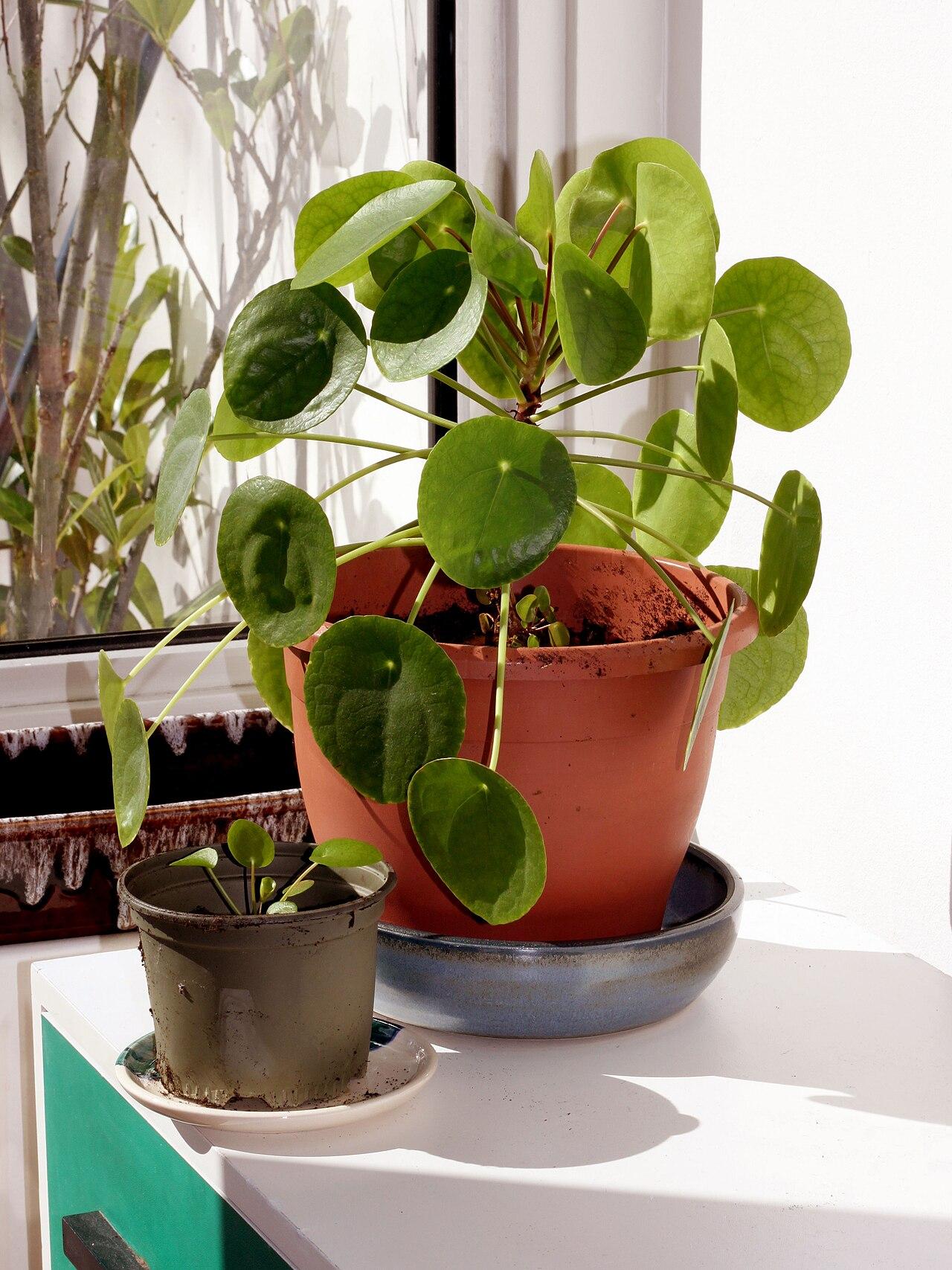
Photo: Pilea peperomioides by Husky · CC0 · via Wikimedia Commons
01How each one delivers
Liquid fertiliser is a soluble salt mixture diluted into water and applied at watering. It becomes available to the roots immediately, it is entirely used or leached within days, and the dose is whatever you mixed. It is the same principle as a hydroponic nutrient solution, just applied intermittently to a medium that already holds some nutrition.
Slow-release fertiliser — properly, controlled-release — is granules of soluble fertiliser encased in a semi-permeable resin coating. Water permeates the coating, dissolves the fertiliser inside, and the solution diffuses out gradually over months. The prills sit in or on the medium and feed continuously.
There is a third category worth separating: organic amendments such as worm castings, seaweed meal and bone meal, which release as soil organisms break them down. These are slow and gentle, and their release rate depends on biological activity rather than on a coating.
The choice between the first two is genuinely about your habits rather than about which is better for plants. Both grow excellent houseplants when used properly, and both cause problems when used carelessly — in different ways.
02The temperature effect nobody reads about
The one technical fact that changes how you use slow-release fertiliser is that diffusion through the resin coating is temperature-dependent. Warmth increases it substantially — a prill labelled for six months at 21°C may exhaust itself considerably faster at 27°C, and will release much more slowly in a cool room.
That is convenient outdoors, where release speeds up in exactly the warm conditions that make plants grow fastest. Indoors it is less well matched, because central heating keeps a room warm in December when the plants have almost no light and cannot use what is being released.
The practical consequence is a common and hard-to-diagnose problem: a plant fed with slow-release prills in autumn, sitting in a warm dim room all winter, accumulating nutrients it cannot use. The result is salt build-up, brown leaf tips, and sometimes root damage, on a plant nobody has fed since September.
So if you use slow-release indoors, apply it in spring at the start of the growing season, use the lower end of the label rate, and do not top it up in autumn.
03Comparing them honestly
Liquid feed wins on control. You decide the strength, you can stop instantly if a plant looks stressed, and you can correct a specific deficiency quickly — a magnesium shortage shows improvement within a fortnight of a suitable feed. It is also cheap, and one bottle covers a whole collection for a season.
Its weakness is that it depends entirely on you remembering, and on you being consistent. In practice most people feed enthusiastically in April and forget by July, which produces a growing season with a burst of nutrition at the start and nothing afterwards.
Slow-release wins on consistency. Applied once in spring, it feeds steadily for months with no further attention, and it is very difficult to burn a plant with it if you follow the rate — the coating prevents the concentration spike that overdosing liquid feed produces.
Its weaknesses are that you cannot take it back, you cannot easily adjust it, you cannot tell how much is left, and the temperature effect above makes indoor timing imprecise.
| Liquid feed | Slow-release prills | |
|---|---|---|
| Control | Complete — adjust or stop any time | None once applied |
| Effort | Every 2–4 weeks in the growing season | Once or twice a year |
| Speed of effect | Days | Weeks |
| Risk of overfeeding | Real if you misjudge the dilution | Low if you follow the rate |
| Risk of underfeeding | High — most people forget | Low |
| Temperature sensitivity | None | Releases faster when warm |
| Cost per plant | Very low | Moderate |
| Best for | Attentive owners; correcting problems | Large collections; people who forget |
04Using each one properly
For liquid feed, the single most useful adjustment is to halve the label rate and feed twice as often. Houseplant fertiliser labels are generally written for outdoor container plants in full sun, which grow several times faster than a monstera in a living room. Half strength every two weeks through spring and summer suits most foliage plants.
Feed only when the plant is actively growing, which in a temperate home means roughly March to September. Stop entirely in winter unless the plant is under a grow light and still producing leaves.
Never feed a dry pot. Water first, or dilute into the watering can and apply a full soak — concentrated fertiliser onto dry roots burns them. And never feed a freshly repotted plant: fresh compost contains several weeks' worth of nutrition, and cut roots are easily damaged.
For slow-release, apply in spring, at or slightly below the label rate, and either mix it through the medium at repotting or scatter it on the surface. Surface application is easier to remove if you change your mind. Note the date somewhere, because the one thing you cannot do is check how much is left.
With either method, flush the pot two or three times a year: water slowly with three or four pot-volumes of plain water, letting it drain away each time. This carries out accumulated salts and prevents the majority of feeding-related problems.
- Reading the NPK ratio — The three numbers are nitrogen, phosphorus and potassium. A balanced feed such as 10-10-10 or 20-20-20 suits foliage plants; higher potassium suits flowering plants; higher nitrogen produces leafy growth and, in poor light, floppy growth.
- Micronutrients matter — Check the label includes magnesium, calcium and trace elements. This is particularly important in coir-based and inert media, which supply none of their own.
- Signs of overfeeding — White crust on the surface or rim, brown crisp leaf tips, wilting despite damp medium, and slowed growth. Flush thoroughly and stop feeding for two months.
- Signs of underfeeding — Uniformly pale new growth, smaller new leaves, and lower leaves yellowing evenly. Confirm light is adequate first, since low light produces the same appearance.
05The verdict
For most people with a small to medium collection, liquid feed at half strength every two weeks from spring to early autumn is the better choice. It is cheap, it gives you a lever to pull when something looks wrong, and the fortnightly rhythm is easy to attach to an existing watering routine.
Choose slow-release if you have a large collection, if you travel, or if you know from experience that you will not remember. Consistency beats precision, and a plant fed adequately all season by prills does better than one fed perfectly in April and forgotten until October.
A combined approach works well and is what many experienced growers do: slow-release applied at repotting in spring to provide a baseline, plus liquid feed at half strength during periods of strong growth, and nothing at all through winter.
And the most useful thing to remember is that feeding is a smaller lever than light or water. A plant in the right position, watered properly in a decent medium, will be healthy on very modest feeding. No fertiliser regime rescues a plant in a dark corner.
Frequently asked questions
- Can I use garden fertiliser on houseplants?
- Usually yes, at a much reduced rate — typically a quarter to a half of the label dose. Avoid high-nitrogen lawn feeds, which produce soft floppy growth indoors.
- Do houseplants need feeding at all?
- After the first few months in fresh medium, yes, if you want them to keep growing. A plant in the same compost for two years with no feed will slow, pale and produce smaller leaves.
- Are organic fertilisers better indoors?
- Not necessarily. They release slowly and gently, which is good, but several — bone meal, fish emulsion, manure-based products — smell strongly and attract pets and flies indoors. Worm castings are the most practical indoor organic option.
- What about fertiliser spikes?
- They are convenient but deliver nutrition in a concentrated zone rather than through the pot, which can burn nearby roots while leaving the rest of the root ball unfed. Liquid feed or prills distribute far better.
Marcus Hale
Contributor — soil & propagation
Marcus spent six years in a wholesale nursery mixing media by the cubic metre before moving to container growing at home. He covers potting mixes, repotting and the unglamorous half of plant care.
Keep reading
Bottom Watering vs Top Watering: Which, and When
Bottom watering has become the default recommendation online, and it does solve real problems. It also creates one that nobody mentions, and the fix is to stop doing it occasionally.
Succulents vs Cacti: Which One Actually Belongs Indoors?
They sit on the same shelf at the garden centre and get sold with the same care card, but succulents and cacti want noticeably different amounts of light. Picking wrong is why one of them is stretching.
Pothos vs Monstera: The Honest Comparison
Both are climbing aroids with glossy green leaves, and in a nursery pot they look like the same plant at different sizes. The difference shows up two years later, when one has taken over a corner of the room.