Powdery Mildew and Leaf Spots: What Is Fungal and What Only Looks It
Fungal problems on houseplants are less common than people assume and more preventable than they expect. Almost all of it comes down to still air, wet leaves and a plant kept in the dark.
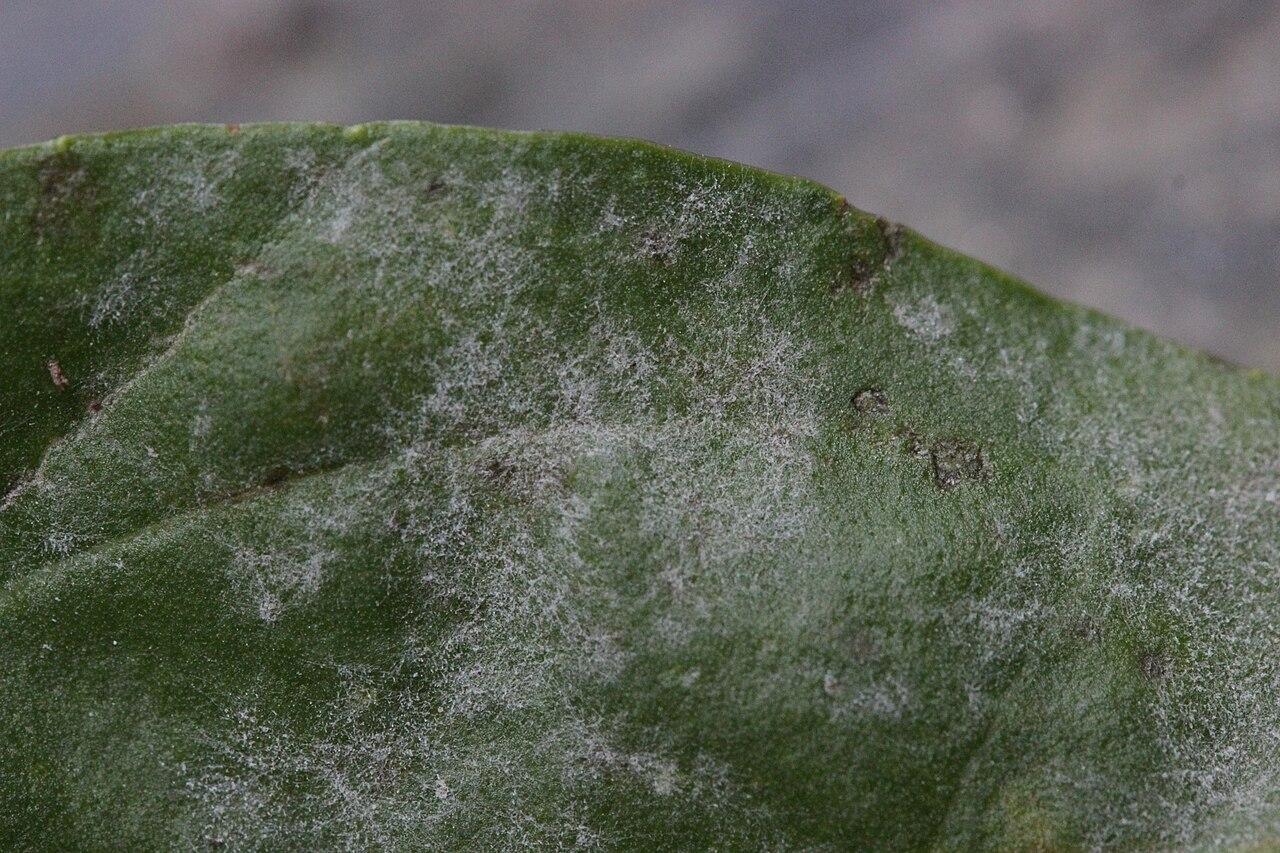
Photo: Powdery mildew by Björn S... · CC BY-SA 2.0 · via Wikimedia Commons
01Fungal problems are rarer indoors than you think
Outdoors, fungal disease is the dominant plant health problem. Indoors it is not, and the reason is that fungi need free water on the leaf surface for spores to germinate, and most indoor plants never get wet leaves.
That single fact does a lot of diagnostic work. If a plant is watered at the medium, is not misted, and stands in a room with some air movement, a brown patch on a leaf is very unlikely to be fungal — and treating it with a fungicide will achieve nothing while the real cause continues.
The exception, and the reason this article exists, is powdery mildew. It is the one common pathogen that germinates without free water, needing only humid air. It is why a plant can develop mildew in a still, humid, shaded corner while every leaf stays dry.
The practical conclusion is that indoor fungal management is almost entirely environmental. Move air, keep foliage dry, give plants enough light and enough space, and you will rarely need to treat anything.
02Powdery mildew
It is unmistakable once seen: circular white or greyish patches on the upper leaf surface that look exactly like dusted talcum powder and spread until they merge. Rub it and it smears rather than washing off, which distinguishes it from the water-mineral deposits people sometimes confuse it with.
The conditions it wants are specific and worth memorising, because they are the opposite of what most people assume about fungus: warm days, cool nights, humid air, still conditions, moderate shade, and dry leaves. High humidity with poor air movement is the combination.
Among houseplants it is most common on begonias, African violets, kalanchoe, poinsettia, jade, rosemary and anything crowded on a shelf in a humid room. It rarely kills a plant outright, but it blocks light, distorts new growth and looks terrible.
Treatment starts with the environment. Increase air movement with a small fan on a low setting, space the plants further apart, move the plant somewhere brighter, and lower the humidity in that spot. Remove and bin the worst-affected leaves rather than composting them.
For an active outbreak, a potassium bicarbonate spray is effective and gentle; a sulphur or horticultural oil spray also works, though not within two weeks of each other. The traditional milk-and-water spray at about one part milk to nine parts water has real evidence behind it for mildew specifically, and is worth trying on a small plant before buying anything.
03The leaf spots that are actually fungal
Several distinct pathogens produce spotting, and they can usually be separated by looking closely at the edge and the centre of the spot.
- Fungal leaf spot (Cercospora, Colletotrichum and others) — Round to irregular brown or black spots, often with a yellow halo and a distinct margin, sometimes with tiny dark dots — the fruiting bodies — in the centre. Spreads to new leaves where water sits. Remove affected leaves; keep foliage dry.
- Bacterial leaf spot — Similar but wetter-looking: dark, greasy or water-soaked patches that spread irregularly, often following the veins, sometimes with a foul smell. Spreads fast in warm wet conditions. Remove affected leaves immediately and isolate; fungicides do not work on bacteria.
- Botrytis (grey mould) — Fuzzy grey-brown growth on flowers, dying leaves and any damaged tissue, in cool damp still conditions. Remove dead material promptly — it establishes on dead tissue first and moves into healthy tissue afterwards.
- Downy mildew — Angular yellow patches on the upper surface with greyish fuzz beneath, confined between the veins. Much less common indoors than powdery mildew, and needs genuinely wet leaves.
- Rust — Raised orange, brown or yellow pustules on the leaf underside. Uncommon indoors except on pelargoniums and a few others. Remove affected leaves and improve air movement.
04The spots that are not fungal at all
This is the more useful half of the article, because most spotting on houseplants is physiological or cultural and treating it with a fungicide accomplishes nothing.
The distinguishing question is whether the problem spreads. A fungal or bacterial spot spreads: to other parts of the same leaf, to other leaves, and to neighbouring plants. Damage from watering, cold, sun or salts appears, stops, and stays exactly as it is.
| What it looks like | Where | Cause |
|---|---|---|
| Dark brown or black patches spreading from the centre or base | Lower leaves first | Root rot from overwatering — check the roots, not the leaf |
| Crisp light brown edges and tips with a yellow band | Margins | Underwatering, salts, or dry air |
| Pale bleached patches, sharply defined | The side facing the window | Sunburn — does not spread |
| Blackened, collapsed, water-soaked patches after a cold night | Leaves nearest the glass | Chill damage |
| Small corky bumps or blisters on the underside | Undersides, often on succulents | Oedema — cells burst from rapid water uptake; harmless |
| Pale rings and blotches | Where droplets sat | Cold water on the leaves, common on African violets |
| Fine pale stippling, dull leaf surface | Undersides, both surfaces later | Spider mites — a pest, not a disease |
05Prevention, which is nearly all of the work
Water at the medium and not over the plant. This single habit removes the free water that most fungal spores need, and it is the most effective preventative available. If you have plants that must be watered from above, do it in the morning so anything splashed dries within hours.
Do not mist. Misting is ineffective as humidity management and it puts water precisely where pathogens need it, particularly on plants with dense crowns, fuzzy leaves or tightly packed rosettes.
Give plants space and air. Crowding creates still humid pockets between the leaves, which is the microclimate that mildew and botrytis exploit. A little space between pots, and a fan in a densely planted room, changes that microclimate at no cost.
Remove dead material promptly. Botrytis in particular establishes on dead flowers and yellowing leaves before moving into living tissue, so tidying is genuinely preventative rather than merely cosmetic.
Use clean tools and clean pots. Wipe blades with alcohol between plants, and wash and dry reused pots — a surprising proportion of leaf spot outbreaks in a collection come from a contaminated pair of scissors.
Finally, get the light right. Almost every fungal problem on houseplants occurs in a shaded, still, humid corner. A plant in appropriate light with air moving around it is a plant that rarely needs a fungicide.
Frequently asked questions
- Can I use a garden fungicide on a houseplant?
- Check the label for indoor use and for plant compatibility, and test on a couple of leaves first. Many are not intended for enclosed spaces, and ferns, palms and succulents are sensitive to several of them.
- Does cinnamon work as a fungicide?
- It has mild antifungal properties and is genuinely useful dusted on a fresh cut or a rot wound to keep it clean. It will not clear an established mildew or leaf spot infection.
- Should I remove every affected leaf?
- Remove leaves that are more than about half damaged, and any leaf on a spreading infection. Leaves with a small stable patch are still photosynthesising and are better left on the plant.
- My plant got mildew after I bought a humidifier. Is that connected?
- Very likely. Raising humidity without also increasing air movement creates exactly the conditions powdery mildew needs. Keep the humidifier and add a fan.
Lan Nguyen
Balcony grower & founding editor
Lan has kept ornamental plants on a 12 m² apartment balcony for eight years, mostly tropical foliage and small-scale bonsai. She writes the care and comparison guides here, and has killed enough plants to be specific about how.
Keep reading
Scale and Thrips: The Two Pests That Get Found Too Late
Mites and mealybugs are visible and vulnerable. These two are neither — scale sits under a waterproof cover and thrips spend half their life inside the leaf and in the pot. Both need a different approach from a bottle of soap.
When It Isn't a Pest: Sunburn, Oedema, Chill and Salt Damage
A large share of the damage people spray for was never caused by anything living. These marks have a cause, a diagnosis and a fix — and none of them involve a bottle.
Spider Mites vs Mealybugs: Identify It Before You Spray
These are the two pests you are most likely to meet indoors, and the treatments barely overlap. Getting the identification right saves weeks of the wrong approach.