When It Isn't a Pest: Sunburn, Oedema, Chill and Salt Damage
A large share of the damage people spray for was never caused by anything living. These marks have a cause, a diagnosis and a fix — and none of them involve a bottle.
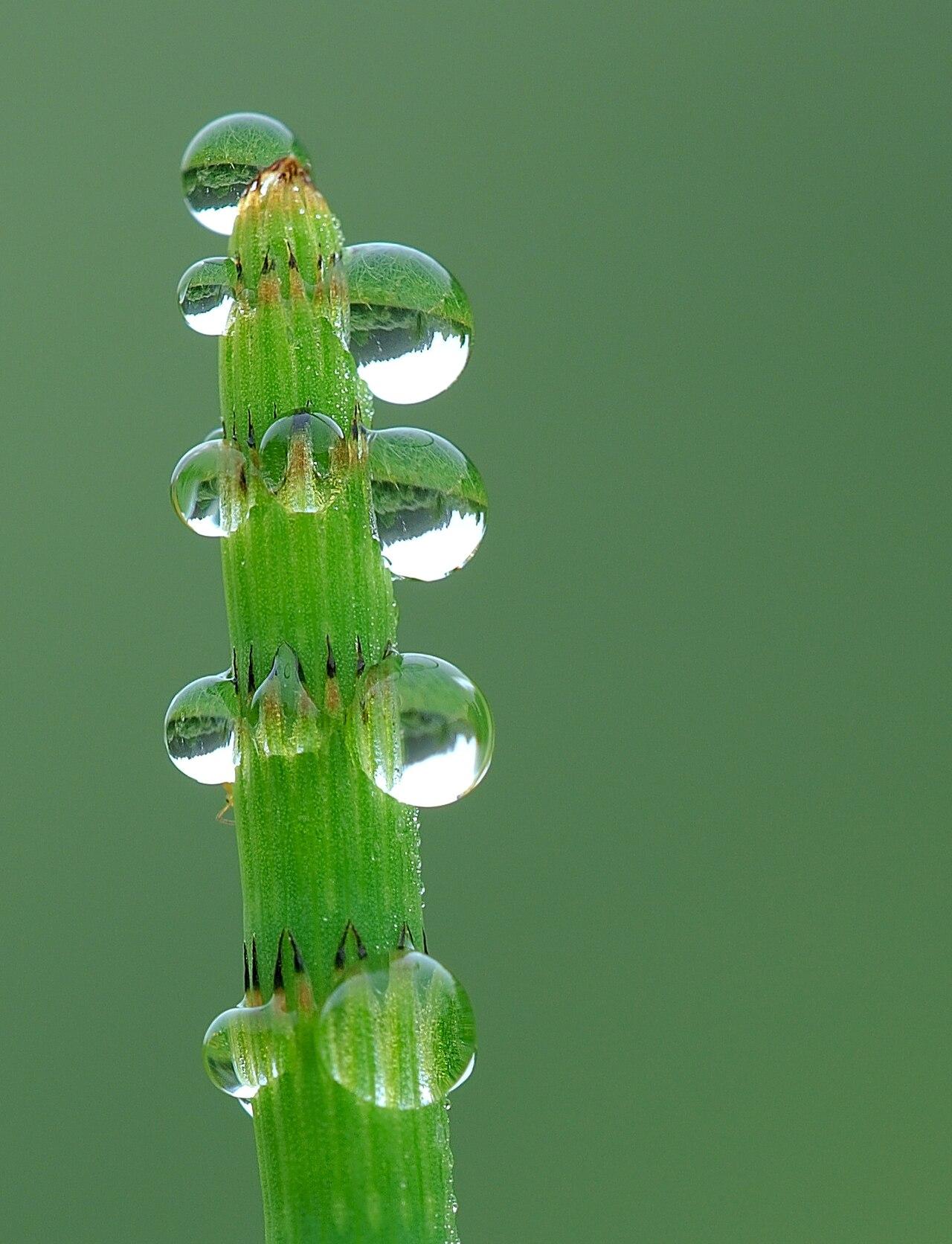
Photo: Guttation by Luc Viatour · CC BY-SA 3.0 · via Wikimedia Commons
01Ask whether it is spreading
Before identifying any specific mark, establish whether you are looking at something ongoing or something finished. This one question separates most of the diagnostic space and it takes a week rather than a lens.
Pests and pathogens spread. New leaves develop the same problem, marks enlarge, and neighbouring plants eventually show it too. Physiological damage does not: it appears in response to an event or a condition, it stops when the condition ends, and the mark then stays exactly as it is because leaf tissue does not heal.
So mark a couple of affected leaves — a small dot of nail varnish on the stem, or a photograph with a date — and look again a week later. Unchanged marks with clean new growth means whatever caused it has passed, and there is nothing to treat.
The second question is which leaves are affected. Oldest leaves first points at the roots, at water, or at nutrition. Newest leaves first points at light, at feeding, or at sap-sucking pests on the growing tip. One side of the plant only points at something in the room — a window, a radiator, a draught.
02Sunburn and light stress
Sunburn produces bleached, pale, papery patches with a sharply defined edge, on the surfaces facing the light source. On thick-leaved plants such as succulents and cacti the patch is often whitish and slightly sunken; on thin-leaved foliage plants it goes straight to dry brown.
The characteristic that identifies it is position. Damage on the window side and nothing on the far side is sunburn, not disease — no pathogen respects the geometry of a room that precisely.
It is almost always caused by a change rather than by strong light itself. A plant that has been growing indoors has leaves acclimated to indoor light, and moving it outdoors in summer, or to a south window in spring, exceeds what those leaves can handle within a day or two. The same plant would be perfectly happy in the same position if it had been moved there gradually over a fortnight.
There is no treatment. Move the plant back or shade it, acclimate properly next time, and leave the damaged leaves in place unless they are more than half gone — they still photosynthesise.
Light stress has a milder cousin worth recognising: reddening or bronzing of the leaves in strong light, which is anthocyanin acting as a sunscreen. That is a healthy response, and on succulents it is actively desirable.
03Oedema, guttation and the marks that alarm people needlessly
Two harmless phenomena account for a surprising number of worried questions, and both are worth recognising precisely because they look like something is wrong.
Oedema appears as small raised corky bumps, blisters or brown warty patches, usually on the undersides of leaves and on petioles. It happens when roots take up water faster than the leaves can transpire it away — typically after generous watering in cool, humid, dim conditions — and individual cells burst and then scar over. It is common on succulents, peperomias, pelargoniums and ficus.
It is entirely harmless and it is not contagious, but it is permanent on affected leaves. The fix is environmental: water less in cool dim weather, increase air movement and light, and water in the morning rather than the evening.
Guttation is the beads of liquid that appear along leaf edges or at leaf tips overnight, most familiar on monstera, pothos and calathea. It is the plant expelling excess water through specialised pores under root pressure. Harmless, though it usually indicates the medium is wetter than the plant needs, and the dried residue can leave small white mineral spots.
Neither should be sprayed for. Both are the plant managing water, and both are signals to adjust watering rather than to intervene.
04Cold, salts and mechanical damage
The remaining physiological problems are each caused by something identifiable in the room, and each has a distinctive signature.
- Chill damage — Blackened, water-soaked, collapsed patches appearing suddenly after a cold night, on the leaves nearest the glass or the door. Tropical foliage plants are damaged well above freezing — often below about 10°C. Move the plant, and expect the affected leaves to be lost.
- Salt burn — Crisp brown leaf tips and margins with a narrow yellow band, on plant after plant, often with a white crust on the surface of the medium or around the pot rim. Caused by accumulated fertiliser and hard-water minerals. Flush the pot with several pot-volumes of plain water and reduce feeding.
- Transplant shock — Wilting, leaf drop and a stalled plant in the fortnight after repotting or division. Normal. Keep it out of direct light, water once thoroughly, do not feed, and wait — intervening makes it worse.
- Mechanical damage — Tears, creases and holes with brown dried edges, in positions that correspond to a doorway, a pet or a passing sleeve. Distinguishable from insect damage because the edges are irregular and there is no frass, webbing or insect anywhere.
- Cold-water spotting — Pale rings and blotches where droplets sat, classically on African violets and other fuzzy-leaved plants. Use tepid water and water at the base.
- Natural senescence — One lower leaf at a time going evenly yellow and then dropping, with healthy growth above. This is a plant retiring old foliage and needs nothing at all.
05A short diagnostic sequence
When something looks wrong, working through in a fixed order is faster than guessing, and it prevents the common error of treating for pests first.
Start with the roots. Slide the plant out of the pot and look. Firm, pale, springy roots that smell of nothing are healthy; brown, soft, smelly roots that slough off between your fingers are rot. This one check resolves a large share of all houseplant problems, and it takes a minute.
Then check the medium and the position. Is the pot draining? Is it standing in water? Is it above a radiator, against cold glass, in a draught? Has anything changed in the last month — a move, a repot, the heating going on, a change of season?
Then look for the pest, properly: leaf undersides, axils, growing tips and the top of the medium, with a hand lens. Look for the insects themselves and for their evidence — webbing, honeydew, cast skins, black frass specks.
Only then consider treating. In practice, working in this order means most problems are solved by moving a plant or changing how it is watered, and the bottle stays on the shelf.
| What you see | Look at | Usual answer |
|---|---|---|
| Yellowing lower leaves, damp medium | Roots | Overwatering or rot |
| Crisp brown tips on many plants at once | Feeding and water quality | Salts, or hard or fluoridated water |
| Bleached patch on one side | Position relative to the window | Sunburn after a move |
| Blackened collapsed leaves overnight | Nearest window or door | Chill damage |
| Corky bumps underneath | Watering routine and air movement | Oedema — harmless |
| Fine stippling, dull surface, webbing | Leaf undersides with a lens | Spider mites — a real pest |
| Sticky leaves | Undersides and axils | Scale, mealybug, aphid or whitefly |
| Spreading spots with yellow halos | Whether it spreads | Fungal or bacterial leaf spot |
Frequently asked questions
- Should I remove damaged leaves?
- Only those more than about half destroyed, or those carrying a spreading infection. A leaf with a stable brown patch still earns its keep, and removing several at once weakens the plant.
- My plant looked fine and then went downhill after I repotted it. Is it dying?
- Usually transplant shock. Keep it out of direct sun, water once, do not feed, and give it two to three weeks. Repotting into too large a pot, or watering it heavily afterwards, is what turns shock into rot.
- Can a plant recover from cold damage?
- The plant can; the damaged leaves cannot. If the stems and roots are still firm, move it somewhere warmer, water sparingly until it is growing again, and remove leaves as they die off.
- How do I tell oedema from scale insects?
- Oedema bumps are part of the leaf — the same tissue, raised — and cannot be scraped off without tearing it. Scale sits on the surface and lifts away with a fingernail.
Lan Nguyen
Balcony grower & founding editor
Lan has kept ornamental plants on a 12 m² apartment balcony for eight years, mostly tropical foliage and small-scale bonsai. She writes the care and comparison guides here, and has killed enough plants to be specific about how.
Keep reading
Root Rot: Catching It Early and Saving the Plant
By the time the leaves tell you, the roots have been failing for weeks. Here is what to look for earlier, and the surgery that saves a plant that still has firm tissue somewhere.
Scale and Thrips: The Two Pests That Get Found Too Late
Mites and mealybugs are visible and vulnerable. These two are neither — scale sits under a waterproof cover and thrips spend half their life inside the leaf and in the pot. Both need a different approach from a bottle of soap.
Spider Mites vs Mealybugs: Identify It Before You Spray
These are the two pests you are most likely to meet indoors, and the treatments barely overlap. Getting the identification right saves weeks of the wrong approach.