Pothos: The One Plant Worth Owning Several Of
Epipremnum aureum is the plant people learn on and then quietly keep buying. Here is what separates the cultivars, why yours has lost its variegation, and how to make one look like a plant rather than a curtain of string.
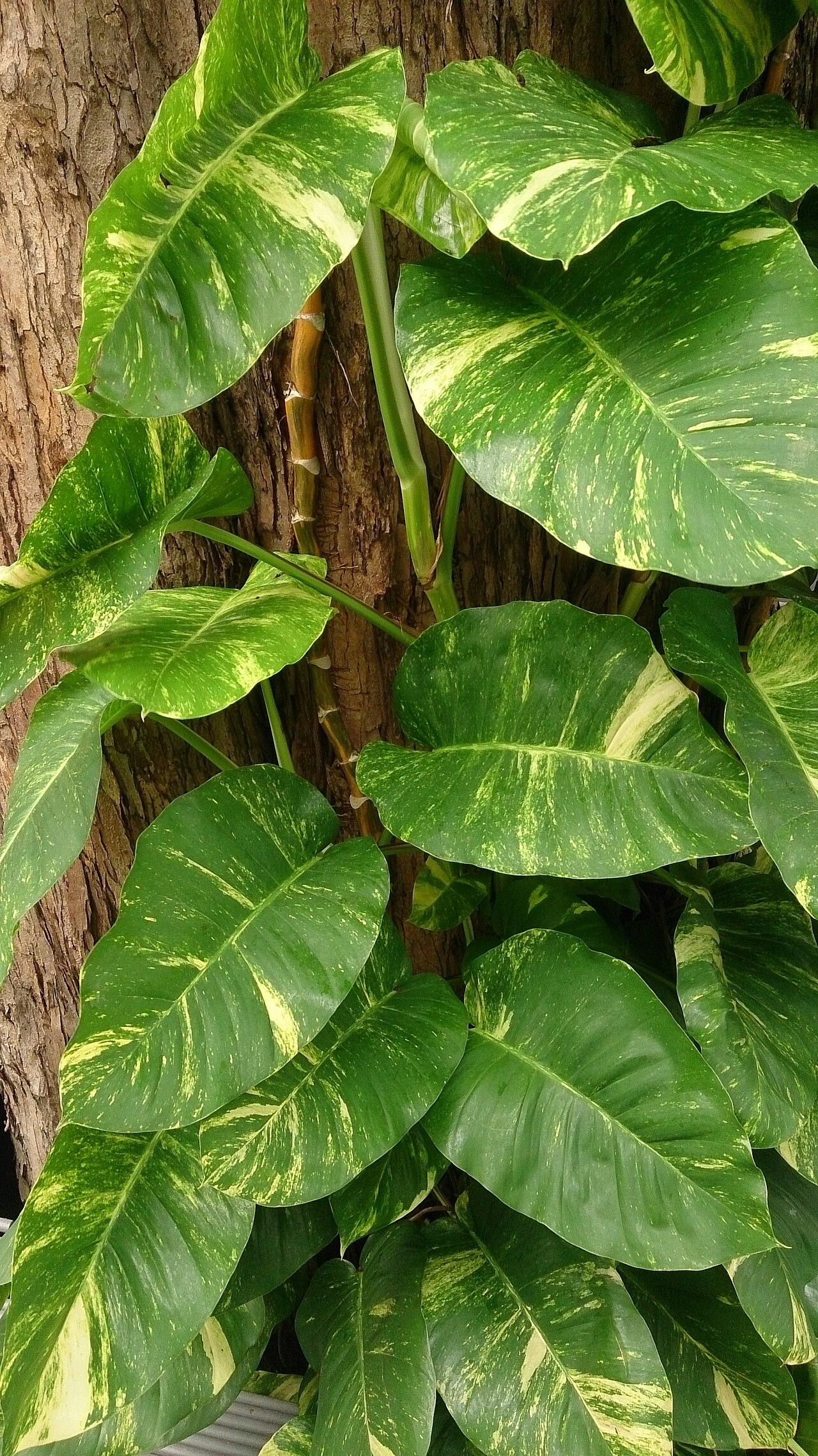
Photo: Epipremnum aureum by Mokkie · CC BY-SA 3.0 · via Wikimedia Commons
01What pothos actually is
Epipremnum aureum is a climbing aroid from the Society Islands, naturalised across the tropics to the point of being invasive in several of them. In the wild it climbs tree trunks, and its leaves change character dramatically as it goes: the familiar palm-sized heart is the juvenile form, and a mature plant on a tree carries leaves half a metre long, deeply lobed, closer to a monstera than to anything sold in a shop.
That matters indoors for one reason. A pothos in a hanging pot is permanently juvenile, because nothing about a dangling stem tells it to mature. Give it a damp pole to climb and the leaves get progressively larger — not to wild size, but noticeably, and the plant looks like a different species within two years.
It also explains the plant's famous tolerance. A vine that starts in deep forest shade and climbs toward light has to survive years of near-darkness on the way up. Indoors that translates into a plant that copes with conditions almost nothing else does.
02Telling pothos from philodendron
These two are stocked side by side, both sold as trailing heart-leaved vines, and the labels are wrong often enough that it is worth being able to tell them apart yourself.
The quickest test is the new leaf. A philodendron produces each new leaf inside a cataphyll — a papery sheath that unwraps and then dries to a brown wisp that hangs on the stem. Pothos has no cataphyll; the new leaf simply unfurls out of the previous petiole.
Then look at the petiole itself. On pothos it is grooved along its length, as if a channel had been pressed into it. On a heartleaf philodendron it is round in cross-section. Finally, pothos leaves are thicker, waxier and slightly asymmetric, while philodendron leaves are thinner, more matte and perfectly heart-shaped.
Care overlaps heavily, so a mix-up is rarely fatal. The practical differences are that philodendron tolerates lower light a little better and dry air noticeably better, while pothos handles missed waterings better.
03The cultivars, and what each one costs you in light
Every white or yellow section of a pothos leaf is tissue without chlorophyll. It contributes nothing to photosynthesis while still needing water and structure, so a heavily variegated cultivar is running the same plant on less engine. This is the single most useful thing to understand when choosing one.
The consequence is counterintuitive but consistent: the more variegated the cultivar, the brighter the position it needs, and the slower it will grow even there. A Marble Queen in the corner where a Jade thrives will either revert to green or sit still for a year.
| Cultivar | Look | Light needed | Growth rate |
|---|---|---|---|
| 'Jade' | Plain deep green | Low to bright indirect | Fast — the toughest of the group |
| 'Golden' | Green with yellow marbling | Medium to bright indirect | Fast |
| 'Marble Queen' | Heavy cream and green marbling | Bright indirect, essential | Slow |
| 'Neon' | Uniform chartreuse | Medium to bright; dulls in shade | Fast |
| 'N'Joy' / 'Pearls and Jade' | Crisp white blocks and speckling | Bright indirect | Slow, compact |
| 'Cebu Blue' | Narrow silver-blue lance leaves | Bright indirect | Fast; fenestrates when climbing |
| 'Manjula' | Wavy leaves, swirled cream | Bright indirect | Slow |
04Water, light and the rest of the routine
Water when the top 3–4 cm are dry, which in a bright warm room means roughly every 7–10 days, and every 2–3 weeks in winter or in a dim corner. Pothos wilts visibly and recovers completely, so it forgives a late watering far better than an early one.
It tolerates anything from a shaded corner to a metre back from a bright window. What it will not take is unfiltered direct sun, which bleaches the leaves within days. Low light will not kill it, but it will produce the long bare vines people dislike.
Feed at half strength monthly through spring and summer, and not at all in winter. Ordinary peat-free potting compost loosened with a couple of handfuls of perlite is sufficient — this is not a plant that needs a specialist mix, though it appreciates a chunkier one in a large pot.
Repot every two to three years. Pothos is untroubled by being slightly pot-bound and grows perfectly well in a pot most people would call too small.
- Yellow leaves, one at a time, from the base — Normal ageing if occasional. If several at once and the medium is damp, it is overwatering — check the roots.
- Brown crisp edges — Underwatering or salt build-up. Flush the pot through with plain water if you have been feeding regularly.
- Black stem at soil level — Stem rot, and the plant is unlikely to recover as a whole. Take healthy cuttings from further up the vine immediately and start again.
- Small leaves with long gaps between them — Too little light. Moving it is the fix; pruning alone will just reproduce the same growth.
05Making one look full instead of straggly
A neglected pothos becomes a few very long vines with the leaves concentrated at the far end and nothing near the pot. It looks thin because the plant is only growing at its tips, and nothing is triggering the buds further back.
Cutting fixes this. Prune a straggly vine back to within 10–15 cm of the pot, cutting just above a node, and the dormant buds behind the cut activate — usually two new shoots where there was one. Do it in spring or early summer, take no more than a third of the plant at once, and put the plant somewhere brighter at the same time or you will get the same thin growth back.
The other trick is density from the start. Root four or five cuttings into one pot rather than one, and it fills out in a season. Nurseries do exactly this, which is why a bought pothos looks fuller than one grown from a single cutting.
For larger leaves rather than longer vines, train it upwards. A damp moss pole works the same way it does for a monstera: aerial roots grip, the plant reads it as climbing, and leaf size steps up.
06Propagation, which is close to automatic
Cut a length of vine with at least one node — the small brown bump on the stem opposite each leaf, where an aerial root is starting. A leaf without a node roots nothing.
Cut about 1 cm below the node, remove the lowest leaf, and put the cutting in water, in damp sphagnum, or straight into potting mix. Roots appear in one to two weeks in water and slightly slower in soil. Pot up once they are 3–5 cm long, before they get long enough to be brittle.
Cuttings taken from an established vine root fastest when they include two or three nodes. A single-node cutting works but takes longer and produces a weaker plant for the first few months.
Water-rooted pothos can be left permanently in water and will live for years, though it will slowly starve without a dilute nutrient solution and never grows as well as one in a pot.
Frequently asked questions
- Why does my pothos have small leaves compared to the one I bought?
- Light, and lack of support. Nursery plants are grown in bright greenhouses, often up a pole. In an average room, on a trailing stem, leaf size drops. Brighter light and something to climb both help.
- Can pothos live in a windowless room?
- Not indefinitely. It survives lower light than nearly any other houseplant, but a room with no daylight at all needs a grow light on a timer, or the plant slowly declines over about a year.
- Should I cut the aerial roots off?
- Only if you dislike them. They are the plant's climbing apparatus; leaving them lets you train it up a pole later. They do no harm either way.
- Why is my golden pothos turning all green?
- Not enough light to justify the variegated tissue. Move it closer to a window and prune out the reverted growth, or the green will gradually take over the whole plant.
Lan Nguyen
Balcony grower & founding editor
Lan has kept ornamental plants on a 12 m² apartment balcony for eight years, mostly tropical foliage and small-scale bonsai. She writes the care and comparison guides here, and has killed enough plants to be specific about how.
Keep reading
Spider Plant Care and How to Turn One Into Twenty
Chlorophytum comosum is the plant most people were handed as a child, and it is still one of the best: fast, tolerant, and it hands you free plants on the end of long arching stems.
Nine Indoor Plants That Genuinely Tolerate Low Light
Most 'low light' lists are wishful thinking — half the plants on them need a bright window to look like the photo. These nine actually hold up a few metres from the glass.
Peace Lily Care: The Plant That Tells You When It's Thirsty
Spathiphyllum droops theatrically the moment it runs low on water and perks back up within hours. That feedback loop makes it the best teaching plant there is — as long as you don't take the drooping as a schedule.