Philodendron vs Pothos: Telling Them Apart, and Which to Buy
They sit side by side on the same shelf, they are frequently mislabelled, and they are not even in the same genus. Three physical features separate them for good, and the care difference is smaller than the price difference.
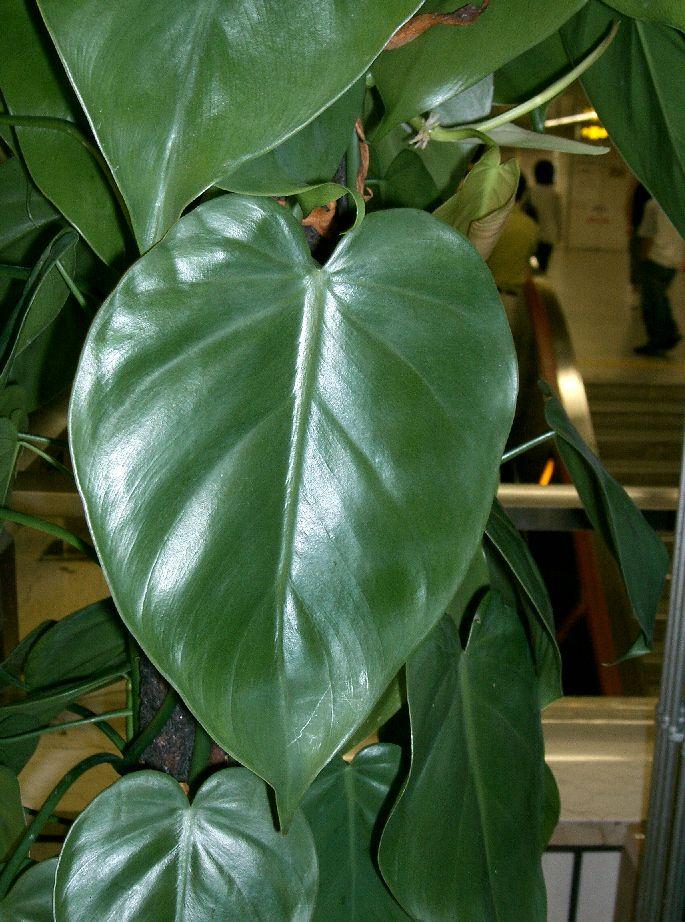
Photo: Philodendron hederaceum by KENPEI · CC BY-SA 3.0 · via Wikimedia Commons
01Why the confusion exists
Heartleaf philodendron (Philodendron hederaceum) and golden pothos (Epipremnum aureum) are both climbing aroids from tropical America and Southeast Asia respectively, both grown as trailing houseplants, both sold in the same hanging pots, and both frequently labelled with the other's name. Neither is a scindapsus, which is a third genus sold in the same section and confused with both.
Since their care overlaps heavily, a mix-up rarely does harm. But the differences are real enough to matter when you are choosing a plant for a specific position, and being able to identify what you own is useful when a care guide gives conflicting advice.
The good news is that three physical features distinguish them absolutely, and none requires a flower or a mature plant.
02The three reliable tests
Start with the new growth, which is the clearest test. Philodendrons produce each new leaf inside a cataphyll — a small papery sheath that protects the developing leaf, unfurls as it opens, and then dries to a brown papery wisp that hangs on the stem for weeks. Pothos has no cataphyll at all; a new pothos leaf emerges directly from the previous leaf's petiole. If you can see brown papery remnants along the stem, it is a philodendron.
Second, feel the petiole — the stalk between stem and leaf. On pothos it is grooved, with a distinct channel running along its upper surface. On philodendron it is round in cross-section. Run a fingernail along it and the difference is unmistakable.
Third, look at the leaf itself. Pothos leaves are thicker, waxier, glossier and slightly asymmetric, with one side of the heart a little fuller than the other. Philodendron leaves are thinner, softer, more matte, and symmetrical, with a more pronounced point and a deeper, more elegant notch at the base.
One further clue: new philodendron growth is often bronze, coppery or pinkish before hardening to green, whereas new pothos leaves come out light green and stay that way. And philodendron aerial roots tend to emerge as several thin roots per node, while pothos produces one thicker nub.
| Pothos (Epipremnum aureum) | Heartleaf philodendron (P. hederaceum) | |
|---|---|---|
| New leaf | Emerges from the previous petiole | Emerges from a papery cataphyll that dries and hangs on |
| Petiole | Grooved along its length | Round in cross-section |
| Leaf texture | Thick, waxy, glossy | Thin, soft, matte |
| Leaf shape | Slightly asymmetric heart | Symmetric heart with a deeper notch |
| New growth colour | Light green | Often bronze or pink |
| Aerial roots | One thick nub per node | Several thin roots per node |
| Variegation | Common — many cultivars | Less common in the heartleaf type |
03Where the care genuinely differs
Both want bright indirect light, water when the top few centimetres are dry, a free-draining mix, feeding at half strength in the growing season, and something to climb if you want larger leaves. That covers nine-tenths of what either needs.
The differences appear at the margins, and they are worth knowing because they map onto real rooms.
Philodendron tolerates low light slightly better and dry air noticeably better. Its thinner leaves are more comfortable in a heated room in winter, and it holds its colour in a dimmer position. In a genuinely dark corner, a plain green philodendron will look better after six months than a pothos will.
Pothos tolerates drought better. Its thicker, waxier leaves hold more water and it wilts, forgives and recovers more readily from a forgotten fortnight. It also has far more variegated cultivars, so if you want a marbled or white-blocked plant, pothos offers the choice.
Pothos is also faster in good light, and slightly tougher about cold. Philodendron is more sensitive below about 13°C.
| Your situation | Pick | Why |
|---|---|---|
| A dim corner or north-facing room | Philodendron | Holds appearance better in low light |
| You forget to water | Pothos | Thicker leaves buffer drought better |
| Dry heated flat in winter | Philodendron | Thinner leaves cope better with low humidity |
| You want variegation | Pothos | Far more cultivars available |
| Cool room, under 15°C at night | Pothos | Slightly more cold-tolerant |
| You want fast growth up a pole | Pothos | Faster in good light; both climb well |
| A pet chews the plants | Neither | Both are aroids and both cause painful mouth irritation |
04The other plants in the same section
Two more genera are sold alongside these and mistaken for both, and it is worth being able to place them.
Scindapsus pictus — satin pothos — is neither a pothos nor a philodendron. It has thick matte leaves with a silvery sheen and silver blotching, and it is one of the most attractive plants in the group. Care is essentially identical to pothos, and it is slightly slower.
Rhaphidophora tetrasperma, sold as mini monstera, has split leaves and belongs to yet another genus. It is faster than any of them and wants brighter light.
Among philodendrons themselves, the heartleaf type is one of many. Philodendron 'Brasil' is the variegated heartleaf; 'Micans' is the velvet-leaved form and one of the loveliest houseplants there is; and the upright self-heading philodendrons — 'Birkin', 'Xanadu', 'Congo' — are the same genus with a completely different growth habit and no trailing at all.
None of these substitutions matters much for care. All of them want the same broad conditions, and none of them is difficult.
05The verdict
For a first houseplant, or for someone who wants something that will survive being ignored, take the pothos. It is faster, cheaper, more widely available, more forgiving of a missed watering, and it offers the variegated cultivars most people are actually after.
For a dark room, a dry heated flat, or a position where the plant needs to look good rather than merely survive, take the heartleaf philodendron — and if you can find it, Philodendron 'Micans', whose velvet leaves are a genuine step up in appearance for no extra difficulty.
For a shelf where the plant will be seen close up, Scindapsus pictus is the best-looking of the three and no harder than either.
And if you already own one and do not know which it is, check the petiole. The answer takes two seconds and does not change what you should do next, which is the most honest summary of this comparison.
Frequently asked questions
- Is satin pothos a pothos?
- No. Scindapsus pictus is a separate genus from both Epipremnum and Philodendron. The care is close enough to pothos that it rarely matters in practice.
- Which grows faster?
- Pothos, given decent light. In low light both slow down considerably, and the gap narrows.
- Can I plant them in the same pot?
- Yes — their requirements are similar enough to share a pot happily, and the contrast in leaf texture looks good. Pothos will usually out-compete the philodendron over time.
- Why does my philodendron have brown papery bits on the stem?
- Those are spent cataphylls, the sheaths each new leaf emerged from. They are entirely normal and can be pulled off once dry.
Lan Nguyen
Balcony grower & founding editor
Lan has kept ornamental plants on a 12 m² apartment balcony for eight years, mostly tropical foliage and small-scale bonsai. She writes the care and comparison guides here, and has killed enough plants to be specific about how.
Keep reading
Pothos vs Monstera: The Honest Comparison
Both are climbing aroids with glossy green leaves, and in a nursery pot they look like the same plant at different sizes. The difference shows up two years later, when one has taken over a corner of the room.
Snake Plant vs ZZ Plant: Which Survives a Dark Room?
These two get recommended interchangeably for the corner that gets no light. They are both genuinely tough, but they fail in different ways, and one of them handles a cold flat much better.
Liquid vs Slow-Release Fertiliser: Which Suits Your Habits
One gives you control and demands attention. The other runs by itself and releases faster when the room gets warm. Choosing badly is how people end up with salt-burnt roots or a plant that has been unfed for a year.