Perlite vs Vermiculite: They Do Opposite Things
Both are white-ish mineral granules sold on the same shelf for the same price, and people treat them as interchangeable. One adds drainage; the other adds water retention.
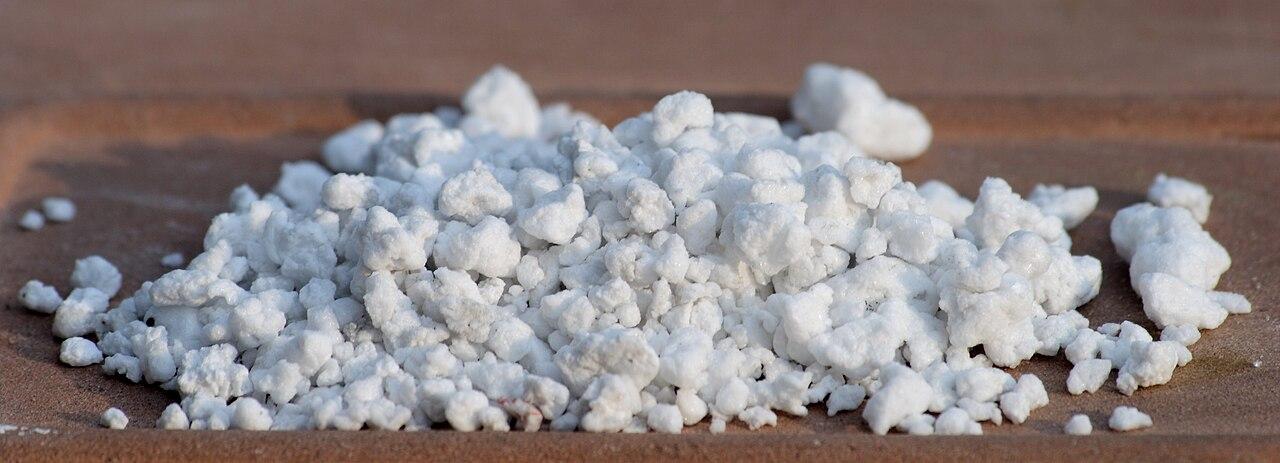
Photo: Perlite by Ragesoss · CC BY-SA 3.0 · via Wikimedia Commons
01What they are
Perlite is volcanic glass heated to around 900°C, at which point trapped water flashes to steam and pops it like popcorn into lightweight closed-cell granules. Those granules are rigid and hold water only on their outer surface, so their real function is to occupy space and leave air gaps behind.
Vermiculite is a mica-family mineral, also heat-expanded, but it expands into accordion-like layers with open spaces between them. Those layers absorb and hold water — several times the material's own weight — and release it slowly to roots.
So the physical structures are opposite in effect: one keeps a medium open and airy, the other makes it a sponge.
02Side by side
| Perlite | Vermiculite | |
|---|---|---|
| Appearance | Bright white, hard, irregular | Golden-brown, soft, flaky layers |
| Water holding | Low — surface only | High — 3–4× its own weight |
| Aeration | Excellent | Poor to moderate |
| Compression | Rigid, keeps structure for years | Compresses over time, loses loft |
| Nutrient holding (CEC) | Very low | Moderate — holds and releases nutrients |
| pH | Neutral, 6.5–7.5 | Neutral to slightly alkaline |
| Best for | Succulents, aroids, cuttings, general aeration | Seed starting, ferns, moisture-lovers |
| Drawback | Floats to the surface, dusty | Can waterlog a mix; degrades faster |
03When to use perlite
Perlite is the default amendment for indoor growing, and adding 25–30% to bagged compost improves almost every houseplant mix.
Use it heavily — 40 to 60% — for succulents, cacti and anything drought-adapted, where the goal is a medium that dries fast and completely.
It is also excellent for rooting cuttings. Pure perlite, or perlite with a little coir, kept lightly damp gives cuttings the air they need to root without the saturation that rots them.
The main annoyance is that it floats. Over months of watering, perlite migrates to the surface and forms a white layer. This is cosmetic; the granules lower down are still doing their job.
- Standard houseplant mix — 25–30% perlite by volume. The single most useful change to bagged compost.
- Aroid mix — 30–35% perlite alongside orchid bark, for monstera, philodendron and pothos.
- Succulent mix — 50–60% perlite or pumice. Consider pumice instead in shallow pots, since it does not float and adds useful weight.
- Propagation — Pure perlite or 3:1 perlite to coir, kept just damp.
04When to use vermiculite
Vermiculite earns its place in seed starting, where consistent moisture is the whole game and the seedlings are only in the medium for a few weeks. A 50/50 mix with coir holds water evenly and is easy for delicate roots to push through.
It also suits genuinely moisture-loving houseplants — ferns, calathea, fittonia, maranta — at around 10 to 20% of the mix, where it buffers against the drying-out that these plants punish you for.
It has one further advantage: a moderate cation exchange capacity, meaning it holds nutrient ions and releases them gradually. Perlite has almost none. In a low-nutrient mix that difference is worth something.
Keep it out of succulent mixes, out of anything in a pot without excellent drainage, and out of large deep pots, where its water-holding compounds the volume problem.
05Alternatives worth knowing
Pumice does everything perlite does, but heavier and without floating. It is the better choice for top-heavy plants and shallow bonsai-style pots, though it costs more and is harder to find in some regions.
Coarse horticultural grit or crushed lava rock serves the same purpose in succulent mixes, adding weight and permanent structure.
Orchid bark is the coarse organic equivalent — it aerates like perlite while also holding a little moisture and breaking down slowly to feed the medium. For aroids it is arguably more important than perlite.
Leca and pon are inert clay and mineral systems used for semi-hydroponic growing. They are not amendments to mix in; they replace the medium entirely and come with their own watering and feeding regime.
Frequently asked questions
- Can I use both in one mix?
- Yes, and it is common in seed-starting media — perlite for air, vermiculite for moisture. For established houseplants it is usually simpler to choose one based on whether the plant wants to dry out or stay damp.
- Is perlite reusable?
- Yes. Rinse it, and if it came from a plant with a pest or disease problem, soak it in a dilute bleach solution and rinse thoroughly. It does not break down, so it lasts indefinitely.
- Why has white stuff appeared on top of my pot?
- Usually perlite that has floated up during watering, which is harmless. If it is crusty rather than granular, it is mineral salt build-up — flush the pot with plain water.
Marcus Hale
Contributor — soil & propagation
Marcus spent six years in a wholesale nursery mixing media by the cubic metre before moving to container growing at home. He covers potting mixes, repotting and the unglamorous half of plant care.
Keep reading
Four Potting Mixes That Cover Almost Every Houseplant
Bagged compost is designed for garden beds and outdoor containers, not for a pot indoors. Four ingredients and four ratios will serve everything on your shelf better.
The Gravel Layer Myth: Why It Makes Drainage Worse
Putting stones in the bottom of a pot is the most widely repeated piece of plant advice there is. It has been known to be counterproductive since the 1950s, and the physics is not complicated.
Terracotta vs Plastic Pots: Does It Really Change Anything?
Terracotta is the aesthetic default and plastic is what your plant arrived in. The difference is not decorative — it changes how fast the medium dries, which changes your entire watering routine.