Monstera Deliciosa: How to Actually Get the Holes
The splits are not a matter of waiting. A monstera fenestrates when it is mature enough, lit well enough, and — the part everyone skips — climbing something. Two of those three are in your control.
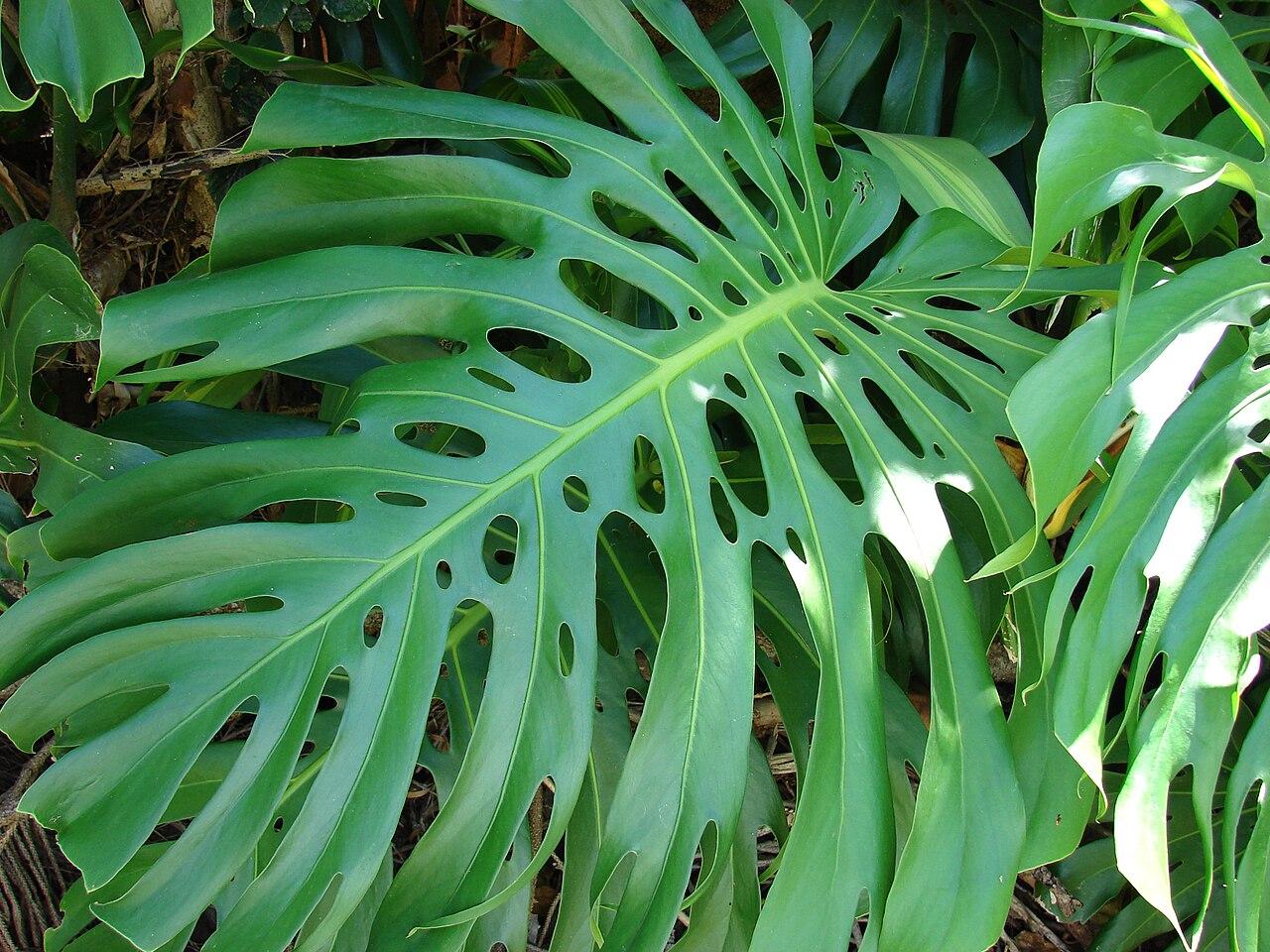
Photo: Monstera by Forest & Kim Starr · CC BY 3.0 · via Wikimedia Commons
01Make sure you own what you think you own
Four different plants are sold under the monstera name, and only one of them ends up with the leaf everybody is buying it for. Before diagnosing a plant that will not split, check that splitting is something it does at all.
Monstera deliciosa is the large one. Its juvenile leaves are plain hearts with no holes whatsoever, which is why small nursery plants look nothing like the poster. Monstera adansonii makes holes but never the deep cuts through to the leaf margin, and stays much smaller. Rhaphidophora tetrasperma — sold everywhere as mini monstera — is not a Monstera at all; it splits early and stays modest, which is precisely why it suits a shelf.
The variegated forms behave like their green parents, only slower. 'Thai Constellation' is a stable tissue-cultured variegation and will not revert, but the white sectors carry no chlorophyll, so the plant needs the same light with less capacity to use it and scorches faster in direct sun.
| Plant | Indoor mature leaf | Fenestration type | Note |
|---|---|---|---|
| Monstera deliciosa | 45–90 cm | Holes plus deep splits to the margin | Needs floor space and a support; the classic |
| Monstera adansonii | 20–40 cm | Holes only, margins stay intact | Faster, tidier, good in a hanging pot |
| Rhaphidophora tetrasperma | 15–25 cm | Splits only, from a young age | A different genus entirely; fastest of the four |
| Monstera deliciosa 'Thai Constellation' | 45–75 cm | As M. deliciosa, arriving later | Stable variegation, slower, burns easily |
02Why the leaves split at all
There is no settled answer, which is worth saying plainly because most care advice states one as fact. The leading explanations are that the holes let sunflecks pass through to leaves lower down the same climbing stem, that a perforated blade sheds wind and heavy rain without tearing, and that a hole-riddled leaf covers more area per gram of tissue built. All three are plausible; none is proven.
What matters practically is the implication they share. Fenestration is a property of a mature leaf produced in good conditions, high up on a climbing stem. It is a consequence of the plant doing well, not a treatment you apply to it.
That reframes the question usefully. You cannot make a leaf split. You can only make the plant able to afford a leaf that does — after which it happens on its own, usually somewhere in the plant's second or third year, on leaves that have grown past roughly 25 cm.
03Light: the ceiling on everything else
The target is bright indirect light for six hours or more a day — within a metre or two of an east or south-facing window, or right up against a north-facing one. A little direct morning sun is a bonus; unfiltered afternoon sun through glass bleaches the blades within days.
In good light a healthy plant produces a new leaf every four to six weeks through the growing season, and each one is noticeably larger than the last. That escalation is the signal you want. When leaf size plateaus, the plant has hit a limit — light or support, almost always in that order.
Under-lighting has a recognisable look well before it becomes fatal: petioles stretch long and thin, the gaps between leaves along the stem widen, new leaves emerge no bigger than the old ones, and the whole plant leans toward the window. None of that is a watering problem, and feeding it improves nothing.
Fenestrated leaves are overwhelmingly a growing-season event. In a north-temperate home, expect the good leaves between April and October, and expect very little in January. That is normal, not a failure of care.
04Support: the lever almost nobody pulls
Monstera deliciosa is a hemiepiphyte. It germinates on the forest floor, crawls toward the darkest thing it can find — a trunk — and then climbs it, growing larger the higher it gets. Leaf size tracks how far the growing tip has climbed, not how old the plant is.
Left flat on a shelf, a monstera reads its own situation as still being on the floor and keeps producing floor-sized leaves indefinitely. Give it a damp pole to grip and the same plant steps its leaves up within two or three growth cycles. This is the difference between a pleasant houseplant and the one in the photographs.
The mechanism is the aerial roots. On a moist pole they penetrate, anchor, and begin absorbing water and nutrients, and the plant responds by building bigger. On a dry coir pole they make contact and give up. Watering the pole as well as the pot is what separates a support from a decoration.
Anchor the pole to the pot rather than merely standing it in the medium. A mature monstera is heavy and top-loaded, and a pole that shifts whenever the plant is nudged never gets colonised. Tie the stem to it loosely at each node with soft twine, and extend the pole before the plant reaches the top rather than after.
| Support | Aerial roots attach? | Effect on leaf size | Drawback |
|---|---|---|---|
| Sphagnum moss pole | Yes, readily, if kept damp | Large — the fastest gain available | Must be watered and extended; moss compacts and needs topping up |
| Coir / coco pole | Poorly — it dries too fast | Small | Cheap and everywhere, but only works if you keep it wet |
| Wooden slab or plank | Yes, over time | Large | Heavy, needs solid anchoring, slow to colonise |
| Bamboo stakes or trellis | No | None | Keeps the plant upright and tidy, nothing more |
| No support at all | Not applicable | None — leaf size plateaus | The stem sprawls and lower leaves shade each other out |
05Water, medium and feeding
Water when the top 3–5 cm are dry: roughly every 7–10 days in a bright warm room in summer, and every 2–3 weeks in winter. Water until it runs from the drainage hole, then empty the saucer. Monstera roots are thick and coarse and tolerate a short dry spell far better than a permanently damp pot.
The medium matters more than the schedule. These are aroids with fat roots adapted to bark and leaf litter, and they suffocate in dense compost. A workable mix is about half peat-free potting compost, a quarter orchid bark and a quarter perlite. In any pot over 25 cm, err chunkier rather than finer.
Feed a balanced liquid fertiliser at half strength every three to four weeks from spring to early autumn, and stop in winter unless the plant is under a grow light and still producing leaves. A monstera in poor light cannot use fertiliser, and the surplus accumulates in the medium as salts.
Repot roughly every two years, in spring, one pot size up. Thick roots escaping the drainage holes are the reliable signal. Roots visible at the surface are not — a climbing aroid produces those regardless.
- Aerial roots hanging in mid-air — Normal, and not a symptom of anything. Guide them into the pole or tuck them down into the medium; both work. Cutting them harms nothing, but you give up the support and uptake they would have provided.
- Beads of water along the leaf edges in the morning — Guttation — the plant pushing out surplus water through pores at the margin. Harmless in itself, but it usually means the medium is wetter than the plant needs, so read it as a nudge to stretch the interval.
- A new leaf that unfurls torn or crumpled — Almost always dryness while the leaf was still rolled, or a knock in passing. There is nothing to correct after the fact.
06Cutting it back, and turning the cuttings into plants
A monstera is pruned to control where it goes, not to make it bushier — removing the top produces one or two new growing points at most, not a hedge. Prune in spring or early summer, cut just above a node, and take no more than a third of the plant at once.
The node is the whole game in propagation. It is the slightly swollen band on the stem where a petiole joins, usually with a brown nub of aerial root beside it. Every viable cutting includes at least one. A leaf with a length of petiole and no stem section stays green in a vase for months and never grows, because there is nothing on it to grow from.
Cut 2–3 cm below a node with clean shears, strip the lowest leaf if it would sit in water, and root the cutting in water, damp sphagnum or straight into perlite. Water is the easiest to monitor and gives slightly brittle roots; sphagnum gives the sturdiest ones. Expect roots in three to six weeks in the growing season, and pot up once they are about 5 cm long.
A stem section carrying a node but no leaf at all — a wet stick — will still wake its dormant bud and produce a leaf given warmth and humidity. It takes longer, and looks like nothing whatsoever is happening for the first month.
07Reading the common complaints
Most monstera problems come down to one of five things, and they separate cleanly if you note which leaves are affected and where on the leaf the damage begins.
| Symptom | Where it shows | Most likely cause |
|---|---|---|
| Whole leaf yellowing and going soft, one at a time | Oldest leaves first | Overwatering — or simple ageing, if it is one leaf every few months |
| Brown crisp edges with a thin yellow band behind them | Leaf margins | Underwatering, dry heated air, or fertiliser salts |
| New leaves small and unsplit, long bare stem | New growth | Not enough light, or nothing to climb |
| Pale bleached patches | The side facing the window | Direct sun through glass |
| Black patches spreading from the petiole | Leaf base, lower leaves first | Root rot — check the roots before changing anything else |
Frequently asked questions
- How old does a monstera have to be before it splits?
- Typically two to three years from a small plant, but age is the least useful predictor. A well-lit, well-supported plant splits sooner; a plant in a dim corner may never split at any age.
- Do I have to use a moss pole?
- Not to keep the plant alive. But without something to climb, leaf size plateaus and fenestration usually stalls with it. If you want the large perforated leaves, support is not optional.
- Can I cut off the aerial roots?
- Yes, with no harm to the plant. Just be clear that you are removing its means of gripping and feeding from a pole, so cut them for looks only if you have already decided against climbing it.
- Why has my monstera not made a new leaf in months?
- In winter, that is normal. In summer it is light, root space, or feeding — in that order. Check the plant is within about two metres of a decent window before adjusting anything else.
Lan Nguyen
Balcony grower & founding editor
Lan has kept ornamental plants on a 12 m² apartment balcony for eight years, mostly tropical foliage and small-scale bonsai. She writes the care and comparison guides here, and has killed enough plants to be specific about how.
Keep reading
Nine Indoor Plants That Genuinely Tolerate Low Light
Most 'low light' lists are wishful thinking — half the plants on them need a bright window to look like the photo. These nine actually hold up a few metres from the glass.
Peace Lily Care: The Plant That Tells You When It's Thirsty
Spathiphyllum droops theatrically the moment it runs low on water and perks back up within hours. That feedback loop makes it the best teaching plant there is — as long as you don't take the drooping as a schedule.
Fiddle Leaf Fig Care Without the Drama
Ficus lyrata has a reputation for being temperamental. It isn't, particularly — it just hates being moved and shows every mistake on leaves that stay on the plant for years.