Propagating Houseplants: Which Method for Which Plant
Water, soil, sphagnum, perlite, division, air layering — they all work, on different plants, at different speeds. Choosing the wrong one is why cuttings rot instead of rooting.
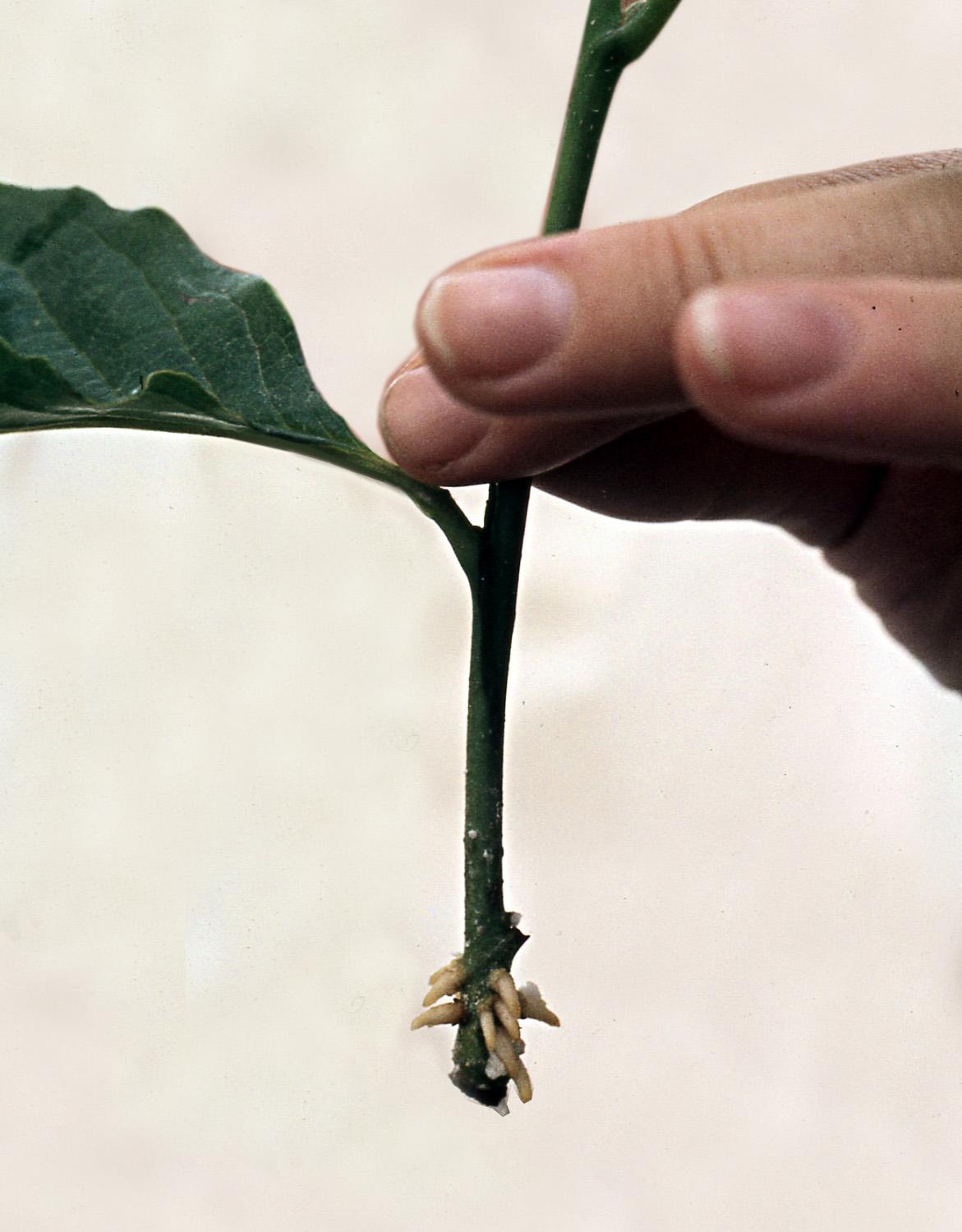
Photo: Cutting (plant) by The original uploader was Gmihail at Serbian Wikipedia. · CC BY-SA 3.0 rs · via Wikimedia Commons
01The node, and why most failures start there
A node is the point on a stem where a leaf attaches. It contains the meristematic tissue — undifferentiated cells that can become either shoot or root — and it is the only place on most stems where new roots will form. Everything else is plumbing.
This is why a monstera leaf on a long petiole sits in a vase looking healthy for six months and never grows: there is no node in it. The same is true of a philodendron leaf, a pothos leaf, or any aroid leaf taken without a section of stem. The plant is alive, it is photosynthesising, and it has no capacity whatsoever to build a new plant.
Some plants break this rule and it is worth knowing which. African violets, begonias, peperomias, sansevieria and many succulents can regenerate a whole plant from a leaf alone, because their leaf tissue retains that capacity. Aroids, ficus, hoyas and most woody plants cannot.
So the first question with any cutting is always the same: does the piece I am about to cut contain a node, or is it a species that can root from a leaf? If neither, put the shears down.
| Plant | Take | Roots from a leaf alone? |
|---|---|---|
| Pothos, philodendron, monstera | Stem with 1–3 nodes | No |
| Ficus (rubber plant, fiddle leaf) | Stem tip with 2–3 leaves and a node | No |
| Hoya | Stem with 2 nodes, lower leaves removed | No |
| Tradescantia, coleus, begonia (cane) | Stem tip with a node | No |
| African violet, rex begonia, peperomia | Whole leaf with petiole | Yes |
| Snake plant | Leaf section, right way up | Yes — but variegation is lost |
| Echeveria, jade, sedum | Whole leaf, cleanly detached at the base | Yes |
| Calathea, ferns, spider plant, aloe | Division or offsets only | No |
02The five rooting media, honestly compared
All of these work. The differences are in how easy they are to watch, how strong the resulting roots are, and how well the young plant transitions into a pot afterwards.
| Medium | Speed | Root quality | Best for |
|---|---|---|---|
| Water | Fast — visible in 1–3 weeks | Weak, brittle, water-adapted | Beginners, aroids, quick results |
| Perlite (damp, in a covered tub) | Fast | Strong, transitions well | Almost everything; the best all-rounder |
| Sphagnum moss | Fast | Strong and fibrous | Aroids, hoyas, anything that wants humidity |
| Potting mix direct | Slow — 3–6 weeks | Strongest; no transition needed | Tough species, large batches |
| LECA / semi-hydro | Moderate | Water-adapted, stays in the system | Plants you intend to keep in semi-hydro |
03Taking a stem cutting properly
Work in spring or early summer if you have the choice. Cuttings taken in the growing season root two to three times faster than the same cuttings in midwinter, because rooting is driven by the plant's own energy and hormone levels.
Use clean, sharp secateurs or a blade. A crushed cut heals badly and invites rot, and a blunt tool crushes. Wiping the blade with alcohol between plants takes seconds and prevents transferring problems around a collection.
Cut 1–3 cm below a node, so the node itself sits at the bottom of the cutting. Remove any leaf that would be below the medium or water line — a submerged leaf rots and fouls the water. Leave two or three leaves at the top; the cutting needs them to photosynthesise, but too many leaves lose more water than the rootless stem can replace.
Then give it warmth, humidity and light. Around 20–24°C is ideal; a clear bag or a lidded tub raises humidity and dramatically improves success on anything woody; and bright indirect light is essential, because a cutting is a working plant, not a dormant seed.
Rooting hormone is genuinely useful on woody and semi-woody cuttings — ficus, hoya, woody herbs — and largely unnecessary on soft aroids that root in a week anyway.
- Change the water weekly — Stagnant water is low in oxygen and accumulates bacteria. Fresh water every five to seven days roughly halves the failure rate.
- Do not pull to check — Tugging a cutting breaks the fragile new root initials. In an opaque medium, wait for new top growth as the signal instead.
- Take more than you need — Losses of a quarter to a third are normal even with good technique. Three cuttings gives you a plant; one gives you a coin toss.
- Pot several together — Three to five rooted cuttings in one pot look like a plant within a season. One cutting alone looks thin for a year.
04Division and offsets: the method for plants that cannot be cut
A large group of houseplants has no stem to cut from. Calatheas, ferns, spider plants, aspidistra, peace lilies, aloes, sansevieria and most clumping plants grow as a colony of shoots from a shared root mass, and the way to make more is to separate them.
Do it in spring, at repotting, when the plant is about to grow. Slide the whole plant out, shake or wash enough medium away to see the structure, and look for natural divisions — points where a section has its own shoots and its own roots.
Separate by hand where it comes apart willingly, and with a clean knife where it does not. Each division needs both a decent share of roots and several leaves; a piece with roots and no foliage has nothing to grow with, and a piece with foliage and no roots is a cutting, not a division.
Pot each division snugly rather than generously — the commonest mistake is potting a small division into a large pot, where the surplus medium stays wet. Water once, keep out of direct light for a fortnight, and do not feed for a month. Expect four to six weeks of no visible progress; that is normal.
Offsets — pups on aloes, plantlets on spider plants, suckers on bromeliads — are the easy version of the same idea. Wait until the offset has its own roots and is roughly a third the size of the parent before separating it.
05Air layering: for the plants that are too big to cut
Air layering is the answer to a specific and common problem: a rubber plant, fiddle leaf fig or dracaena that has become a two-metre bare stem with a tuft of leaves at the top. Taking a cutting means losing the top for months while it roots, with a real chance it fails. Air layering roots the top while it is still attached to the parent, so nothing is risked.
Choose a point on the stem below the foliage where you want the new plant's root system to be. Cut a ring of bark about 2 cm wide right around the stem, down to the hard wood, and scrape the green cambium layer away — that interruption is what forces roots to form. On thin stems, an upward-slanting cut held open with a matchstick works instead.
Dust the wound with rooting hormone, wrap it in a generous handful of damp sphagnum moss, and enclose that in clear plastic tied above and below. Clear plastic matters, because you need to see the roots without opening it.
Keep the moss damp — inject water with a syringe if it dries — and wait. Roots appear in the moss within four to ten weeks depending on the species and the season. When the ball is well filled with roots, cut the stem just below the layer and pot the new plant, moss and all.
The parent, meanwhile, is left as a cut stem that will usually branch below the cut, which solves the leggy plant at the same time. This is the technique's real advantage: two good plants instead of one bad one.
Frequently asked questions
- How long should cuttings take to root?
- Pothos and tradescantia in 7–14 days; monstera and philodendron in 3–6 weeks; ficus and hoya in 4–10 weeks; woody plants longer. In winter, roughly double all of it.
- My cutting has roots but no new leaf. Is it stuck?
- Usually it is fine — cuttings root first and grow second, and the pause between the two can be a month. If it lasts longer than that in the growing season, check for light levels and root rot.
- Can I propagate a variegated plant and keep the variegation?
- From stem cuttings, yes — take the cutting from a well-variegated section, since the new plant grows from the tissue you gave it. From snake plant leaf cuttings, no: those revert to plain green, and division is the only way to keep the pattern.
- Does rooting hormone actually help?
- On woody and semi-woody cuttings, measurably. On soft-stemmed aroids that root in a fortnight anyway, it makes little difference and is not worth buying for.
Marcus Hale
Contributor — soil & propagation
Marcus spent six years in a wholesale nursery mixing media by the cubic metre before moving to container growing at home. He covers potting mixes, repotting and the unglamorous half of plant care.
Keep reading
What Actually Changes for Houseplants Between October and March
Winter care is not a separate discipline. One variable moves — light — and watering, feeding, growth and pest pressure all follow it. Get the causal order right and the seasonal advice writes itself.
Stop Watering on a Schedule: A Seasonal Approach Instead
The most common question is 'how often should I water this?' — and the honest answer is that the interval changes by a factor of three between July and January. Here is how to read it instead of counting days.
How to Read the Light in Your Home Honestly
Every care label says 'bright indirect light' and almost nobody knows what that means in an actual room. Here are three ways to measure it without buying anything.