Grow Lights: What to Buy, Where to Put It, How Long to Run It
A grow light is the only way to change the one variable everything else depends on. It is also the piece of equipment surrounded by the most nonsense — about colour, about wattage, and about how close is close enough.
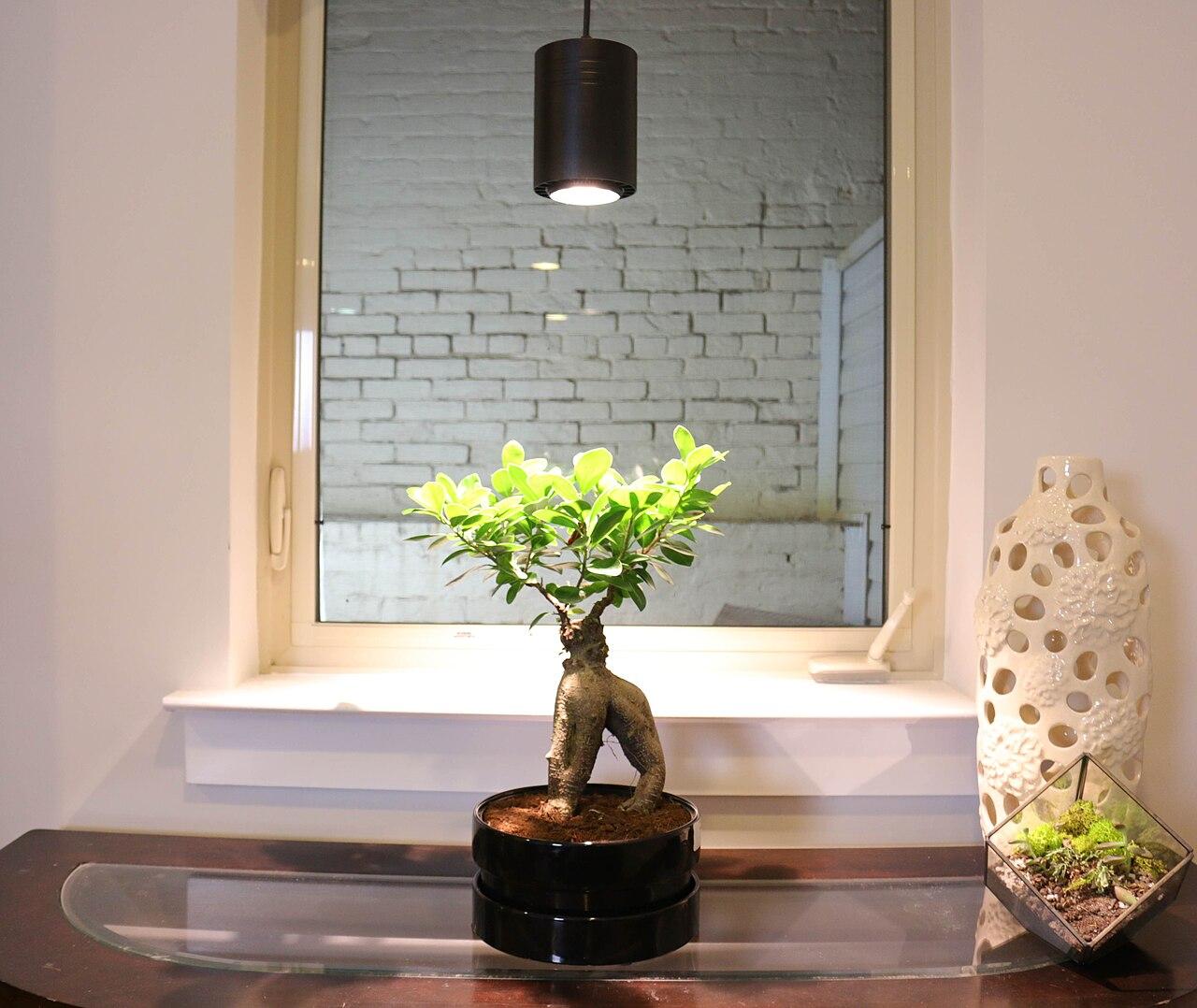
Photo: Grow light by Hotmilk400 · CC BY-SA 4.0 · via Wikimedia Commons
01Why room light does not count
Human eyes adapt across an enormous range of brightness, which makes them useless for judging light for plants. A room that feels well lit under a ceiling fitting can be delivering a small fraction of what a plant a metre from a window receives, and a tiny fraction of outdoor shade.
The two numbers worth knowing are PPFD and DLI. PPFD is the intensity of usable light arriving at the leaf, measured in micromoles per square metre per second. DLI is the total delivered across a whole day, in moles per square metre — intensity multiplied by hours. DLI is what actually drives growth, which is why a moderate light running twelve hours can beat a brighter one running four.
As rough targets for houseplants: low-light foliage plants do reasonably at roughly 50–100 µmol/m²/s at the leaf; bright-indirect plants such as monstera, calathea and most aroids want somewhere around 100–300; and high-light plants — succulents, cacti, citrus — want 300 and upwards. A typical living room away from a window sits well below the bottom of that range.
You do not need a meter to use a grow light well, but a phone app that estimates light levels, or a cheap PAR meter, turns guesswork into a decision and is worth it if you are buying more than one fitting.
02What to buy
Buy a white LED. Full-spectrum white LEDs grow houseplants as well as the pink-purple fittings that dominated the market a decade ago, and they have a decisive practical advantage: you can see the true colour of your plants and spot problems. Pink light makes chlorosis, pests and burn almost impossible to notice.
Ignore the advertised wattage of cheap fittings, which is often the theoretical maximum of the chips rather than what the fitting draws. Look instead for actual power consumption, and for a manufacturer publishing a PPFD figure at a stated distance. A fitting that will not tell you what it delivers is usually not delivering much.
For a single plant or a small shelf, 10–25 W of real consumption is plenty. For a shelf a metre long, look at 30–60 W spread across a bar or panel rather than a single point source, which lights the middle and leaves the ends dark.
Beware of two categories. Screw-in bulbs in a standard lamp are convenient but generally weak and narrowly focused; they work for one small plant at close range and little else. And clip-on gooseneck lights with tiny heads look appealing but usually deliver useful light over only 10–15 cm.
| Situation | Fitting | Rough distance | Hours |
|---|---|---|---|
| One plant in a dark corner | 10–20 W bulb or small panel | 20–35 cm | 12 |
| A shelf of foliage plants | 30–60 W LED bar | 30–45 cm | 12 |
| Succulents and cacti indoors | High-output panel | 20–30 cm | 12–14 |
| Seedlings and cuttings | Cheap LED bar | 15–25 cm | 14–16 |
| Winter supplement beside a window | 20–30 W bar | 30–40 cm | 8–10, on in the morning |
03Setting it up
Put it on a timer. This is not a refinement; it is the difference between a grow light working and a grow light being an inconsistent nuisance. A mechanical plug timer costs very little and removes the whole question from your daily attention.
Run it 10–14 hours a day for foliage plants and up to 14–16 for seedlings and succulents. Plants do need a dark period — respiration and several developmental processes happen at night — so continuous light is not better, and for a handful of species it actively prevents flowering.
Mount it above the plants and pointing down, not from the side. Side lighting produces the same lean and one-sided growth that a window produces, and it wastes most of the output on the wall.
Set the height by the target above, then adjust by watching the plant for a fortnight. Growth that is compact with slightly smaller leaves and good colour means it is about right. Bleached, yellowing or bronzed patches on the upper leaf surfaces mean it is too close. Continued stretching and pale growth means it is too far away or running too few hours.
Clean the fittings occasionally. Dust on a diffuser reduces output measurably over a season, as does dust on the leaves.
04The claims that are not true
Grow lights attract more folklore than any other piece of houseplant equipment, and most of it is either outdated or invented for marketing.
- "Plants only use red and blue light" — The old absorption graphs for isolated chlorophyll drove this idea. In whole leaves, green light penetrates deeper into the tissue and contributes meaningfully to photosynthesis. Broad white spectrum works well.
- "More hours makes up for a weaker light" — Only within limits. There is a minimum intensity below which a leaf cannot maintain positive net photosynthesis, and no number of hours below that threshold produces growth.
- "UV light makes plants stronger" — UV has real effects on pigmentation and secondary metabolites in some crops, but it is irrelevant to houseplant growth and the fittings that supply it are a needless expense and an eye hazard.
- "Any LED bulb is a grow light" — A domestic bulb produces the right kind of light but nowhere near enough of it. The difference is quantity, not quality.
- "You cannot burn a plant with an LED" — You can. Modern panels are bright enough to bleach leaves at close range, and the risk is photo-oxidative damage rather than heat, so the fitting can feel cool while the damage happens.
05Whether you need one at all
Before buying, exhaust the free options, because they are often enough. Move the plant closer to the glass — a metre nearer a window is a large gain. Clean the windows and wipe the leaves. Remove or tie back anything shading the window from outside. Swap heavy curtains for a sheer blind. Move a plant from a north-facing room to an east or south-facing one.
A grow light earns its place in four situations: a genuinely dark room with no usable window; a north-facing home in a cloudy climate through winter; growing plants that want considerably more light than a home provides, such as succulents and citrus; and propagation, where consistent light on cuttings and seedlings makes a real difference.
It is also worth being realistic about running cost. A 30 W fitting for twelve hours a day uses roughly 11 kWh a month — the price of a couple of coffees in most places. The reason to hesitate is rarely the electricity.
Finally, expect a change in watering. A plant under a good light grows faster and uses more water, so the interval that suited it in a dim corner will be too long once the light goes in. Check the medium rather than keeping the old routine.
Frequently asked questions
- Can I just leave the light on all the time?
- You can, and for many foliage plants it does no lasting harm, but it produces no benefit over 14 hours and it prevents flowering in short-day species. Use a timer.
- How do I know if the light is too close?
- Watch the upper leaf surfaces directly under the fitting. Bleaching, bronzing or crisp pale patches there, with the lower leaves fine, means raise it by 10 cm and reassess in a fortnight.
- Do I need a special light for succulents?
- Not special, just stronger and closer. Succulents want several times the intensity foliage plants do, which usually means a higher-output panel at 20–30 cm rather than a small bulb.
- Will a grow light replace a window entirely?
- Yes, for most foliage plants. Plenty of people grow excellent collections in windowless rooms. What it will not do is replace a window while sitting two metres away on a bookshelf.
Lan Nguyen
Balcony grower & founding editor
Lan has kept ornamental plants on a 12 m² apartment balcony for eight years, mostly tropical foliage and small-scale bonsai. She writes the care and comparison guides here, and has killed enough plants to be specific about how.
Keep reading
What Actually Changes for Houseplants Between October and March
Winter care is not a separate discipline. One variable moves — light — and watering, feeding, growth and pest pressure all follow it. Get the causal order right and the seasonal advice writes itself.
How to Read the Light in Your Home Honestly
Every care label says 'bright indirect light' and almost nobody knows what that means in an actual room. Here are three ways to measure it without buying anything.
Stop Watering on a Schedule: A Seasonal Approach Instead
The most common question is 'how often should I water this?' — and the honest answer is that the interval changes by a factor of three between July and January. Here is how to read it instead of counting days.