Echeveria: Keeping the Rosette Tight and Making More of Them
The rosette succulent everyone photographs is also the one most people flatten within a season. Compactness is a light problem, colour is a stress response, and the leaves you knock off are free plants.
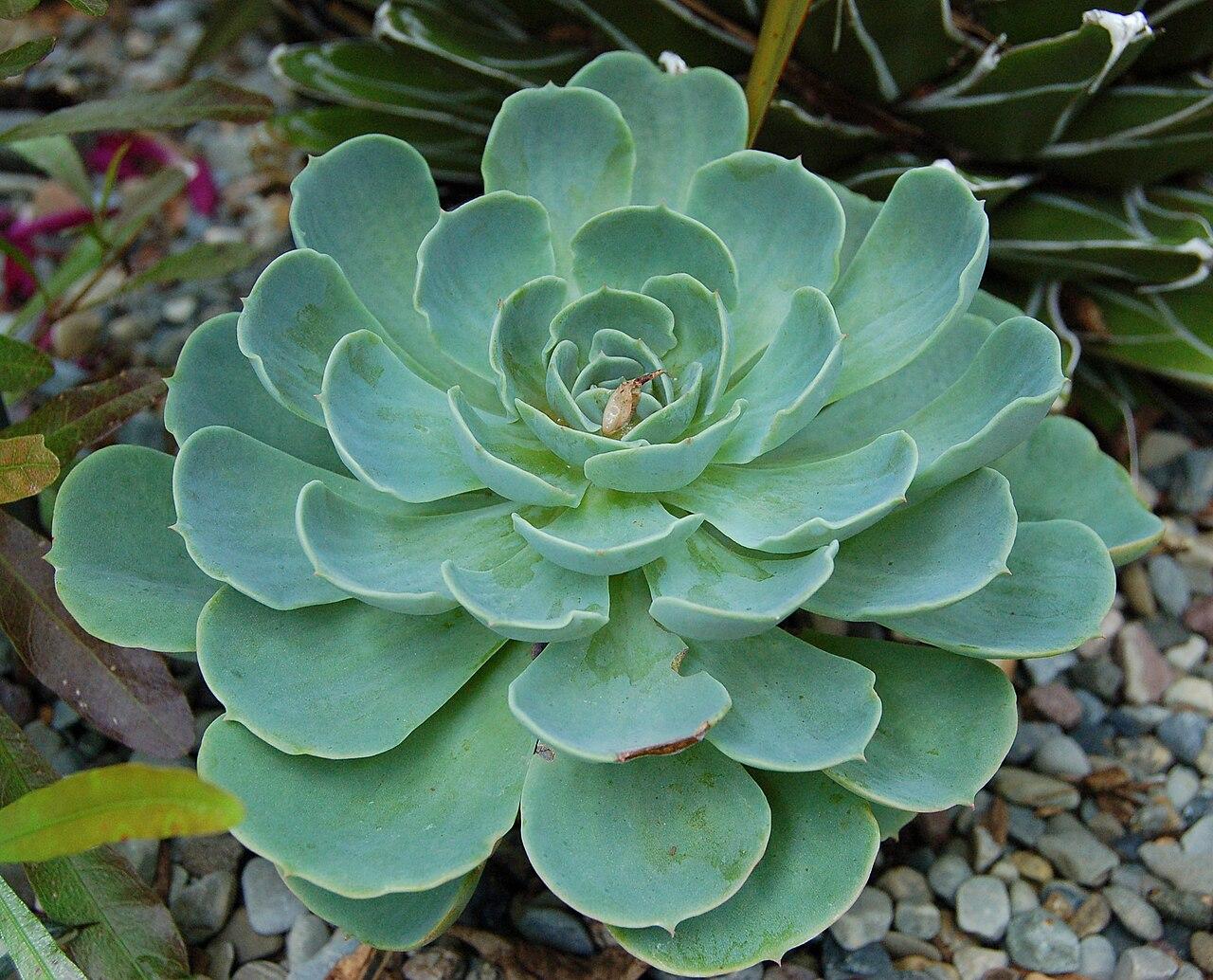
Photo: Echeveria rosette by Photo by and (c)2006 Derek Ramsey (Ram-Man). Location credit to the Chanticleer Garden. · CC BY-SA 3.0 · via Wikimedia Commons
01What the rosette is for
Echeverias are Mexican and Central American succulents from bright, exposed, rocky habitats with sharp drainage and strong sun. The rosette shape is a response to that: it packs the maximum number of water-storing leaves into the smallest area, shades its own centre, and channels what little rain falls down the leaves to the roots.
Almost every problem people have with them is the plant abandoning that shape. In insufficient light the rosette opens outwards and flattens, the centre stretches upward, and gaps appear between the leaf whorls. That is etiolation, it is permanent on the growth already made, and it is by far the most common complaint about these plants.
The powdery grey-blue coating on many species — farina — is a natural wax that reflects light and repels water. It rubs off permanently at a touch, and it does not regrow on that leaf. This is why handling an Echeveria leaves fingerprints for the life of the plant, and it is a good reason to move them by the pot rather than the plant.
02Light, and the colours in the photographs
Echeverias want as much direct sun as you can give them. Indoors that means a south or west window with several hours of unfiltered sun; anything less and the rosette starts opening within a few weeks. A grow light on a timer for ten to twelve hours a day is a genuinely effective substitute if your windows will not do it.
The vivid pink, red, purple and orange colouring that sells these plants is not their default appearance. It is anthocyanin pigment produced in response to stress — strong light, cool nights and a degree of drought. The same plant in a nursery greenhouse in summer looks pale green; put it on a bright windowsill through a cool autumn and it colours up.
This is worth stating plainly because people buy a highly coloured plant, keep it in ordinary indoor conditions, and conclude something is wrong when it fades to green. Nothing is wrong. Fading is the plant relaxing; recovering the colour means giving it more light and cooler nights, not more fertiliser.
Acclimate before any increase in light. An Echeveria moved straight from indoors to full outdoor sun in summer bleaches and scars within two days, and the marks are permanent. Two weeks of gradually increasing exposure avoids it entirely.
03Water, soil and the pot
Soak and dry, with genuinely dry in between. Water thoroughly until it runs out of the base, then wait until the medium is dry all the way down and the lowest leaves have begun to soften slightly. In summer that is roughly every 10–14 days; in winter, in a cool bright room, every four to six weeks or less.
Water at the medium and never over the plant. The tight rosette holds water in its centre, and in cool or still conditions that trapped water rots the growing point — a failure that kills the plant outright rather than damaging a leaf. If you do splash it, blow the water out or blot it.
Use a mostly mineral medium: about half cactus or peat-free compost and half coarse grit, pumice or perlite. Bagged cactus compost is usually still too retentive on its own, and adding a further third of grit makes a real difference.
A shallow terracotta pot, barely wider than the rosette, suits them best. Echeveria roots are fine and shallow, and a deep pot holds a column of permanently damp medium underneath them. Feed very lightly — a half-strength cactus feed two or three times across the growing season is plenty.
| Symptom | Cause | Action |
|---|---|---|
| Rosette opening out, stem lengthening | Too little light | Move to full sun or add a grow light; behead to restart |
| Lower leaves shrivelling | Normal ageing, or thirst | Remove them; check whether the medium is bone dry |
| Translucent, mushy lower leaves | Overwatering | Stop; check for rot at the stem |
| Black or brown soft centre | Crown rot from water in the rosette | Usually fatal; take healthy leaves for propagation |
| Fading from pink to green | Less light or warmer nights — normal | Nothing, unless you want the colour back |
| White cottony spots in the leaf axils | Mealybugs — very common on these | Cotton bud with 70% alcohol; repeat weekly |
| Papery bleached patches | Sunburn from an unacclimated move | Shade; the damage is permanent |
04Leaf propagation, properly
Echeveria is one of the best plants there is for leaf propagation, and the technique is simple, but there is one detail that decides whether it works at all: the leaf must come away complete, with the small pale base where it joined the stem intact. That base contains the meristematic tissue everything grows from. A leaf snapped off part-way, leaving its base on the plant, will sit there for months and then shrivel.
Take leaves from the lower part of a healthy rosette. Hold the leaf close to the stem and twist gently side to side rather than pulling — it should come free with a clean snap.
Lay the leaves on top of dry, gritty mix, not buried in it, somewhere bright but out of direct sun. Leave them alone for a week to callus. Then mist very lightly every few days, or water the tray only when the medium is completely dry.
After two to six weeks small pink roots emerge from the base, and then a tiny rosette. Keep the parent leaf attached until it has shrivelled away completely — it is feeding the plantlet. Once it has gone, pot the plantlet up and treat it as a small adult plant.
Not every leaf takes, and that is normal. A success rate of half to three-quarters is good, which is why it is worth starting twenty rather than three.
- Offsets — Many Echeverias produce pups around the base. Once one has its own roots and is a third of the parent's size, cut it free, callus for two days, and pot it. Faster and more reliable than leaves.
- Beheading — For a stretched plant: cut the rosette off with 3–5 cm of stem, let it callus for a week, then set it on dry gritty mix until roots form. The decapitated stump usually produces several offsets along its length.
- Stem cuttings — Any leftover length of stem with a few leaves will root the same way. Nothing from a beheaded plant needs to be thrown away.
- Seed — Possible but slow — two to three years to a decent rosette, and hybrids do not come true. Useful only if you want to breed.
05Flowering, and what to do about it
A mature Echeveria sends up an arching stalk of bell-shaped orange, pink or yellow flowers in spring or summer. It is a genuine bonus, and unlike some succulents, Echeveria is not monocarpic — flowering does not kill the plant.
It does cost the plant something. A flower stalk draws heavily on stored reserves, and a small or recently propagated plant is better off without one. Cutting the stalk off at the base as soon as it appears redirects that energy into the rosette, and there is no harm in doing so.
If you let it flower, keep watering as normal and cut the stalk back once it browns off. Echeveria flower stalks can themselves be used for propagation — the small bracts along the stalk often root like leaves.
One caution: aphids are strongly attracted to Echeveria flower stalks, and a stalk left on an indoor plant is a reliable way to introduce them to the rest of a collection. Check the stalk regularly, or remove it.
Frequently asked questions
- Why has my colourful Echeveria turned plain green?
- Less light, warmer conditions, or generous watering — all three reduce the stress pigments. It is a healthy plant behaving normally, not a problem.
- Are echeverias safe for pets?
- Echeveria is generally considered non-toxic to cats and dogs, which distinguishes it from several other popular succulents such as jade and aloe.
- Can I grow one in a pot with no drainage hole?
- No. Of all the plants that dislike it, rosette succulents are the least tolerant — the medium at the base never dries and the roots rot. Use the decorative pot as a cover for a plain plastic one.
- The bottom leaves keep dying. Is that normal?
- Yes, if it is the outermost ring and they dry to papery brown. Rosettes grow from the centre and shed from the edge. Soft translucent lower leaves are a different matter and mean too much water.
Marcus Hale
Contributor — soil & propagation
Marcus spent six years in a wholesale nursery mixing media by the cubic metre before moving to container growing at home. He covers potting mixes, repotting and the unglamorous half of plant care.
Keep reading
Why Your Succulent Is Stretching — and What You Can Still Do
The rosette opens up, the stem lengthens, the leaves point downward and get further apart. That is etiolation, it is always a light problem, and it does not reverse. But the plant is fixable.
Aloe Vera: The Succulent Most People Drown
It survives neglect for years and dies in a fortnight of attention. Aloe vera is genuinely easy once you accept that almost everything it needs from you is something you do not do.
String of Pearls and the Other Trailing Succulents That Keep Dying
Curio rowleyanus is bought on sight and lost within months, almost always the same way: a deep pot, a shaded shelf, and water reaching a stem that was never meant to be wet.