Aloe Vera: The Succulent Most People Drown
It survives neglect for years and dies in a fortnight of attention. Aloe vera is genuinely easy once you accept that almost everything it needs from you is something you do not do.
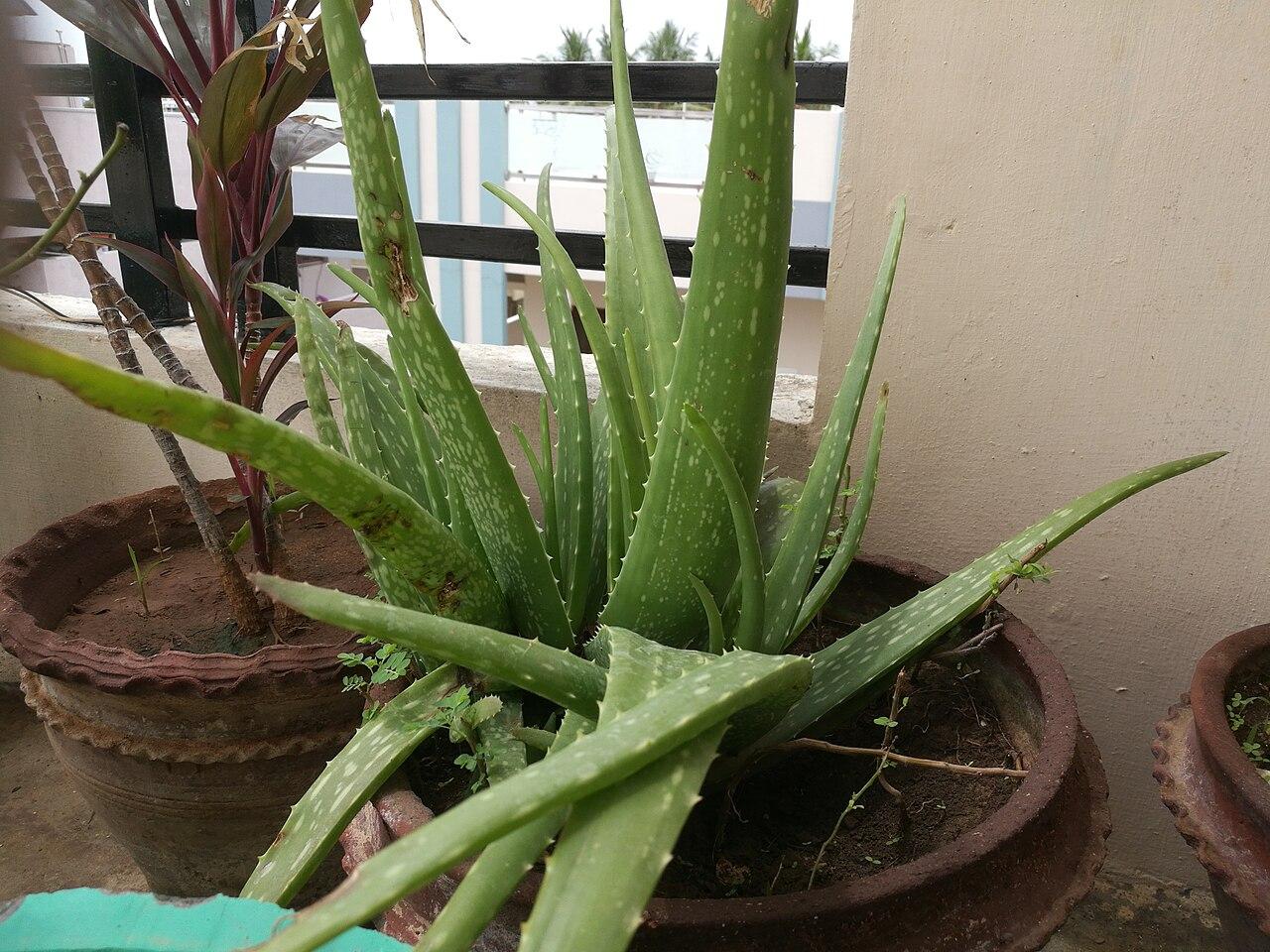
Photo: Aloe vera by Praneethpjv · CC BY-SA 4.0 · via Wikimedia Commons
01What the plant is, and what it is not
Aloe vera is a stemless clumping succulent with thick fleshy leaves edged with soft teeth, and it is one of the oldest cultivated ornamental plants there is — grown, traded and moved around by people for so long that no confirmed truly wild population is known. Its natural affinities lie with the dry Arabian Peninsula, and everything about how it behaves in a pot follows from that.
The leaves are water storage. A healthy aloe holds enough reserve to go months without rain, which is exactly why it responds so badly to a weekly watering schedule: it has no mechanism for shedding surplus, only for storing what arrives and waiting.
It is regularly confused with three other rosette plants, and the confusion matters because their care is not identical. Agave has stiff fibrous leaves with a hard terminal spine, grows far larger, and dies after flowering. Haworthia and Gasteria are much smaller, tolerate less light, and want the same watering approach at a smaller scale.
Cut a leaf and the identification is immediate: aloe leaves are full of clear gel, and a yellow latex weeps from the cut edge. Agave leaves are fibrous and their sap irritates skin badly.
| Plant | Leaf | Size indoors | Light | Note |
|---|---|---|---|---|
| Aloe vera | Thick, gel-filled, soft marginal teeth | 40–60 cm across | As bright as you have | Offsets freely; toxic to pets |
| Agave | Rigid, fibrous, sharp terminal spine | Outgrows most rooms | Full sun | Dies after flowering; sap irritates skin |
| Haworthia | Small, firm, often windowed or banded | 10–15 cm | Bright indirect | Handles a north window better than aloe |
| Gasteria | Thick, tongue-shaped, blunt | 15–25 cm | Bright indirect, tolerates less | The most shade-tolerant of the group |
02Light, and the sunburn people do not expect
Give it the brightest position you have. A south or west-facing window, unshaded, with six or more hours of light a day, is the target indoors. Aloe is one of the few common houseplants that genuinely wants direct sun through glass.
The complication is that a plant which has spent its life indoors is not acclimated to unfiltered outdoor sun. Move it straight onto a balcony in June and the leaves bleach white or turn papery brown within two or three days — a real burn, permanent, on tissue that stays on the plant for years.
If you want it outside for the summer, acclimate it. Start in full shade for a couple of hours a day, then add about an hour of morning sun daily over ten days to a fortnight. The same applies in reverse to a plant bought from a bright nursery and put into a dim room, though there the symptom is stretching rather than burning.
Some reddening or bronzing of the leaves under strong light is not damage. It is pigment produced as a sunscreen, and a bronzed aloe in full sun is a normally stressed plant, not a dying one. Bleached white patches are the line between the two.
03Water: the only thing that really kills it
Soak thoroughly, then let the medium dry out completely — genuinely completely, all the way to the bottom of the pot — before watering again. Partial watering on a frequent schedule keeps the lower half of the root ball permanently damp, which is precisely the condition aloe roots cannot survive.
In practice that means roughly every two to three weeks in a bright warm room in summer, and every five to eight weeks in winter. Those are starting points, not a schedule. A large plant in a small terracotta pot in a sunny window will want water twice as often as a small plant in a big plastic pot in a cool room.
The leaves tell you where you stand. Slight wrinkling and a subtle inward curl means the plant has drawn on its reserves and would like a drink; this is the correct condition to water in. Leaves that are soft, translucent, yellowing or mushy — particularly at the base where they meet the crown — mean water has already done its damage.
Never let water sit in the rosette. Water at the medium, not over the plant, and pour off anything standing in the saucer. Water trapped in the crown of an aloe in a cool room is how crown rot starts, and crown rot is not usually survivable.
| What you see | Where | Meaning |
|---|---|---|
| Slight wrinkling, leaves curling inward | Whole plant | Thirsty — water thoroughly, this is normal |
| Soft, translucent, mushy leaves | Lowest leaves first, at the base | Overwatering, likely already root rot |
| Flat splayed rosette, pale thin new growth | Whole plant | Not enough light |
| Bronze or reddish tint, firm leaves | Sun-facing side | Sun pigment — harmless, often desirable |
| White or papery bleached patches | Sun-facing side | Sunburn from unacclimated exposure; permanent |
| Brown dry tips | Leaf tips | Underwatering over a long period, or fertiliser salts |
04The pot and what goes in it
Aloe roots are shallow, wide-spreading and coarse. That argues for a wide, relatively shallow pot rather than a deep one — a deep pot holds a column of medium below the roots that never dries and never does anything useful.
It also argues strongly for terracotta. Unglazed clay loses moisture through its walls, which shortens the wet period after every watering; for a plant whose main risk is a medium that stays damp, that is a meaningful safety margin. The trade-off is stability, and a top-heavy aloe in a light plastic pot will eventually tip over.
The medium should be mostly mineral. A workable mix is about half a peat-free potting compost or cactus compost, and half coarse mineral grit — perlite, pumice, or horticultural grit at 3–6 mm. Bagged cactus compost straight from the bag is usually still too water-retentive; adding a further third of grit is close to standard practice.
A drainage hole is not negotiable. Decorative pots without one are for slipping a plastic nursery pot inside, never for planting into directly.
- Feeding — Very little. A dilute balanced or cactus fertiliser at half strength, two or three times across the whole growing season, is plenty. Aloe evolved on poor mineral soils and overfeeding produces soft, floppy growth that is more prone to rot.
- Repotting — Every two or three years, in spring, one size up. Do it when the plant is dry, not freshly watered, and wait a week before the first watering so any damaged roots can callus.
- Temperature — Comfortable from about 13°C to 27°C. It can tolerate cooler if kept bone dry, but cold plus wet is fatal. Keep it off an unheated windowsill on winter nights.
05Pups: the only propagation that works
A mature aloe produces offsets — pups — from the base, connected to the parent by a short underground stem. They are clones, they carry their own roots once established, and they are the reason a single plant becomes a crowded pot in four years.
Wait until a pup is around 8–10 cm tall and has visible roots of its own before separating it. Taken too early, before it has rooted, it depends entirely on its own reserves and often fails.
Do it in spring. Slide the whole plant out of the pot dry, brush the medium off the base, and find where the pup joins the parent. If it pulls away with roots attached, take it. If it does not, cut it free with a clean sharp knife, keeping as much root as you can.
Then leave it alone for two or three days somewhere dry and shaded so the cut surfaces callus over. Pot each pup into a small pot of gritty mix, and — this is the part people get wrong — do not water for about a week. A fresh wound sitting in damp medium is an invitation to rot. After that first delayed watering, treat it exactly like an adult plant.
The one thing that does not work is a leaf cutting. Echeveria and many sedums root readily from a detached leaf; aloe does not. An aloe leaf pushed into soil rots without producing a plant, essentially every time. If someone has told you otherwise, they were describing a different genus.
06Harvesting the gel, briefly
If you keep an aloe for use rather than looks, harvest from the outside in. The outer leaves are the oldest and largest; the centre of the rosette is where new growth comes from and cutting into it sets the plant back badly.
Cut an outer leaf as close to the base as you can with a clean knife. Stand it cut-end down in a glass for ten or fifteen minutes and let the yellow latex drain out — that is the aloin-bearing sap, it is bitter and a strong irritant, and it is not what you want on your skin. Then trim the toothed edges, slice the leaf open flat and scrape out the clear gel.
Take no more than a leaf or two at a time from a mature plant, and only from a plant with at least eight or ten healthy leaves. Each leaf removed is a chunk of the plant's stored water and photosynthetic area, and a heavily harvested aloe stalls for a season.
None of this is a health claim, and nothing here is medical advice. It is simply how the leaf is prepared.
Frequently asked questions
- Why has my aloe gone flat and spread out sideways?
- Light. An under-lit aloe cannot hold its leaves upright and splays them to catch more. Move it to your brightest window; existing leaves will not stand back up, but the new ones will grow correctly.
- Can I grow a new aloe from a single leaf?
- No. Unlike echeverias, aloe leaves do not form roots and shoots — they rot. Use an offset, which is the plant's own method of reproducing vegetatively.
- My aloe has never flowered. Is something wrong?
- Almost certainly not. Aloe vera rarely flowers indoors; it needs a mature plant, very high light and usually a cool dry winter rest. It is not an indicator of health.
- The leaves have gone brown and mushy at the base. Can I save it?
- Only by acting fast. Unpot it, cut away every soft brown root and any rotted stem tissue back to clean white, let it dry for several days, and repot into fresh gritty mix. If the crown itself is soft, take a healthy offset instead and start again from that.
Marcus Hale
Contributor — soil & propagation
Marcus spent six years in a wholesale nursery mixing media by the cubic metre before moving to container growing at home. He covers potting mixes, repotting and the unglamorous half of plant care.
Keep reading
Soak and Dry: The Only Succulent Watering Method Worth Learning
Little and often feels careful and kills succulents. The method that works is counterintuitive: drench them completely, then do nothing at all for weeks.
Why Your Succulent Is Stretching — and What You Can Still Do
The rosette opens up, the stem lengthens, the leaves point downward and get further apart. That is etiolation, it is always a light problem, and it does not reverse. But the plant is fixable.
Christmas Cactus Care: Getting It to Flower on Schedule
Schlumbergera is not a desert plant and treating it like one is why yours has never bloomed. It is a jungle epiphyte, and its flowering is triggered by darkness and cool nights.