Pot Size and Shape: Why One Size Up Is a Real Rule
The advice to go up one pot size sounds like fussiness. It is physics: a pot holds a saturated layer at its base regardless of what you fill it with, and a pot too large for its plant keeps that layer wet for weeks.
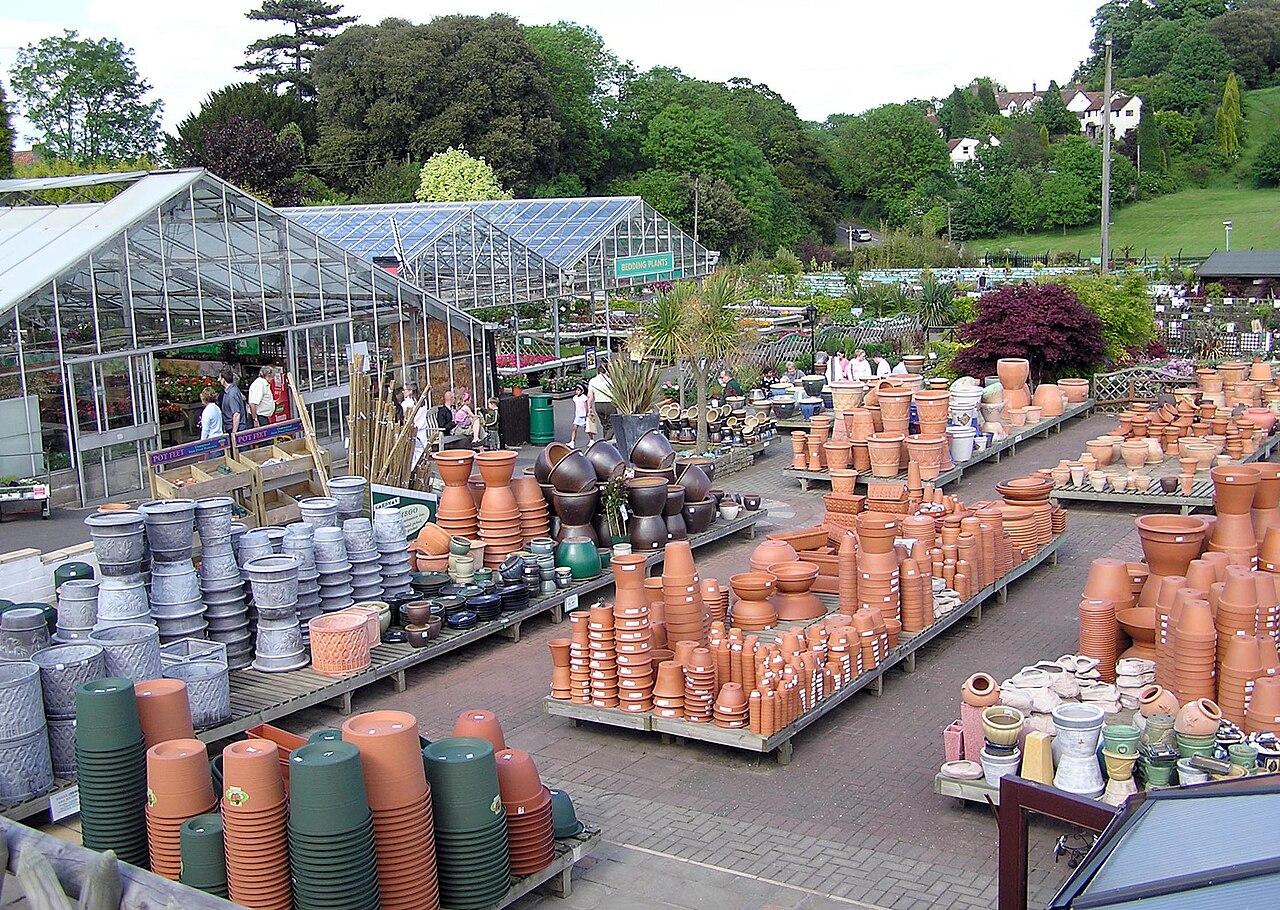
Photo: Garden centre by Arpingstone · Public domain · via Wikimedia Commons
01The perched water table
Fill any container with any medium, saturate it, and let it drain. Water stops draining before the medium is dry, and what remains is a zone of saturated medium sitting at the bottom of the pot. That zone is the perched water table, and understanding it explains almost every potting rule that otherwise sounds arbitrary.
It exists because drainage is driven by gravity working against the capillary forces holding water in the pores of the medium. At the bottom of the pot, with nothing below to pull water onward, those forces win. Water stops moving, and it stays there until roots take it up or it evaporates.
The important and counterintuitive part: the depth of that saturated layer is a property of the medium, not of the pot. A fine compost might hold a saturated layer four or five centimetres deep. A coarse bark or grit mix might hold one a centimetre deep. Change the pot and the layer stays the same depth; change the mix and it changes.
That single fact drives everything below — why tall pots drain better than shallow ones, why a drainage layer of gravel makes things worse, and above all why potting too large is genuinely dangerous rather than merely wasteful.
02Why potting up too far kills plants
When you move a plant from a 12 cm pot into a 25 cm one, the root ball occupies a small volume in the middle and the rest is fresh medium with no roots in it at all. Roots are what dry a pot out — they take water up and transpire it away — so medium with no roots in it dries only by evaporation from the surface, which is slow.
The consequence is a pot that stays wet for weeks. The root ball in the middle sits in permanently damp surroundings, the roots at its edge have no oxygen, and they rot. Meanwhile the owner, seeing a wilting plant, waters it more.
This is why the rule is one size up: about 2–5 cm more in diameter for small pots, and up to 5–8 cm for large ones. The new medium is then a thin shell the roots colonise within weeks, and the pot dries at a rate close to what the plant is used to.
It is also why potting up is not a treatment for an unhappy plant. A plant struggling with rot, pests or low light does not want a larger pot — moving it into one makes the problem worse in every case.
The exception is fast-growing vigorous plants in the growing season, which can handle a bigger jump because they fill the space quickly. A monstera in June is a different case from a sansevieria in November.
03Shape matters as much as size
Because the saturated layer has a fixed depth, its share of the total volume depends on how tall the pot is. In a 10 cm deep pot with a 4 cm saturated layer, 40% of the medium is permanently wet. In a 25 cm deep pot with the same medium, that layer is still 4 cm and it is only 16% of the volume.
So tall narrow pots drain better than shallow wide ones, all else equal. This is exactly why bonsai pots — very shallow — require coarse mineral mixes: nothing else would leave any usable air space at all.
The counterweight is the root system. Shallow-rooted plants — echeverias, string of pearls, most cacti, calatheas — do not reach the bottom of a deep pot, and the medium down there stays wet and useless. Deep-rooted plants such as dracaenas, ficus and sansevieria are happy in tall pots.
The practical resolution is to match the pot shape to the roots, and then match the medium to the pot. Shallow pot plus shallow-rooted plant plus a grittier mix; deep pot plus deep-rooted plant plus a standard mix.
| Plant type | Pot shape | Why |
|---|---|---|
| Echeveria, string of pearls, most cacti | Shallow and wide | Fine shallow roots; deep medium stays wet and unused |
| Calathea, fern, spider plant | Standard, slightly wide | Fibrous spreading roots near the surface |
| Dracaena, ficus, sansevieria | Standard to tall | Deeper root systems; better drainage from depth |
| Monstera, philodendron | Standard, sturdy and heavy | Thick roots plus a top-heavy plant that needs ballast |
| Orchids | Small, slotted, clear | Roots want air and light; flowering improves when tight |
| Bonsai | Very shallow | Requires a coarse mineral mix to leave any air at all |
04Material, drainage holes and cachepots
Unglazed terracotta breathes: water evaporates through the walls, so the medium dries faster and more evenly, and the pot is heavy enough to stabilise a top-heavy plant. That is an advantage for succulents, cacti, jade, and anyone who tends to overwater. The trade-offs are weight, breakability, salt crusting on the outside, and the need to water more often.
Plastic and glazed ceramic hold moisture, which suits moisture-loving plants, saves water and effort, and is lighter to move. They are the sensible default for calatheas, ferns and most tropical foliage. Glazed ceramic is not terracotta in behaviour — the glaze seals it, so it acts like plastic with the weight of clay.
A drainage hole is non-negotiable in the pot the plant actually grows in. Without one, the saturated layer has nowhere to go and grows with every watering, and no amount of care compensates.
This is where the cachepot habit is worth adopting. Keep the plant in a plain plastic nursery pot with generous drainage, and stand that inside the decorative pot you actually want to look at. Water at the sink, let it drain fully, and put it back. You get the appearance you want, the drainage the plant needs, and the ability to check the roots without an excavation.
- Never plant directly into a hole-free pot — Not with a gravel layer, not with charcoal, not with care. The saturated zone simply accumulates.
- More holes are better than one — A single small hole clogs. Several holes, or a mesh screen over a large one, drain reliably.
- Mesh, not crocks — A square of plastic mesh over the hole stops medium washing out without reducing drainage. Broken pottery shards can block it instead.
- Empty the outer pot — The commonest way people drown plants that have perfect drainage is leaving 2 cm of water in the cachepot after every watering.
05Choosing at the shop
Take the plant's current pot with you, or measure it. Buying by eye reliably produces a pot two or three sizes too large, because a pot always looks smaller in a shop than in a room.
Check the drainage hole before anything else, and be sceptical of the very shallow bowls sold for succulents with a single tiny hole — the shape is right and the hole often is not.
Consider weight against the plant. A mature ficus or monstera in a light plastic pot will tip; a large terracotta pot full of wet medium may be too heavy to move for watering. Both are practical constraints that people discover afterwards.
And remember that a pot is a multi-year decision for a slow-growing plant. A sansevieria or ZZ plant might stay in the same pot for four or five years, so it is worth buying one you like. A fast-growing pothos will outgrow anything you buy within two.
Frequently asked questions
- Does a layer of gravel at the bottom improve drainage?
- No — it raises the saturated layer up into the root zone and reduces the usable volume. This is one of the most persistent myths in houseplant care and it makes drainage worse, not better.
- Can I put a small plant in a big pot if I use a very gritty mix?
- It helps considerably, because a coarse mix holds far less water. It is still not ideal — the medium away from the roots stays damper than the root zone — but it is a workable compromise for a plant you cannot repot often.
- How often should I pot up?
- Fast growers such as pothos and monstera roughly every one to two years; slow growers such as sansevieria, ZZ and cacti every three to five. Judge by roots, not by the calendar.
- Is it bad to reuse a pot from a plant that died?
- Not if you wash it. Scrub off salt crust and old medium, rinse with hot water, and if the plant died of root rot or a soil-borne disease, soak it in a dilute bleach or disinfectant solution and rinse thoroughly.
Marcus Hale
Contributor — soil & propagation
Marcus spent six years in a wholesale nursery mixing media by the cubic metre before moving to container growing at home. He covers potting mixes, repotting and the unglamorous half of plant care.
Keep reading
Can You Reuse Old Potting Mix? Usually, With Conditions
Spent compost is not waste, and it is not automatically safe either. The question is what happened to it in the pot — whether it collapsed, whether it was fed, and whether the plant that lived in it was healthy.
Perlite vs Vermiculite: They Do Opposite Things
Both are white-ish mineral granules sold on the same shelf for the same price, and people treat them as interchangeable. One adds drainage; the other adds water retention.
The Gravel Layer Myth: Why It Makes Drainage Worse
Putting stones in the bottom of a pot is the most widely repeated piece of plant advice there is. It has been known to be counterproductive since the 1950s, and the physics is not complicated.