Why Your Cactus Never Flowers: The Cold Dry Winter It Needs
Desert cacti are among the easiest plants to keep alive and among the hardest to make bloom in a centrally heated flat — because the trigger is a winter that most homes never deliver.
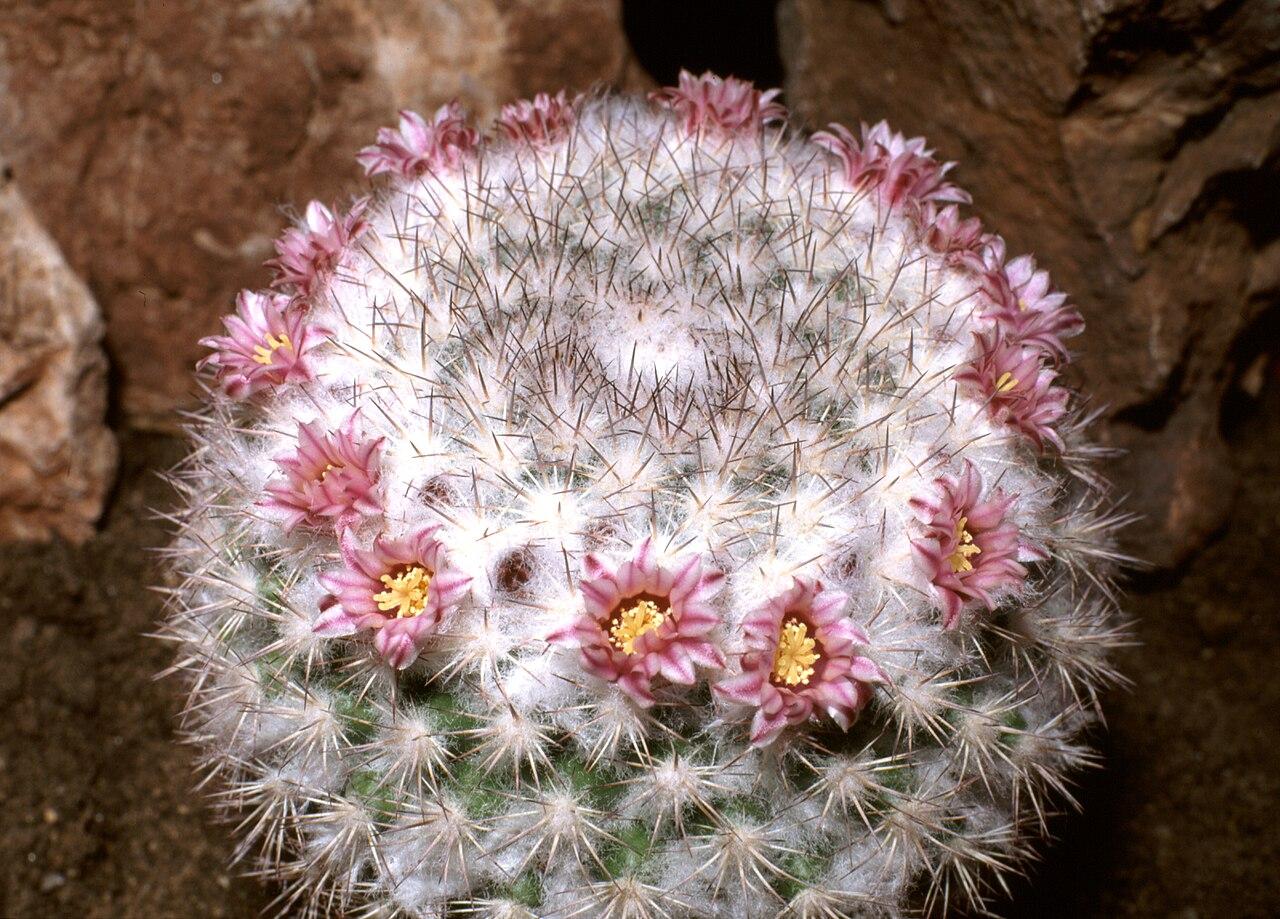
Photo: Mammillaria by Reinhart Schade · CC BY-SA 3.0 · via Wikimedia Commons
01Two very different plants sold as 'cactus'
Before anything else, separate the two groups, because advice for one actively harms the other. Desert cacti — Mammillaria, Echinopsis, Ferocactus, Gymnocalycium, Opuntia and most of what is sold in small pots — come from arid habitats with intense sun, sharp drainage and a genuine cold dry season.
Jungle or forest cacti — Schlumbergera (Christmas cactus), Rhipsalis, Epiphyllum — are epiphytes from humid tropical forest, growing on tree branches in dappled shade. They want more water, more humidity, less direct sun and a different flowering trigger entirely.
Everything in this article is about the first group. If your plant has flat segmented leaf-like stems and no real spines, it is the second, and it wants a different regime.
| Desert cacti | Jungle cacti | |
|---|---|---|
| Look | Ribbed or tubercled body, prominent spines | Flat segmented stems, few or no spines |
| Light | Full direct sun | Bright indirect; scorches in direct sun |
| Summer water | Soak and dry, thoroughly dry between | Evenly moist, never soggy |
| Winter | Cold and completely dry | Cool, but still lightly watered |
| Flowering trigger | Cool dry rest, then spring warmth and water | Long nights and cool nights in autumn |
02The growing season: sun, water and food
From about March to September a desert cactus is actively growing and wants to be treated far more generously than most people expect. This is the second surprise about cacti, after the winter rest: in summer they are thirsty plants.
Water thoroughly whenever the medium has dried out completely — typically every 7–14 days in a sunny position in summer. Soak until water runs from the base, then let it dry all the way through. A cactus watered in small sips never wets the lower root mass and grows poorly.
Give them the most direct sun you have. Cacti in insufficient light grow etiolated: the newest growth at the top narrows into a pale soft cone, quite unlike the body below it. That deformation is permanent, and it is the clearest indicator that a plant is under-lit.
Feed at half strength with a low-nitrogen or cactus fertiliser roughly monthly through the growing season. High-nitrogen feeds produce soft, fast, weakly spined growth prone to rot.
Many cacti also enjoy a summer outdoors, which improves both spination and flowering. Acclimate over two weeks — an unacclimated cactus scorches just like any other plant, and on a cactus the scar is on the body and permanent.
03The winter rest, which is the actual answer
Flower buds in most desert cacti are initiated in response to a cool, dry dormancy followed by warmth and water in spring. Without the first part, the second part produces growth instead of buds. This is why a plant that looks perfectly healthy on a warm windowsill can go a decade without flowering.
The recipe is unglamorous. From late October to late February or early March, keep the plant at roughly 5–12°C, in as much light as you can give it, and water it not at all. A frost-free garage, an unheated spare room, a porch or a cold conservatory all work. It should look completely untouched — no growth, no change.
Withhold water entirely for most species over that period. Small plants in small pots may need a token watering once in midwinter to stop the roots desiccating; large established plants in bigger pots need nothing at all. Cold plus wet is what kills cacti in winter, so if you cannot keep them cold, keep them dry and accept fewer flowers.
Then in early spring, move the plant back into warmth and light and water thoroughly. That transition is the signal. Buds typically appear within four to eight weeks, and on many species they emerge from the previous year's growth, which is why a plant that grew softly all winter has nowhere to put them.
04Reading the body
Cacti give slow, subtle feedback, and the most useful skill is distinguishing damage from normal ageing.
- Corking — Brown, dry, bark-like tissue spreading upward from the base of a mature plant. This is normal ageing — the plant laying down woody support — and it is firm to the touch. Nothing to treat.
- Rot — Soft, sunken, discoloured tissue, often blackish and sometimes smelling. Usually starts at the base or at a damaged point. Cut well back into clean firm tissue with a sterile blade, dust with sulphur if you have it, and let it callus dry.
- Etiolation — A narrow pale cone of new growth at the top of a previously fat body. Permanent. More light prevents further stretching but will not restore the shape.
- Sunburn — A bleached, yellowish-white patch on the side that faced the sun, usually after a sudden move outdoors. Permanent scarring.
- Shrivelling and leaning — In summer, thirst. In winter, normal — many cacti deflate slightly during their dry rest and plump up again when watering resumes.
- White cottony masses at the base or in the ribs — Mealybugs, including root mealybugs, which are common on cacti and easy to miss. Check the roots at repotting.
05Potting, handling and the practical details
Use a very free-draining mineral mix: roughly a third cactus or peat-free compost to two-thirds coarse grit, pumice or perlite. Cacti sold in shops are almost always in a peat-based medium that stays wet far too long, and repotting a new plant into something grittier is usually the single most useful thing you can do for it.
Terracotta is a real advantage here, and a pot only slightly larger than the plant is better than a generous one. Repot every three to four years, in spring, when the plant is dry.
Handle with folded newspaper wrapped around the body, or thick gloves. Take particular care with Opuntia and its relatives, which carry glochids — tiny barbed bristles that detach at a touch, are almost invisible in skin and are far more unpleasant than the large spines.
Wait a week after repotting before watering. Cut roots in damp medium rot; the same rule as every other succulent on this site.
Finally, be realistic about age. Many cacti simply will not flower until they reach a certain size, and for some of the large globular species that is a decade or more. Mammillaria, Rebutia, Echinopsis, Gymnocalycium and Notocactus are the genera that flower young and reliably, and they are the ones to buy if flowers are the point.
Frequently asked questions
- How cold is too cold for a cactus in winter?
- Kept completely dry, most common desert species tolerate 4–5°C without difficulty and many go lower. Wet is the danger, not cold — a damp cactus is damaged at temperatures a dry one shrugs off.
- I live somewhere warm. Can I still get flowers?
- It is harder but not impossible. Withhold water for two to three months over the coolest part of the year, keep the plant in strong light, and choose free-flowering genera such as Mammillaria and Rebutia, which are less demanding about the temperature drop.
- Do the flowers really only last a day?
- It varies. Echinopsis blooms are often spectacular and last a day or two; Mammillaria flowers persist for several days and appear in a ring around the crown. Many species flower repeatedly through the season once they start.
- My cactus has not grown at all this year. Is it dead?
- Probably not. Slow or no visible growth in a season is normal for many species, particularly in a small pot. Check that the body is firm and the roots are white and intact; a firm cactus is a living one.
Lan Nguyen
Balcony grower & founding editor
Lan has kept ornamental plants on a 12 m² apartment balcony for eight years, mostly tropical foliage and small-scale bonsai. She writes the care and comparison guides here, and has killed enough plants to be specific about how.
Keep reading
Soak and Dry: The Only Succulent Watering Method Worth Learning
Little and often feels careful and kills succulents. The method that works is counterintuitive: drench them completely, then do nothing at all for weeks.
Christmas Cactus Care: Getting It to Flower on Schedule
Schlumbergera is not a desert plant and treating it like one is why yours has never bloomed. It is a jungle epiphyte, and its flowering is triggered by darkness and cool nights.
Aloe Vera: The Succulent Most People Drown
It survives neglect for years and dies in a fortnight of attention. Aloe vera is genuinely easy once you accept that almost everything it needs from you is something you do not do.